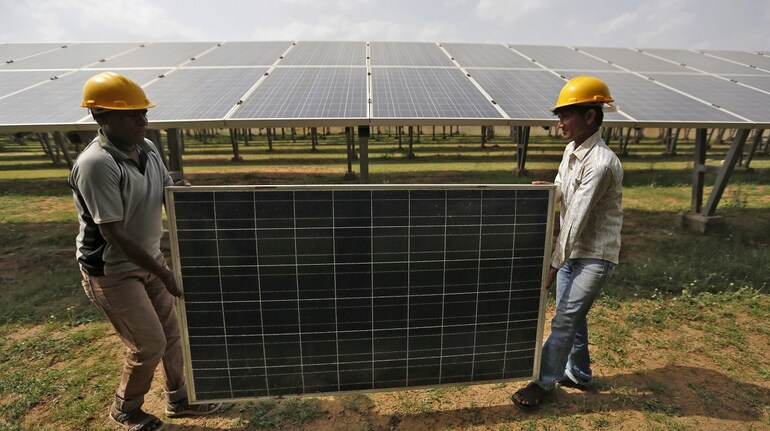

The Centre is planning to separately regulate solar photovoltaic (PV) waste, instead of treating it under the existing e-waste management rules, as India prepares for rising volumes of discarded solar panels later this decade, government officials in the Ministry of New and Renewable Energy (MNRE) told Moneycontrol. In the interim, from 2029, the government plans to route all solar waste to a centralised storage location, while it works on a new framework to govern the reuse, recycling and disposal of solar panels.
“Solar PV waste currently falls under the e-waste rules, but the classification does not adequately reflect the scale, lifespan and material characteristics of solar installations. The government is, therefore, working towards delinking solar waste from the broader e-waste regime and putting in place a separate regulatory framework tailored to the sector,” said an official from MNRE.
Reuse of panels before recycling
A second official said the government plans to initially reuse solar panels that are no longer suitable for large solar parks but remain functional.
"Such panels can be redeployed in rooftop installations, decentralised power systems and other lower-capacity applications, instead of being sent directly for recycling," the official said.
Centralised storage from 2029
For this, the government has directed that solar waste generated from 2029 be collected and stored at a single, centralised location.
“In the initial years, solar waste volumes will be limited, which is why a centralised storage approach makes sense,” an official said. The arrangement is expected to remain in place while a dedicated regulatory and compliance framework is finalised.
Current rules and gaps
At present, solar PV waste is regulated under the E-Waste (Management) Rules, which were framed for short-life consumer electronics.
Officials said the framework does not prescribe panel-wise collection or recycling targets, does not distinguish between utility-scale and rooftop solar installations, and provides no clarity on handling end-of-life modules from large solar parks.
As a result, most discarded or damaged panels are currently stored or stockpiled, with limited formal recycling pathways in place.
Solar waste volumes: current levels and outlook
India has already begun generating solar PV waste, though volumes remain relatively modest. According to a joint MNRE–Council on Energy, Environment and Water (CEEW) study, the country has generated around 100 kilotonnes of cumulative solar PV waste, largely from early installations, damaged panels and replacements.
According to government estimates, significant volumes of end-of-life solar waste are not expected until after 2033, reflecting India’s deployment history. While early solar installations began around 2002–03, capacity additions remained limited for over a decade, with the bulk of India’s solar build-out taking place only from 2016–17. Given the typical 25-year operational life of solar modules, waste volumes are expected to rise gradually, with cumulative solar PV waste estimated at around 600 kilotonnes by 2030, according to the MNRE–CEEW study.
What is solar PV waste?
Solar photovoltaic waste includes end-of-life solar panels and associated components such as inverters, cables and mounting structures, as well as damaged or prematurely replaced modules. Solar panels typically have an operational life of around 25 years and contain materials such as glass, aluminium, silicon and copper, along with small quantities of hazardous substances.
Scale of solar expansion
India’s installed solar power capacity has crossed around 132.8 GW as of November 2025, with solar accounting for about 26% of total installed power capacity and over half of renewable energy capacity. MNRE is also funding research and development to improve recycling technologies and maximise material recovery from end-of-life solar modules.
Discover the latest Business News, Sensex, and Nifty updates. Obtain Personal Finance insights, tax queries, and expert opinions on Moneycontrol or download the Moneycontrol App to stay updated!
Find the best of Al News in one place, specially curated for you every weekend.
Stay on top of the latest tech trends and biggest startup news.