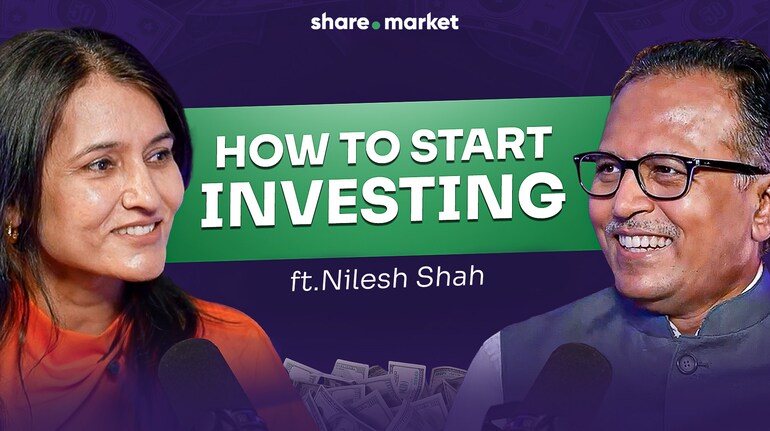
With India’s capital markets opening up to a new generation of investors, questions around where to begin, how to stay disciplined, and what truly drives wealth creation have never been more relevant. To address this, PhonePe’s wealth management platform, Share.Market, has launched a podcast series that goes beyond numbers to explore the mindset behind successful investing. Each episode will bring insights from seasoned professionals, offering practical guidance and clear do’s and don’ts for smarter and informed investment decisions. Whether you are just starting out or have years of experience, this series serves as a practical guide to smarter, more confident investing.
The inaugural episode features Priya Patankar, Head of Corporate Communications, PhonePe Group, in conversation with Nilesh Shah, MD, Kotak Mutual Fund, on what drives long-term wealth creation. Shah highlighted that successful investing is less about timing the market and more about deep research, broad industry knowledge, people skills, and continuous learning. The discussion also touched on SIP myths, financial safety, gold, real estate, and India’s multi-trillion-dollar growth potential. Excerpts from the conversation:
Q: SIPs have become a buzzword for young investors. What are the biggest misconceptions you see around them?
The first misconception is that - SIPs are only for equities. In reality, SIPs can be done across debt funds, hybrid funds, even gold funds..The second misconception is that - SIPs require large sums of money. That is not true. Today you can start a SIP for as little as ₹50 a day or ₹250 per instalment. It is not about how big or small the amount is, but about building a habit of investing consistently.The third and most important misconception is that - people assume that SIPs are meant for beginners, while they themselves need something exotic. I often say SIP is like an airplane. It has both business class and economy class. You can sit where you like. Whether you invest ₹250 or ₹2 crore, the process works the same.Q: Many young investors try to chase returns. What would you say to them?
Investing is not about chasing the highest returns in the shortest time. It is about process, patience and common sense. There is no secret sauce, no shortcut to creating wealth. Legendary investor Peter Lynch once made his fund managers compete with school children in picking stocks. The children outperformed because they picked companies whose products they used, while fund managers complicated things with high-risk bets. The lesson is simple: investing is about using common sense and giving time to your investments.Q: What’s a simple thumb rule for financial safety, and how much should one ideally save, especially for those living month to month?
Financial safety begins with avoiding the extremes of greed and fear. Greed often drives people toward speculation, lotteries, or quick gains, where the odds are stacked against them. Fear, on the other hand, keeps investors tied to only “safe” instruments like bank deposits or PPFs, which usually fail to beat inflation. To put this in perspective, if you had invested ₹1.5 lakh every year in PPF for 25 years, you would end up with about ₹1.1 crore. The same amount in an equity scheme could grow to around ₹4.4 crore. Even after tax, the gap of nearly ₹3 crore could mean the difference between owning a flat in Bengaluru or missing out on one.How much one should save depends largely on their risk appetite. A natural risk taker may consider leverage, but only when markets are cheap, the payout is predictable, and they have the means to manage it. Conservative investors should steer clear of leverage altogether. For example - if a short person tries to run alongside a tall person, he is likely to stumble. Similarly, risk takers and risk avoiders cannot move at the same pace.The real thumb rule is simple: understand your risk profile, save early, save regularly, and stay invested. Aligning discipline with your true appetite for risk is the most reliable path to long-term financial safety and freedom.Q: How should young investors deal with phases like market crashes, which can be unnerving?
Think of it like shopping. If you buy a shirt today and tomorrow it goes on 50 percent discount, most people would go back and buy more, not throw away the shirt they already purchased. Investing should be the same. When the market falls, you are getting good companies at cheaper prices. That is the time to buy more, not panic and sell.Q: Many still prefer gold or real estate over financial investments. Do you think that will change?
In real estate, people often make money not because they trade frequently but because they stay invested for the long term. Try buying property today and selling it tomorrow, even in an expanding city like Bengaluru, you are 100% likely to make losses. Real estate returns typically come when people buy with leverage and hold the property for a long period of time. That patience delivers results. The same principle holds true for equity investing. There are countless examples where investment in good companies has delivered far superior returns than real estate. Take Infosys as an example. When it came out with its IPO in the mid-90s, the stock opened at a discount to the issue price. Since then, the stock price has appreciated nearly 17,000 times. How many real estate properties could have matched that? It is not that people did not buy Infosys shares; many did, but very few stayed invested long enough to enjoy that level of wealth creation.Gold tells a similar story. It’s considered a safe haven, but many people buy physical gold in the form of coins or bars. What they don’t realize is that the transaction cost on such small purchases can be 20–40%. That is equivalent to giving away three to four years of returns upfront. A smarter way to invest would be sovereign gold bonds or gold ETFs, where costs are minimal. Even with gold, returns have come not from timing but from staying invested. Over the last five years, it has delivered phenomenal returns despite a negative year in 2021. Gold too has corrected 70%, from $800 to around $200. So, just like equities, gold also faces fluctuations.
Q: Young investors are entering the markets in large numbers today. What is the one piece of advice you would like to give them?
You are very fortunate to be born in an India that is growing at such a rapid pace. When I began my career, India was a $300 billion economy. Today it is at $4 trillion. Over the next 25 years, we could be looking at $30 trillion. I witnessed $3.7 trillion of wealth creation, while this generation could see $27 trillion. You have an ocean of opportunity ahead of you. The best thing you can do is to stay invested and participate in India’s growth story.Q: Are tools like CRISP by Share.Market helpful for new investors trying to choose funds?
Absolutely. Just like food delivery apps give you ratings and reviews to make choices, a tool like CRISP helps you balance your portfolio. Some funds bring immediate pleasure, others bring long-term health, and you need the right mix. CRISP provides that framework so that investors can stay invested with confidence for the long term.No Moneycontrol journalist was involved in this article
Disclaimer: The views and investment tips expressed by experts on Moneycontrol.com are their own and not those of the website or its management. Moneycontrol.com advises users to check with certified experts before taking any investment decisions.
Discover the latest Business News, Sensex, and Nifty updates. Obtain Personal Finance insights, tax queries, and expert opinions on Moneycontrol or download the Moneycontrol App to stay updated!
Find the best of Al News in one place, specially curated for you every weekend.
Stay on top of the latest tech trends and biggest startup news.