
Technical indicators often promise clarity in markets that feel chaotic. Among the most widely used tools is the Supertrend indicator, popular for its clean visual signals that appear to simplify trading decisions. When the line turns green and moves below price, it signals a buy and when it turns red and shifts above price, it signals a sell.
But simplicity does not automatically translate into profitability. To evaluate whether the Supertrend genuinely creates long term value, a large scale quantitative study was conducted on the Nifty 500 universe, covering more than 200,000 trades between 2012 and 2025. The findings challenge common assumptions about win rates, trade frequency and trader behaviour, while highlighting what actually drives returns.
Understanding How the Supertrend Works
The Supertrend is built using two core parameters that determine how sensitive it is to price movement:
Period, which defines how many days of historical data the indicator analyses
Multiplier, which determines how far the indicator sits from price and therefore how much volatility it tolerates
A lower multiplier keeps the indicator close to price, making it highly reactive. A higher multiplier creates more distance from price, allowing larger swings before the trend flips. These two inputs significantly influence performance outcomes, trade frequency and holding periods.
The Win Rate Illusion: Why Profitability Is Not About Winning Often
Many new traders believe that a good strategy must win 70 to 90 percent of the time. The data shows that this assumption does not hold for trend following systems like the Supertrend.
Across all tested combinations:
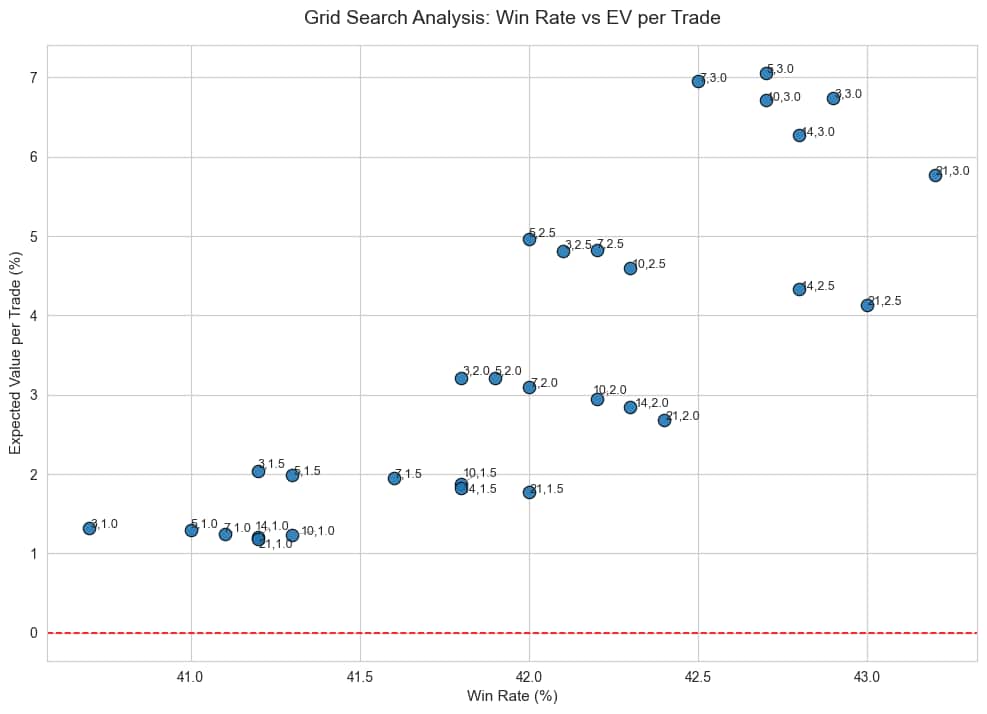
● The lowest win rate observed was approximately 40.7 percent using settings 3 and 1
● The highest win rate observed was approximately 43.2 percent using settings 21 and 3
This means that the strategy loses more often than it wins. On average, six out of ten trades are losses.
However, profitability does not depend on how often you win. It depends on the relationship between average gains and average losses. The Supertrend functions as a classic trend following system where smaller frequent losses are offset by occasional large winners.
The key lesson is that focusing only on accuracy can be misleading. In systematic trading, edge comes from asymmetry, not frequency.
 .
.
Figure 1: The Supertrend Trade-Off. This grid search shows that while Win Rate (X-axis) remains low across all settings, the Expected Value per Trade (Y-axis) varies dramatically. The best settings (top right) have the highest EV, not the highest win rate.
The Multiplier Effect: Why Less Frequent Trades Deliver Larger Gains
One of the most important discoveries in the study was the impact of the multiplier setting. When the multiplier is small, such as 1.0, the indicator reacts to minor price fluctuations. This produces frequent entries and exits.
When the multiplier is increased to 3.0, the behaviour changes significantly. For a 3 period setting, the data revealed the following:
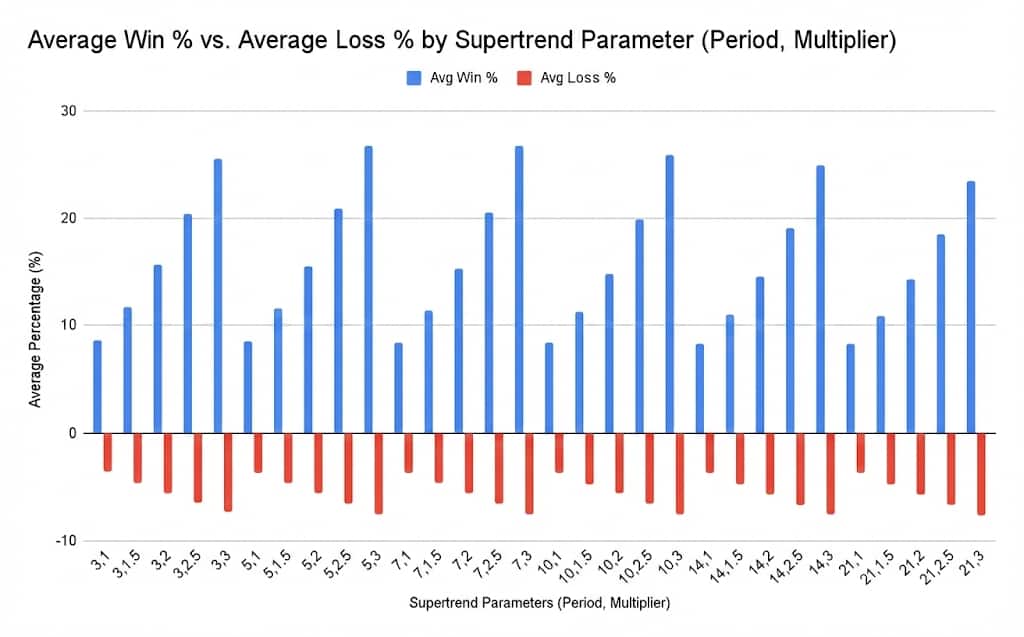
● At multiplier 1.0, the average win was 8.54 percent, average loss was negative 3.64 percent and win rate was 40.7 percent
● At multiplier 1.5, the average win increased to 11.69 percent and average loss widened to negative 4.69 percent
● At multiplier 3.0, the average win expanded sharply to 25.53 percent while average loss was negative 7.40 percent and win rate rose to 42.9 percent
| Parameter (Period, Mult) | Avg Win % | Avg Loss % | Win Rate |
| 3, 1.0 | 8.54% | -3.64% | 40.7% |
| 3, 1.5 | 11.69% | -4.69% | 41.1% |
| 3, 3.0 | 25.53% | -7.40% | 42.9% |
The higher multiplier dramatically increased the size of winning trades. Although losses became slightly larger, the gain in average win size more than compensated. There was also a major reduction in trade count. Lower multipliers generated around 65,000 trades in the sample, while higher multipliers generated roughly 15,000 trades. Fewer trades, but far larger winners.
This demonstrates a core principle of trend following. The goal is not constant action. The goal is to remain invested during rare, powerful market moves.
 .
.
Figure 2: The Sniper Effect. Notice how the blue bars (Average Win %) grow significantly taller as the multiplier increases. By widening your stops, you stay in trades longer and capture massive, trend-defining moves that smaller multipliers miss.
Identifying the Optimal Balance Between Speed and Return
Among the various combinations tested, one configuration stood out in terms of daily return performance. The setting of 3 period and 3 multiplier produced the highest daily return in the study.
This combination offers two structural advantages:
● The shorter period helps detect emerging trends relatively early
● The higher multiplier ensures that positions are not exited prematurely during normal volatility
However, this performance comes with a behavioural requirement. The average holding period under this configuration was approximately 69 days. Traders must remain invested for over two months on average to fully capture the benefit.
By contrast, faster settings with lower multipliers resulted in average holding periods of around 15 days, but with materially smaller average gains.
The evidence suggests that long term profitability in this framework is tied directly to patience and tolerance for interim volatility.
Behavioural Reality: Why Most Traders Struggle to Capture the Edge
The mathematics of the Supertrend appear sound under optimal settings, but execution is another matter.
Trend following strategies require investors to sit through pullbacks without interfering. During a 69 day holding period, it is common to experience temporary drawdowns. Many traders exit manually during these periods out of fear, thereby truncating the very gains that make the system profitable.
The study suggests that under optimal configurations, the strategy's profitability is heavily dependent on allowing trades to run their full course. Cutting winners early meaningfully reduces expected returns.
Practical Takeaways for Investors
The Supertrend indicator is not a shortcut to guaranteed profits. It does not eliminate losses, and it does not deliver high accuracy. What it offers instead is a structured way to participate in sustained market trends. The data driven conclusions from this 13-year study provide three clear principles for using the Supertrend effectively.
● First, accept that losses are frequent. A 40 to 43 percent win rate is normal. The strategy’s edge comes from the magnitude of winners, not the frequency.
● Second, avoid overly tight settings. Multipliers in the 2.5 to 3.0 range are statistically superior in capturing large trend moves. While this reduces trade frequency, it significantly increases average win size.
● Third, align your expectations with holding period realities. If you are unwilling to hold positions for at least one to two months, you are unlikely to realize the full statistical advantage.
Disclaimer: The views and investment tips expressed by experts on Moneycontrol.com are their own and not those of the website or its management. Moneycontrol.com advises users to check with certified experts before taking any investment decisions.
Moneycontrol journalists are not involved in creation of this article.
Discover the latest Business News, Sensex, and Nifty updates. Obtain Personal Finance insights, tax queries, and expert opinions on Moneycontrol or download the Moneycontrol App to stay updated!
Find the best of Al News in one place, specially curated for you every weekend.
Stay on top of the latest tech trends and biggest startup news.