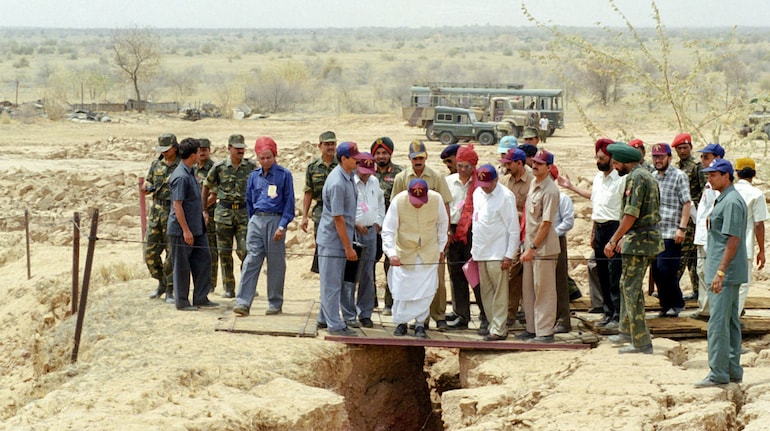

On 11 and 13 May 1998, India carried out a series of underground nuclear tests at the Indian Army’s Pokhran Test Range in Rajasthan, under the code name Operation Shakti (often referred to as Pokhran II). Public memory tends to freeze on the announcement and the diplomatic shockwave that followed. The harder part to picture is what had to happen before the first countdown could begin: the test site had to be prepared, shafts readied, devices moved and assembled, instrumented and wired, and the entire operation kept invisible to foreign surveillance long enough for political clearance to become irreversible.
The story of Pokhran II, in other words, is also a story of military planning. Not “battle planning” in the conventional sense, but operational planning in the purest staff-college meaning of the term: mission clarity, compartmentalisation, deception, movement control, engineering, range safety, and the disciplined execution of timelines in a hostile intelligence environment. India’s own official statements and later reporting outline just how much of Operation Shakti was about the Army’s engineers and security architecture enabling scientists to do their work without interruption.
Why 1998 looked different from 1995
A useful way to understand the “military planning behind Pokhran II” is to begin with what went wrong earlier. Preparations for a test in the mid-1990s were reportedly detected, and the plan was dropped under international pressure. ThePrint’s retrospectives emphasise the lesson India drew from that episode: if you were going to test again, you had to assume overhead surveillance and leakage risks as the primary operational threat, not an afterthought.
This is where the Army’s role becomes central. A test is not only a scientific event. It is a high-security movement-and-construction job in a controlled military range, conducted against a clock, under secrecy, and with strict containment requirements. In 1998, the operational aim was clear: prepare and execute without visible signatures that could be interpreted abroad as “India is about to test.”
The test range as an operational theatre
Pokhran Test Range is an Army-managed space. That matters because an underground nuclear test requires far more than digging a hole. You need a controlled perimeter, access management, and the ability to move men and material without attracting the kind of routine visibility that generates intelligence “noise” outsiders can pattern-match.
The broad shape of the operation appears in later descriptions: work concentrated at night, equipment moved back before daylight, excavated sand reshaped to look like natural dunes, cabling concealed under sand or vegetation, and the entire site maintained to look normal at the times surveillance platforms were expected to pass overhead. Times of India reporting has described the use of mundane cover activities to avoid drawing attention to real engineering work, which fits the classic deception principle of hiding the unusual within the ordinary.
Even if you set aside the most cinematic details, the core point holds: the test site had to be treated like an operational theatre where signature management was the mission.
The 58 Engineer Regiment and the mechanics of concealment
Multiple accounts point to the Indian Army Corps of Engineers, specifically the 58 Engineer Regiment, as a key unit tasked with preparing the test site and shafts in a way that reduced the chance of detection. The tactical logic is straightforward. Large earth-moving activity is easy to spot. Repeated patterns of vehicle tracks, disturbed ground, and new spoil heaps are easy to track over time. So the engineering challenge was to do heavy work while minimising persistent change in what an overhead observer might see.
Public retellings often mention night work and “restoring” the day-time appearance of the site. While some versions are published in lighter, commemorative formats, the broad method is consistent with the kind of camouflage-and-discipline you would expect from military engineers working under strict secrecy protocols.
There is also a second, less glamorous aspect of engineering planning: test containment. The shafts are not just deep. They must be designed and instrumented to ensure the explosion is fully contained, with no venting. A later Press Information Bureau release, quoting Dr Anil Kakodkar and Dr R Chidambaram, describes detailed simulation calculations for each shaft to ensure containment of radioactivity, which underlines that “site prep” was as much physics-informed engineering as it was camouflage.
Compartmentalisation and “need to know” as a security system
Large operations leak when too many people know too much. One recurring theme in accounts of Pokhran II is compartmentalisation: small teams, limited disclosure, and tight control over who had visibility into the full plan. ThePrint has described the operation as involving hundreds of steps where betrayal or loose talk could compromise the entire mission, suggesting a deliberate design to keep knowledge distributed in slices rather than as a single shared picture.
Compartmentalisation is a military habit. It is also a political necessity in sensitive strategic programmes. The operational benefit is that even if one node is exposed, the whole network is not automatically compromised.
Moving the devices and the discipline of timelines
Once the site is ready, the operation becomes a movement-and-assembly problem. Devices, components, diagnostics, and instrumentation have to arrive in a way that does not create a visible “convoy signature” and does not expand the circle of knowledge unnecessarily. The most detailed public discussions of movement procedures often appear outside mainstream newspapers, but they align with what India’s official statements confirm at a higher level: the tests were planned, executed, and “fully contained,” implying a complex instrumentation-and-firing chain was in place and validated before detonation.
This is where military planning shows up again in its most basic form: sequencing. In an underground test, you cannot improvise at the last minute. Shafts, cabling, diagnostics, timing systems, and safety checks are all interdependent. If one step slips, the whole chain becomes riskier, not only scientifically but politically.
Range safety and the handover problem
One of the least discussed but most important elements in such operations is range safety. Nuclear tests involve a procedural handover from “construction and preparation” to “execution and detonation,” and military ranges operate on strict safety clearances. Even in simplified accounts, you can see the outline of a command-and-control chain: site prepared under engineers, then controlled execution under a designated safety authority.
India’s official statements emphasise containment and the absence of radioactive release into the atmosphere. That public assurance is also, indirectly, a statement about safety processes functioning under pressure, because containment is not only a technical outcome but also a procedural one, shaped by design, drilling, sealing, instrumentation, and timing discipline.
Civil-military coordination at the top
Pokhran II was not a “military operation” in the conventional sense. It was a strategic-state operation. That said, the planning logic resembles what you see in high-risk joint missions: political authority sets the decision, the scientific establishment builds the devices and diagnostics, and the armed forces provide the secure range, engineers, movement discipline, and protective security.
The public record repeatedly links senior scientific leadership and defence-scientific leadership to the coordination effort. Press Information Bureau releases and later reporting place figures like R Chidambaram and Anil Kakodkar in the official communication about the tests and their outcomes, reflecting the institutional centre of gravity behind the programme.
ThePrint’s longer recollections also stress that the operation depended on confidence across layers, from the nuclear core group to operational executors. Whether one agrees with every flourish in those accounts, the underlying point is credible: without tight coordination and trust, an operation that must stay hidden while being large-scale simply collapses under its own complexity.
What “success” meant operationally, not just politically
From a military-planning perspective, success at Pokhran II was defined far more narrowly and concretely than in the political speeches that followed. The first and most basic requirement was that the test site be prepared and instrumented without triggering external intervention, because even a hint of imminent testing could have led to diplomatic pressure or surveillance-driven disruption. Equally important was the ability to emplace the devices, lay diagnostics, and execute the firing sequence exactly as planned, without last-minute improvisation or technical slippage that could compromise safety or credibility.
Containment was another non-negotiable benchmark. The explosions had to remain fully underground, with no venting of radioactive material, not only to meet safety and environmental thresholds but also to demonstrate procedural and engineering control under extreme conditions. Timing also mattered. The tests were sequenced and completed quickly enough to deny adversaries the opportunity to halt or influence subsequent detonations once the first test had taken place.
When the Government of India stated that yields were within expected ranges and that there was no release of radioactivity into the atmosphere, it was not merely making a political claim. It was describing the operational end-state that planners had worked towards: a tightly controlled, fully executed strategic test series that concluded before external actors could alter its course.
The “inside baseball” debate and why it matters less for military planning
There is a separate, long-running argument about yields and the thermonuclear device, which erupted publicly in later years and prompted rebuttals and counterclaims in the Indian press. Indian Express coverage from 2009 captures the dispute and the institutional pushback.
That debate matters for deterrence theory and weapons development. But for the specific question of military planning behind Pokhran II, the more relevant point is this: whatever the contested technical interpretations, the operation achieved what the planners most needed in 1998, namely, executing a high-security strategic test sequence without being stopped or exposed early, and doing so under a strict containment and safety envelope as publicly stated.
The enduring lesson: strategic operations are won on logistics and secrecy
Pokhran II is often narrated as India outsmarting foreign intelligence. That is only half the story. The other half is that strategic operations are usually decided by unromantic fundamentals: engineering discipline, movement control, tight timelines, and command responsibility.
If you strip away the mythology and the politics, the military planning behind Pokhran II looks like a case study in how a state conducts a complex, high-risk mission inside its own territory while treating surveillance and leakage as active adversaries. In that sense, Operation Shakti was not just a test series. It was also a demonstration of India’s ability to organise and execute a strategic operation with joint civil-scientific and military components under intense secrecy pressure.
Discover the latest Business News, Sensex, and Nifty updates. Obtain Personal Finance insights, tax queries, and expert opinions on Moneycontrol or download the Moneycontrol App to stay updated!
Find the best of Al News in one place, specially curated for you every weekend.
Stay on top of the latest tech trends and biggest startup news.