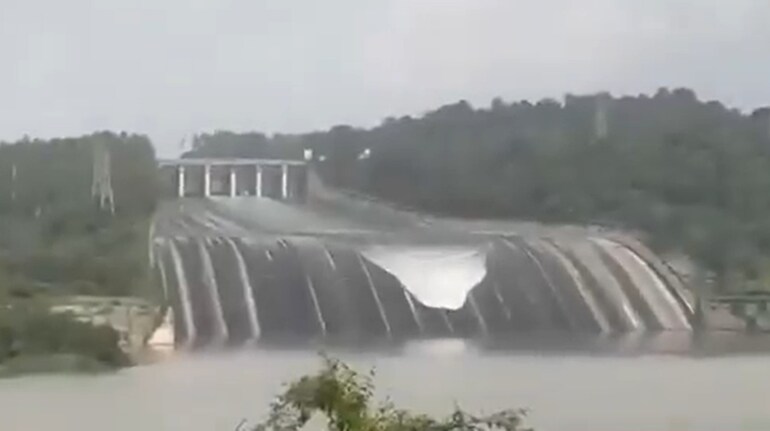
Continuous heavy rains in Himachal Pradesh have begun to impact Punjab, as the state’s three major dams, Bhakra, Pong and Ranjit Sagar, are recording a sharp rise in water levels, leading to possible flooding downstream. Authorities are on high alert and are regulating water releases to prevent any large-scale damage.
According to officials cited by the Hindustan Times, the Bhakra Dam, built on the Sutlej River, crossed the 1,664-feet mark on Monday. Also, the pace of the rise has been alarming, i.e., more than two feet per day, making it a much faster inflow than usual. Officials pointed out that the current level is 35 feet higher than the same time last year, and the inflows have jumped to 70,500 cusecs, compared to just 43,500 cusecs in 2024.
To ease pressure, 25,000 cusecs of water is being released from the dam, which is slightly more than last year’s 23,000 cusecs. Still, authorities of the Bhakra Beas Management Board (BBMB) have said that the floodgates will not be opened immediately, as the dam still has about 16 feet of cushion before it reaches its maximum capacity of 1,680 feet.
The Pong Dam on the Beas River has reached 1,382 feet, which is 28 feet higher than last year. Inflows have spiked to 1.29 lakh cusecs, with a massive one-day surge of 39,000 cusecs recorded. To control the pressure, 18,000 cusecs of water is being released from the reservoir. Authorities confirmed that this managed discharge has already led to the submergence of at least 1,000 hectares of farmland downstream, affecting farmers along the Beas River, according to the HT report.
This surge has caused widespread flooding in the low-lying regions of Kapurthala and Hoshiarpur districts, where floodwaters have inundated large areas of agricultural land and triggered evacuations.
Meanwhile, the Ranjit Sagar Dam on the Ravi River is also witnessing a significant rise. The water level currently stands at 522 metres (1,712 feet), compared to 520.5 metres (1,707 feet) last year. Inflows have shot up to 41,300 cusecs, more than three times higher than the inflows of 12,300 cusecs recorded last year.
The BBMB and state officials are closely monitoring the situation across all three reservoirs. However, there is no immediate plan to release excess water from Bhakra’s floodgates, but the rapidly increasing inflows remain a serious concern. Civil authorities have been instructed to stay prepared, as any sudden release could impact thousands of people and farmlands downstream.
Discover the latest Business News, Sensex, and Nifty updates. Obtain Personal Finance insights, tax queries, and expert opinions on Moneycontrol or download the Moneycontrol App to stay updated!
Find the best of Al News in one place, specially curated for you every weekend.
Stay on top of the latest tech trends and biggest startup news.