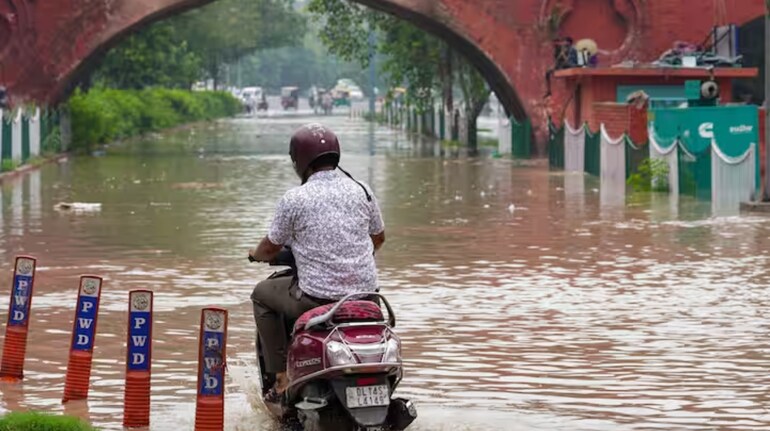
Every monsoon, Delhi’s streets are submerged, as the real rivers that once drained the city have long disappeared, replaced by clogged, poorly maintained drains, experts say.
According to a report by The Indian Express, in the 17th century, when Mughal emperor Shah Jahan built his capital in the 1640s, the new city of Shahjahanabad was laid out with drainage.
“These were mostly covered drains that most streets used to have, and they used to empty out through some of the major gates,” historian Swapna Liddle told The Indian Express. “The Mori Gate, for instance, served as an outlet for large volumes of wastewater. The Ajmeri Gate side also had channels carrying water out of the walled city,” he added.
“Later, through lack of maintenance, particularly as the Mughal empire declined, they became choked up and defunct. By the 19th century, many of the likes of historian and AMU founder Sir Syed Ahmad Khan were already writing that these drains were not working well. A new system had to be put in place,” Liddle explained.
Before concrete, Delhi’s land offered natural drainage
Even outside the walled Mughal capital, Delhi’s geography used to once offer its own natural drainage.
Explaining Delhi’s topography, oral historian Sohail Hashmi told The Indian Express that: “From the west bank of the Yamuna to the foothills of the Aravalli, the land looks like a piece of watermelon—broad in the middle, narrow at the ends. It slopes downward towards the Yamuna.”
Rainwater streams flowed naturally along this slope. From the Kushak Nallah near today’s Race Course Road and Teen Murti to rivulets around Tughlaqabad, nearly a dozen streams once drained into the Yamuna. Along their course, they replenished Delhi’s lakes and ponds. Each monsoon, these natural depressions used to once collect rainwater, which then percolated into the ground, keeping aquifers alive.
“In 1947, there were more than 300 such lakes and ponds in Delhi. Today… not even 20,” Hashmi was quoted as saying. “We encroached on them, filled them with garbage, and built colonies on top. Now there is no place where rainwater can go,” he added.
British intervention in Delhi's water system
Today, Delhi’s drainage system resembles a network of arteries, with streams twisting and branching before joining the Yamuna. These are not artificial drains but natural rivulets that have been converted into sewage channels.
Colonial rule too brought profound changes. In the 1880s, the British colonial government in Delhi introduced significant public health changes by building the municipal waterworks at Chandrawal and digging "Renny's wells" to tap subsoil water, which was then supplied to the city of Shahjahanabad. This infrastructure project was accompanied by the introduction of the flush toilet system, marking a profound shift in water management and sanitation in the city.
“In the 1890s, the municipal committee introduced the flush system and laid underground sewer pipes…Where was the sewage going? Into the drains, and eventually into the Yamuna,” Hashmi said.
Initially, the flow of Aravali waters into these streams helped absorb waste and ward off diseases like E. coli. “The British may have started the destruction of the Yamuna, but we completed it,” Hashmi added.
Partition, refugees, and the rise of Delhi’s clogged drains
In 1947, India-Pakistan partition changed Delhi overnight. Its population first fell from nine lakh to six lakhs as one-third of its residents, mostly Muslims had fled. Soon after, eight lakh refugees arrived from Pakistan.
How was this influx accommodated? “Those who had papers were allotted land. Those who didn’t simply identified open land and built houses,” Hashmi said. Many such colonies sprouted along the streams that once carried fresh water from the Aravallis.
Gradually, as the population increased, the Aravali water flow could no longer dilute the water and these rivulets turned into open drains. The old streams, instead of carrying stormwater, started getting clogged with untreated sewage.
Unplanned post-Independence settlements disrupted natural drainage
By the 1990s, even as Shahjahanabad and New Delhi had received a new and planned sewage system, the rest of the city sprawled without coordinated planning. According to the report, experts say that the post-independence settlements have disregarded the natural slope of the land.
“None of our town planners understood the slope and how crucial it was…if you build a road across the slope, it is unavoidable that the water will collect there …You cannot name one colony built after independence where there is no waterlogging,” Hashmi said.
This is why centuries-old settlements like Mehrauli or Shahjahanabad rarely face waterlogging but post-colonial neighbourhoods routinely drown in rainwater.
‘Poor upkeep and flawed design’
“The problem is not just history but also the neglect of what exists today,” Manu Bhatnagar, Principal Director, Natural Heritage Division, INTACH, was quoted as saying.
“From 1912, since the era of Lutyens’ Delhi, drainage systems were introduced by the British. After Independence, the newly built drainage system has not been maintained,” he added.
Bhatnagar concluded, “The problem is twofold: poor upkeep and flawed design. The built drainage system is not maintained properly because it is full of garbage and silt. It shows lower efficiency than it is made for. Further, the city is so concretised that water can no longer seep into the ground. And when the river is in spate, the natural drainage cannot discharge into it because the river level is as high as the natural rivulets. These are the difficulties in Delhi’s drainage.”
Discover the latest Business News, Sensex, and Nifty updates. Obtain Personal Finance insights, tax queries, and expert opinions on Moneycontrol or download the Moneycontrol App to stay updated!
Find the best of Al News in one place, specially curated for you every weekend.
Stay on top of the latest tech trends and biggest startup news.