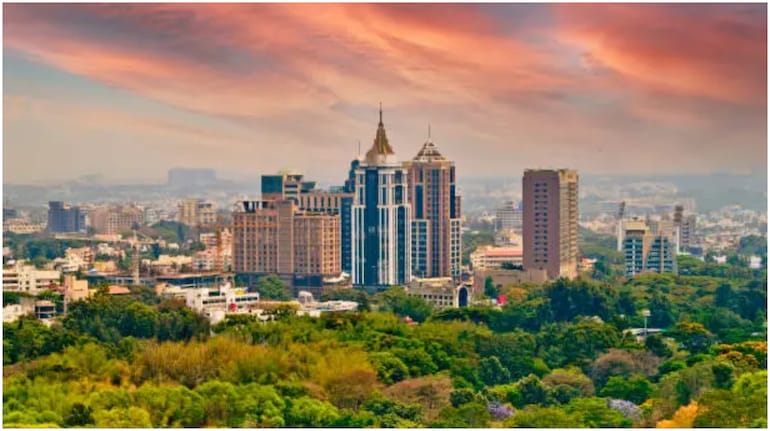
With the official establishment of the Greater Bengaluru Authority (GBA) in May, Bengaluru underwent a significant administrative transformation. GBA replaced the Bruhat Bengaluru Mahanagara Palike (BBMP) as the city’s primary governing body.
According to the Hindustan Times, the move marks a first-of-its-kind attempt in the country to fundamentally re-engineer metropolitan governance, moving beyond traditional models that have long struggled with fragmented responsibilities and poor coordination.
On May 15, Karnataka Chief Minister Siddaramaiah announced the implementation of the Greater Bengaluru Governance Act, replacing the BBMP with the GBA.
As per the report, the Act allows the creation of small municipal corporations to govern the city instead of a single municipal body like the BBMP. Each municipal corporation will have its own elected council but will function under the overarching GBA—a chief minister-led authority, with the minister for Bengaluru development as deputy chairperson — tasked with coordinating and driving major development projects across the Greater Bengaluru area.
As per the report, parastatal agencies such as the Bangalore Development Authority (BDA), the Bangalore Water Supply and Sewerage Board (BWSSB), the Bangalore Metropolitan Transport Corporation (BMTC), the Bengaluru Solid Waste Management Corporation, and the Bengaluru Metro Rail Corporation Limited will now operate under the GBA.
Experts say the GBA’s structure places significant control in the hands of Karnataka government, the report added. It includes elected representatives, key state ministers handling home, transport, urban development, and energy portfolios, as well as the mayors of the newly created municipal corporations.
While the GBA promises decentralisation through smaller municipal corporations, experts warn it could also lead to excessive centralisation. With the chief minister at the helm and municipal commissioners reporting to the GBA’s chief commissioner, the principal executive officer of the body, the model risks sidelining elected mayors and undermining the spirit of decentralisation enshrined in the 74th constitutional amendment, experts were quoted by HT.
“Conceptually, the idea of an integrated metropolitan body like the GBA is good—it draws from models like the Greater London Authority,” Srikanth Viswanathan, CEO, Janaagraha Centre for Citizenship and Democracy was quoted by HT as saying.
“India’s Constitution doesn’t offer a model for governing large cities, so this is important. But the Greater Bengaluru Governance Act, 2024, is poorly drafted. It lacks a clear delineation of roles among the state government, the GBA, and the proposed smaller municipal corporations. Critical aspects, such as staffing, financial allocation, and resource sharing, remain inadequately defined,” he added.
Delhi-based architect and urban designer Dikshu Kukreja calls the GBA a “timely and much-needed intervention” for a city plagued by fragmented, piecemeal planning and disjointed execution, the report added.
“Bengaluru’s core challenges—traffic congestion, water management, and unplanned growth—have persisted because no single agency had the power to align land use, infrastructure, and mobility,” he was quoted by HT.
But even Kukreja strikes a note of caution. “Centralisation always carries the risk of political overreach,” he warned. “If not carefully balanced, it could marginalise local governance structures and weaken civic participation. The key is not to reject centralisation, but to design it in a way that supports a long-term vision while staying responsive to local needs,” he added.
Naresh Narasimhan, a Bengaluru-based architect and urban designer, says Indian cities urgently need governance structures that are integrated, long-term, and people-centric. “The GBA’s integrated structure could offer a template—but only if it evolves beyond bureaucratic centralisation. We don’t just need fewer agencies—we need smarter, more responsive ones. What matters is having a shared long-term vision insulated from political churn integration across planning and service delivery, and deep, consistent citizen participation,” he was quoted by HT.
Narasimhan points to Singapore’s urban planning model—anchored by a strategic Concept Plan and a statutory Master Plan—as a system worth adapting, not imitating.
“Bengaluru needs its own version, tied closely to development controls, mobility plans, and demographic change. A city’s future cannot be tied to five-year political cycles—it must be shaped by fifty-year commitments,” he said. “If the GBA can stay focused on long-term, inclusive, people-first planning, it has the potential not just to reshape Bengaluru—but to set a new benchmark for urban governance across India’s rapidly growing metros,” he added.
But could Bengaluru’s BDA-like model work in Delhi?
“Delhi’s urban management is deeply hampered by overlapping jurisdictions and institutional silos,” Kukreja was quoted by HT. “Agencies like the DDA, MCDs, DJB, and transport bodies often operate in isolation with misaligned mandates, making comprehensive planning nearly impossible. A unified metropolitan governance model like the GBA could bring much-needed synergy, aligning departments and ensuring that urban solutions actually meet the city’s evolving needs,” he added.
Discover the latest Business News, Sensex, and Nifty updates. Obtain Personal Finance insights, tax queries, and expert opinions on Moneycontrol or download the Moneycontrol App to stay updated!
Find the best of Al News in one place, specially curated for you every weekend.
Stay on top of the latest tech trends and biggest startup news.