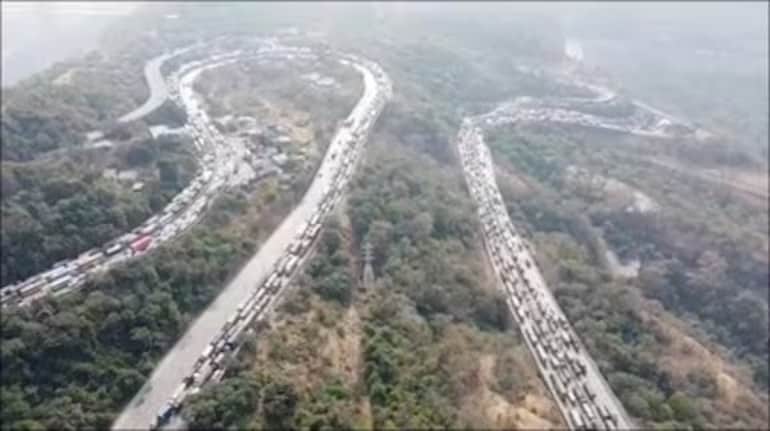

The images are hauntingly familiar: a serpentine line of stalled vehicles stretching beyond the horizon, weary travellers pleading for water and the quiet desperation of a journey stretched from hours into days.
Read: Stuck for hours in e-way gridlock, industrialist calls in chopper
The recent 32-hour ordeal on the Mumbai-Pune Expressway, triggered by an overturned gas tanker, was not an anomaly. It was a stark, predictable manifestation of a systemic breakdown that plagues India’s major corridors.
Why does a single incident on a modern expressway plunge an entire region into paralysis? The answer lies in a toxic confluence of human behaviour, infrastructural neglect and institutional failure.
What turns a single accident into a national headline?
The event on February 3, 2026 was a textbook case. A tanker carrying flammable propylene gas overturned in the crucial Khandala ghat section, necessitating a complete shutdown for safety. What followed was a collapse of crisis management.
The gridlock stretched 20-22 kilometres, trapping thousands without access to toilets, drinking water or food for over 32 hours. Critically, toll collection reportedly continued amidst the chaos and the response from emergency agencies was perceived as painfully slow. This was not merely traffic; it was the total failure of a system designed to keep people and goods moving.
Is reckless driving the primary culprit?
Undoubtedly, human error is the foremost trigger. India’s grim annual tally of over four lakh road accidents finds its roots in behaviours where overspeeding alone accounts for approximately 71% of cases, according to government data.
Reckless overtaking, distracted driving and overloading are endemic. This is compounded by a culture of weak enforcement. Unlike systems in nations like Germany or Sweden, where routine, stringent checks are the norm, enforcement in India remains fragmented and under-resourced.
The deterrent effect of fines is minimal and the certainty of being caught is low, creating a highway environment where rules are often treated as suggestions.
Does infrastructure itself magnify the crisis?
Even on a premium route like the Mumbai-Pune Expressway, infrastructural flaws act as force multipliers. The latest disruption serves as a case study. A tanker carrying highly inflammable propylene gas overturned near the Adoshi tunnel in the Khandala ghat section, forcing a safety shutdown that paralysed traffic for 32 hours.
This incident underscored a stark reality: the 24-year-old expressway remains acutely vulnerable to single-point failures, a susceptibility that persists despite improved enforcement and a marginal decline in accident numbers.
Operational since April 2002 and built at an estimated cost of Rs 1,600 crore, the Mumbai-Pune Expressway was once a transformative feat. It slashed the journey between the two cities from five or six hours on the old national highway to nearly three. Yet, the very success of this artery has seeded its current struggles.
According to estimates from Ideal Road Builders, the expressway's manager, daily traffic has surged to around 100,000 vehicles. This relentless volume steadily erodes the initial time gains and places immense strain on a design conceived for a different era of traffic density.
The resulting pressure exposes inherent flaws. The engineering of the route, particularly through the challenging ghat sections, often features inadequate signage, insufficient lighting and a lack of robust emergency lanes or pre-planned diversion corridors. These shortcomings are compounded by issues like substandard repair work and poor drainage.
Consequently, what should be a manageable incident — a single vehicle breakdown — rapidly escalates. With no parallel path for traffic, a minor crash or spill becomes a total blockade, locking the entire system. The infrastructure, therefore, does not merely host a crisis; it actively amplifies it, turning localised incidents into regional gridlocks with nationwide logistical repercussions.
Why is the emergency response so ineffectual?
The prolonged chaos highlights critical gaps in response protocols. The handling of hazardous materials, as seen with the propylene tanker, requires specialised teams and equipment, which are often slow to mobilise. There is a glaring lack of coordination between multiple agencies — traffic police, national disaster response, fire services and toll operators.
As noted in analyses of the incident, the absence of a quick-response system and real-time traffic management technology is acute. Despite collecting substantial tolls, expressway authorities frequently lack the technological backbone to manage crises, inform stranded commuters, or execute pre-planned diversion strategies efficiently.
Can technology offer a way out?
The solution, as experts increasingly argue, lies in a systemic technological overhaul. An Intelligent Traffic Management System (ITMS) represents a paradigm shift from manual, reactive policing to proactive, data-driven management.
Such systems use AI-powered cameras to automatically detect violations — from overspeeding to wrong-side driving — and issue instantaneous e-challans, creating a credible deterrent. More crucially, they can detect accidents in real time, triggering faster emergency medical and clearance responses.
The data harvested can identify chronic black spots and optimise traffic flow, moving beyond mere enforcement to intelligent management.
The need for a cohesive ecosystem
The Mumbai-Pune gridlock is a sobering national metaphor. India’s rapid vehicular growth, now exceeding 360 million registered vehicles as of 2023, is hurtling down roads plagued by institutionalised neglect.
Modernisation is not just about laying concrete ribbons but about integrating disciplined driving, resilient engineering and smart technology into a cohesive safety ecosystem.
Until that integration happens, the haunting images of stranded families and paralysed logistics will remain a normal, recurring feature of the Indian journey. The expressway chaos is not an accident of fate; it is the inevitable result of choices not made and systems not built.
Discover the latest Business News, Sensex, and Nifty updates. Obtain Personal Finance insights, tax queries, and expert opinions on Moneycontrol or download the Moneycontrol App to stay updated!
Find the best of Al News in one place, specially curated for you every weekend.
Stay on top of the latest tech trends and biggest startup news.