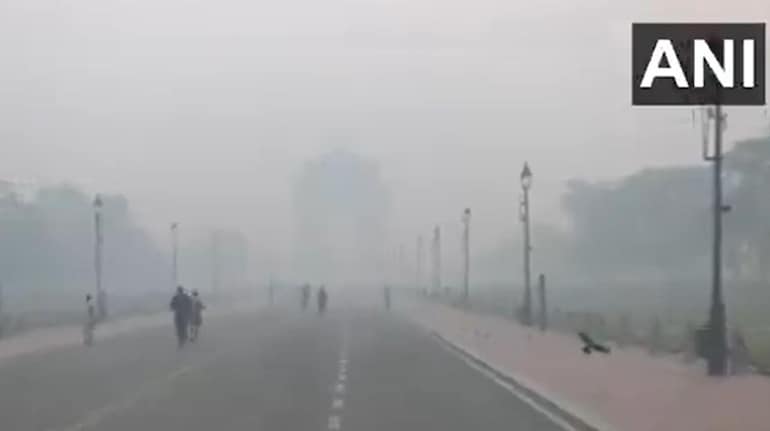
As India celebrated Diwali, pollution levels in Delhi shot up sharply, leaving the city gasping under a thick blanket of smog.
Social media was flooded with screenshots showing Air Quality Index (AQI) figures touching, and even crossing, 1000 at several locations across the national capital. Many users claimed that air quality had hit ‘catastrophic’ levels, with some monitoring apps showing readings as high as 1975.
Even Rajya Sabha MP and Trinamool Congress (TMC) leader Saket Gokhale shared a screenshot of the Mandir Marg monitoring station, showing an AQI of 1975 around 1.30 am on Tuesday.
A very Happy Diwali to the Delhi Govt, BJP, & the Supreme Court of India. This pollution IS BECAUSE OF FIREWORKS. BJP, as usual, will give their 2 standard arguments so let’s bust them in advance: 👉 No, farmers in Punjab did not stay up on Monday night just to burn stubble.… pic.twitter.com/UpUYl7LRhF— Saket Gokhale MP (@SaketGokhale) October 21, 2025
Did Delhi’s AQI really touch 1000?
The confusion arises because different agencies use different systems to calculate AQI. Most of the screenshots going viral on social media were based on data from international air quality monitoring platforms, such as IQAir, which use the United States Environmental Protection Agency (EPA) method.
The EPA system has no upper limit for AQI values. This means it can display readings far beyond the 401–500 ‘severe’ range we are familiar with in India. So, while international platforms can show values like 1000 or 1500, it doesn’t necessarily mean pollution has reached a new record high, it reflects a different calculation scale.
Meanwhile, India’s Central Pollution Control Board (CPCB) uses a capped system. Under the CPCB’s method, any reading above 401 already falls in the ‘severe’ category, with 500 being the practical upper limit.
Different methods of calculating AQI
The difference between these two systems can be dramatic. For example, IQAir showed an AQI of 1365 for Lodhi Road on Tuesday, while the CPCB’s official reading for the same location was 327. Similarly, Mandir Marg showed 1479 on IQAir, compared to 317 reported by the CPCB.
This means that while both systems indicate very poor air quality, the numbers are not directly comparable. International platforms tend to show higher figures because their scale continues to rise with increasing pollution levels, while India’s official system stops at ‘severe.’
What the actual situation was in Delhi
Even with the CPCB’s lower figures, Delhi’s air quality was still alarming. On Tuesday morning, the city’s average AQI stood at 368, which falls in the “very poor” category.
Four monitoring stations, including Anand Vihar, Wazirpur, Ashok Vihar, and Dwarka, recorded “severe” air quality with readings above 400.
Discover the latest Business News, Sensex, and Nifty updates. Obtain Personal Finance insights, tax queries, and expert opinions on Moneycontrol or download the Moneycontrol App to stay updated!
Find the best of Al News in one place, specially curated for you every weekend.
Stay on top of the latest tech trends and biggest startup news.