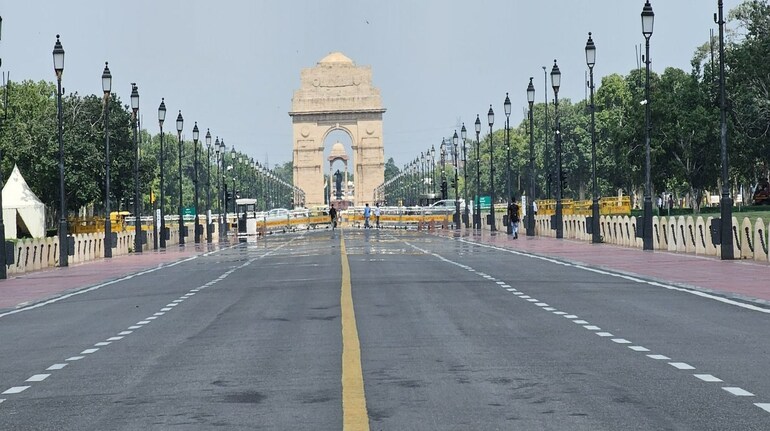
Delhi has recorded its cleanest air for the month of July in the past 10 years with 23 rainy days out of 31 days this month, according to data from the Central Pollution Control Board (CPCB). The city’s average Air Quality Index (AQI) for July, up to the 30th, stood at 79, which falls under the ‘satisfactory’ category as per CPCB’s standards, Hindustan Times reported.
The month was also the coolest July in nine years. The mean maximum temperature was 34.7 degrees Celsius this month (till July 30), making it the coolest July since 2016, when the maximum was 34.5 degrees Celsius. This was nearly a degree less than July’s normal maximum of 35.6 degrees Celsius. Nights were cooler than normal.
In July 2024, Delhi’s average AQI was 96, and in July 2023, it was 83.67. CPCB has been tracking AQI since April 2015. According to its classification, an AQI between 0-50 is ‘good’, 51-100 is ‘satisfactory’, 101-200 is ‘moderate’, 201-300 is ‘poor’, 301-400 is ‘very poor’, and above 400 is ‘severe’.
Looking at the past decade, the highest average AQI for July was recorded in 2016, at 145.64. Other past July AQIs include 87.29 in 2022, 110.06 in 2021, 83.80 in 2020, 134 in 2019, 103.83 in 2018, 98.39 in 2017, and 138.13 in 2015.
As per HT, Delhi has recorded 28 ‘satisfactory’ air days and just two ‘moderate’ ones in July 2025 so far. The cleanest air day was July 15, with an AQI of 51, almost in the ‘good’ category, while the worst air day was July 26, with an AQI of 136. In comparison, July 2024 had 17 ‘satisfactory’ and 14 ‘moderate’ days, with the worst AQI touching 138.
Delhi environment minister Manjinder Singh Sirsa, on July 23, said that Delhi was on its way to record its cleanest July in a decade. “This is not a seasonal blip, it is the result of Delhi’s multi-agency implementation model, continuous landfill action, intensified sweeping operations, and a clear commitment to outcome-based governance,” HT quoted him as saying.
According to the officials, Delhi has already registered 118 days of either ‘good’, ‘satisfactory’, or ‘moderate’ air quality this year, a figure that matches the total count of such days in all of 2024, and that too before July ended.
Delhi has also received more rain than usual this July. The Safdarjung weather station, considered the city's main reference point, recorded 220.2 mm of rainfall as of Wednesday morning, which is more than the long-period average of 209.7 mm.
According to the India Meteorological Department (IMD), Safdarjung received another 15 mm of rainfall by 5.30pm on Wednesday. Other parts of Delhi also saw varying rainfall. Palam recorded 4.6 mm until 8.30 am and 28.3 mm between 8.30 am and 5.30pm. Pusa logged 37.5 mm followed by another 12.5 mm, while Janakpuri saw 11.5 mm of rain during the afternoon.
The IMD has predicted light to moderate rain along with thunderstorms to continue on Thursday.
Discover the latest Business News, Sensex, and Nifty updates. Obtain Personal Finance insights, tax queries, and expert opinions on Moneycontrol or download the Moneycontrol App to stay updated!
Find the best of Al News in one place, specially curated for you every weekend.
Stay on top of the latest tech trends and biggest startup news.