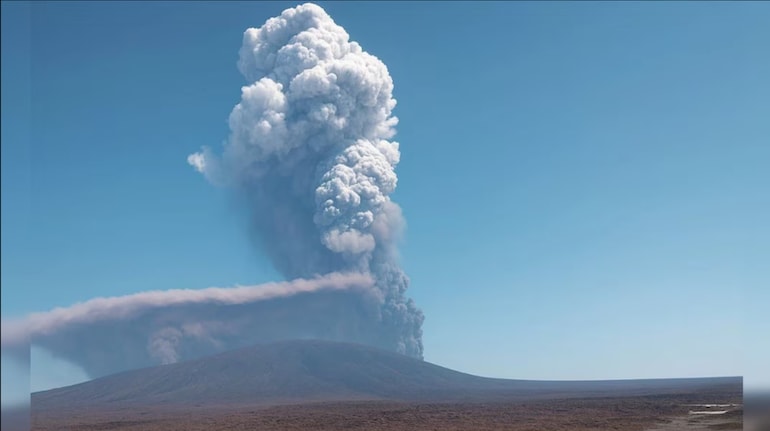
A meteorological event of rare scale is unfolding over northwest India, born not from the atmosphere's usual forces, but from a geological cataclysm thousands of miles away. For the first time in 12,000 years, Ethiopia’s Hayli Gubbi volcano has erupted, propelling a vast plume of volcanic ash on a transcontinental journey that is now entering Indian airspace.
This plume, an abrasive cocktail of microscopic rock, volcanic glass and gases, poses a severe and specific danger, particularly to the aviation sector. So, what exactly is travelling towards Delhi-NCR, Rajasthan and Punjab and why is it so hazardous?
The anatomy of an aerial hazard
Contrary to its name, volcanic ash is not soft soot. It is a dense cloud of sharp, fine fragments of pulverised rock and minerals like silica. This is the primary source of its threat. When ingested into a jet engine, these particles are subjected to intense heat, causing them to melt and then re-solidify on cooler turbine blades. This can lead to immediate engine failure, a pilot's worst nightmare.
The danger does not end there. The abrasive particles can sandblast cockpit windows to obscurity, severely reducing pilots' visibility. They can also clog and damage essential external sensors, such as pitot tubes, which measure airspeed, potentially providing false or failing data to the flight crew.
The India Meteorological Department (IMD) has confirmed that this particular plume is moving at a critical altitude of 10 to 15 kilometres, directly in the flight path of commercial aircraft. This high-altitude positioning is what makes aviation the immediate and primary concern.
Operational impact and response
Recognising the clear and present danger, the Directorate General of Civil Aviation (DGCA) has issued urgent advisories. Airlines have been instructed to strictly avoid the published ash-affected areas and flight levels, forcing significant adjustments to flight planning, routing and fuel calculations.
The operational impact is no longer theoretical. As reported by TOI, an IndiGo flight from Kannur to Abu Dhabi was diverted to Ahmedabad to avoid the hazardous plume. In a telling sign of the perceived risk, an Indian carrier’s aircraft that landed in Abu Dhabi is undergoing a thorough engine inspection before being cleared for its return journey.
IndiGo, in a post on X, acknowledged the situation, stating their teams are "closely tracking the situation in coordination with international aviation bodies." The airline has cancelled at least six flights as a precautionary measure.
Potential ground-level effects
While the current threat is airborne, the TOI report outlines a broader risk profile for volcanic ash. Should the ash settle close to the surface in significant quantities, it can become a direct public health concern. The fine, sharp particles are known to irritate the lungs, eyes and skin, and can significantly worsen air quality, posing a particular risk to those with respiratory conditions.
However, authorities have indicated that the current plume's high cruising altitude is likely to prevent such dense settlement, insulating the population below from these direct health effects for now.
IMD chief Mrityunjay Mohapatra was cited by TOI as saying that while air quality impact is unclear, the plume could manifest as a hazy sky and potentially lead to a slight rise in minimum temperatures by acting as an insulating layer. The situation remains dynamic, with Indian authorities maintaining a close watch.
Discover the latest Business News, Sensex, and Nifty updates. Obtain Personal Finance insights, tax queries, and expert opinions on Moneycontrol or download the Moneycontrol App to stay updated!
Find the best of Al News in one place, specially curated for you every weekend.
Stay on top of the latest tech trends and biggest startup news.