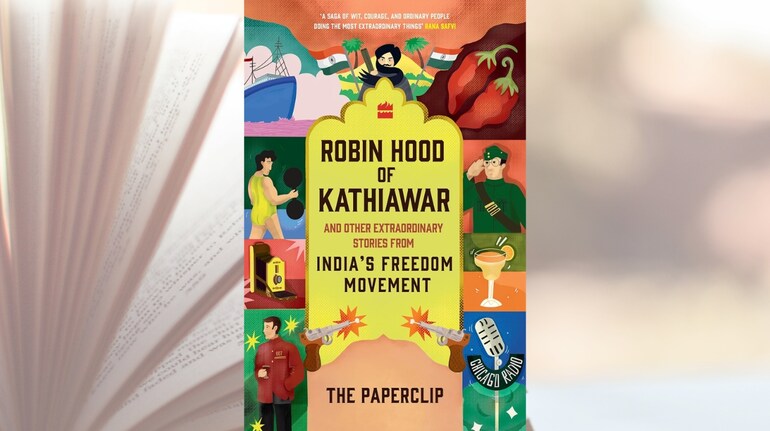
Excerpted with permission from the publisher Robin Hood of Kathiawar and Other Extraordinary Stories from India's Freedom Movement, The Paperclip, published by HarperCollins India.
**************
A Nightclub in Mexico City
We landed in Mexico City in August 2017, expecting to make a short visit. But Mexico City isn’t the kind of place that lets you leave so easily. It pulls you in with all its energy. What was supposed to be a brief stay stretched longer and longer, as the city revealed more of itself, layer by layer.
Before we even left the airport, we found our first surprise. It was a small store, and the banner read ‘Librerías Gandhi’. It was a bookstore named after Mahatma Gandhi. At first, it seemed like a coincidence. But we soon realized the influence of the Indian freedom movement in Mexico ran deeper than we thought.
Back in our university days in Miami, we had seen Hispanic students celebrating something called the ‘Traditional Gandhi Day of Service’. They wore white shirts with bold green lettering and a picture of Gandhi, spending the day volunteering in their communities. It was quite a fascinating cultural overlap that goes back in time. In fact, a month before his assassination, Gandhi had sent an autographed portrait to the President of Mexico. A Mexican world traveller personally delivered it.
Mexico City was everything at once—grand and chaotic, historic yet modern, overwhelming but irresistible. The streets were alive with the aroma of tacos and the sound of music from open windows. And then there were the colours. The pink cabs caught our eye immediately. But this wasn’t just any pink—it was Mexican pink.
For centuries, it had appeared in textiles and murals. And more recently, if you watched Barbie (yes, the one with Margot Robbie and Ryan Gosling), you’ve seen the very Mexican pink in action.
Ice cream and an unexpected discovery
We stayed in Hotel MX Roma, in Roma Norte, a trendy, historic neighbourhood that felt like it had stories hidden around every corner. Its dramatic streets, historic mansions and indie cafés gave it a charm that was both old-world and effortlessly modern.
A few blocks from our hotel, we spotted a tiny ice cream shop painted in that same unmistakable Mexican pink. It was a cheerful little place, standing out against the subdued tones of the old buildings around it. But what we didn’t know yet was that just beyond that shop, something even more surprising was waiting for us—a hidden story that would add yet another unexpected chapter to our Mexico City experience.
It was the third day of our visit and it was quite late at night. While waiting in line for our ice cream, something else caught our attention. Just a few steps away, a long queue stretched outside what looked like an old, unassuming residence. It wasn’t the kind of place you’d expect to see a crowd gathering at night. Yet, there they were—people dressed in their finest, trying to talk their way past a stony-faced bouncer.
What made it even more intriguing was the music. A soft, hypnotic disco beat was drifting out from behind those partially closed doors. It was very subtle but impossible to ignore. With our ice creams in hand, we edged closer, watching as the bouncer turned people away one by one. Just beside the entrance, a sleek plaque read:
CLUB PRIVADO M.N. ROY. SOLO SE PERMITE EL ACCESO A MIEMBROS DEL LUGAR (M.N. ROY PRIVATE CLUB. MEMBERS ONLY)
A secret club, strict entry, an air of exclusivity—this was clearly no ordinary venue.
We had heard whispers about this place before. Apparently, M.N. Roy was one of the most exclusive clubs in Mexico City, notoriously difficult to get into. But luckily, we had a friend who knew how to navigate the city’s underground scene. And, as it turned out, there was a little loophole—foreigners, or gringos, sometimes had a better shot at entry. A quick passport check, a hefty payment for cover charges, a nod from the bouncer, and we were in. What we stepped into was beyond anything we had imagined.
At first, the entrance seemed normal—a dim hallway. But as we walked in, the music got louder. The walls were covered in black tiles, lit from below. Then, suddenly, we saw a huge wooden pyramid stood before us, glowing in warm light. Time seemed to stop as we took it in. Below, a busy dance floor pulsed with energy. The DJ booth was high above, surrounded by walls made of wood, leather, and shiny copper. Everything glowed, with deep colours reflecting off glass and metal.
It wasn’t just a nightclub. It was an experience.
The night unfolded in a blur of Latin EDM trap beats, hypnotic nu-disco rhythms, and overpriced cocktails. The crowd was a mix of artists, socialites and those who had simply managed to slip past the club’s velvet rope. The food? Overhyped. The drinks? Ridiculously expensive. But the sheer atmosphere of the place? Unmatched.
It should have occurred to us earlier, but it was only later that we discovered the story behind the name—M.N. Roy. What had seemed like just another cryptic club moniker was actually a tribute to an Indian revolutionary, a Bengali man named Manabendra Nath Roy, who had founded the Communist Party of Mexico nearly a century ago.
In a city full of unexpected connections, this one felt like the most surreal of them all.
Once home to revolutionary thinker M.N. Roy, this building in Mexico City’s fashionable Roma district is today a sought-after club—an irresistible stop on our walk. (Photo courtesy: Kanishka Dam)
A revolutionary goes westwards
Manabendra Nath Roy was no ordinary figure. To us, he is one of the most fascinating personalities India has ever produced. And there is no way we can pack his life story into a single chapter. But then, this book isn’t for that, either.
Still, let’s take a short trip through time—back to the early twentieth century, into the home of a young man named Narendra Nath Bhattacharya. Narendra Nath was born into a priestly family in West Bengal.
A temple to visit
If you ever find yourself in Kheput village in the Midnapore district, do not miss the mesmerizing Kheputeswari temple that has been standing tall for almost three centuries. Once upon a time, Narendra’s grandfather was its head priest.
Bengal, at the turn of the twentieth century, was a seething cauldron of revolution. Educated young men were being drawn into a firestorm of nationalist fervour, convinced that the British Raj could only be ousted by force. Narendra Nath was no exception.
Under the mentorship of Bagha Jatin (Chapter 19), the great antiBritish revolutionary, he quickly proved himself a natural leader. By the age of twenty, he had already made his mark. In November 1908, he gunned down Nandalal Banerjee, the notorious police officer who had arrested Khudiram Bose (Chapters 15 and 19), one of India’s youngest martyrs. The British now had their sights fixed on him.
As World War I had begun, the rival empires were eager to weaken Britain. Indian revolutionaries saw their chance. If they could secure weapons and funding from Germany, they could overthrow British rule. Narendra Nath volunteered for this mission.
Between 1915 and 1916, he travelled through Java, Malaya, Philippines, Japan, Korea and China, trying to procure arms. Every attempt failed. Finally, in June 1916, he landed in San Francisco.
That was when things took a wild turn.
The American press had already heard of him. The newspapers screamed: ‘Mysterious Alien Reaches America—Famous Brahmin Revolutionary or Dangerous German Spy?’ Narendra had no choice. He had to vanish. He fled to Palo Alto, California, took on a new name—Manabendra Nath Roy, or M.N. Roy—and started over.
Love and a life in Mexico
California, surprisingly, now opened new doors. One of them was to Evelyn Trent. In 1916, at the home of the president of Stanford University, Roy met Evelyn, a brilliant graduate student at the institution. Their connection was instant, and it was Evelyn who influenced Roy to study Marxism. He found himself drawn not just to nationalism but to Marxism. His beliefs evolved. Their bond grew stronger, and in 1917, Roy married Evelyn.
Roy, like many other Indian anti-colonial activists, soon came under suspicion of being a potential German agent in the US. Facing increasing scrutiny, the Roys fled to neutral Mexico to escape the growing threat.
In Mexico City, Roy found a second home. It was surprising to see how an Indian revolutionary, so far from home, became deeply connected to the city’s intellectual life. Mexico City welcomed him in unexpected ways. Roy fully embraced Mexico’s intellectual environment. He formed ties with key figures from the Mexican Revolution movements. He gradually refined his beliefs, especially his understanding of Marxism and revolutionary theory. Mexico’s history of resistance against imperialism resonated with him. He grew more dedicated to international solidarity as the way to break colonial chains.
During this time, the Roys lived in modest circumstances. He wrote often, contributing to journals and newspapers, spreading his message of anti-colonial struggle. In Mexico, he met exiled figures from around the world, including Germans, with whom he discussed raising funds for the independence movement.
As he reflected in his memoirs, Roy lived in a small house on the outskirts of Mexico City, nestled amidst maize fields with the towering, snow-capped Iztaccíhuatl mountains in the distance. The local people called the range ‘Sleeping Woman’ because, when viewed from east to west, the mountains resembled the figure of a reclining woman. This tranquil setting was a far cry from the struggles he faced, yet it was here that he felt most alive. With a pair of Mauser pistols by his side and his loyal Alsatian dog, Roy felt connected to the revolutionary spirit of the land. He used to ride Silver King, a trusted white Mexican horse, exploring the vast countryside and the slopes of the Sierra Nevada every morning.
Roy’s boundless intellect, sharp writing, and captivating charm placed him at the heart of Mexican politics. He was mingling with the who’s who of the political elite—both liberal and socialist—including Venustiano Carranza, the President of Mexico. In 1919, Roy did something historic. He founded the Communist Party of Mexico— the first Communist Party outside Russia.
Roy later moved to the Roma neighbourhood for the convenience of his work. As he recalled in his memoir, his new residence—a house in the affluent Colonia Roma, furnished with green-satincovered Louis XV furniture—felt almost ironic for a revolutionary like him. By then, meeting in cafés was no longer an option, and the two-storey house became the centre of his intellectual and political engagements. It had eight rooms, all filled with furniture, and was run smoothly by Maria, an excellent cook, along with a young boy who assisted with household tasks. This very house would later become the foundation for today’s M.N. Roy Club, remodelled and built upon—right where the pink ice cream shop also stands.
However, one might have expected a club named after M.N. Roy to be more inclusive rather than positioned as an exclusive private space. But at the end of the day, it remains a private club. Would he have liked a nightclub as a tribute to his legacy? There’s a certain quirkiness to the whole idea.
M.N. Roy was a man of many talents, with a vivid and varied outlook on life—part rebel, part bohemian. He wasn’t just a revolutionary; he was a true Renaissance man who embraced a range of passions. He learned wrestling, mastered horseback riding and even took tennis lessons from a Mexican national player. His love for chess led him to train under his Spanish teacher who was a champion in Mexico, and later, in Russia, he even managed to draw a match against Alexander Alekhine, who would go on to become the world champion. Incidentally, Kolkata’s famous Alekhine Chess Club was named after the same chess maestro.
Beyond politics and intellectual pursuits, Roy was a man of culture. As J.B.H. Wadia recounted in M.N. Roy: The Man, after India’s independence, Roy celebrated 15 August by hosting parties at his Dehradun residence. He personally cooked for his guests and took great pleasure in preparing a special cocktail. It was served in a large bowl, made with fine wine—likely his own twist on sangria—blended with delicate flourishes that reflected his passion for refinement.
His friends affectionately called it ‘Roy’s cocktail’.
Now, there’s something for you to try at home. And on second thoughts, maybe M.N. Roy would have loved to have a nightclub named after him.
**********
The Paperclip, Robin Hood of Kathiawar and Other Extraordinary Stories from India's Freedom Movement, HarperCollins India, 2025. Pb. Pp. 368
What links Vivekananda & Lenin?
What connects a Mexican nightclub and a Bengali rebel?
How did football and Chicago Radio fuel India's freedom movement?
Why did Gadhar meetings take place in a tiny restaurant near Times Square?
And who was Kathiawar's Robin Hood who defied the British?
Robin Hood of Kathiawar and Other Extraordinary Stories from India’s Freedom Movement offers a vivid, unexpected view of India’s independence struggle. It shifts focus from podiums and parliaments to football fields, forest hideouts, film studios, factories, photography studios and immigrant cafés. The volume follows rebels, workers, tribal leaders, courtesans, industrialists, artists, athletes and exiles who turned everyday spaces into arenas of resistance - often far from the spotlight.
Across fifty crafted stories, the book traces episodes such as the Rodda arms heist, barefoot footballers defeating British regiments, women like Begum Hazrat Mahal, Gaidinliu and Pritilata leading armed uprisings, exiled revolutionaries building networks from Mexico to Japan, and swadeshi entrepreneurs whose ships, radios, raincoats and ploughs powered the movement. Robin Hood of Kathiawar brings together politics, pop culture, sport, cinema, industry and underground action in a way that makes the freedom struggle sharply contemporary and highly compelling for modern readers. Our fight for independence didn't just create a nation; it created a million strange, moving and brilliant stories that celebrate the odd, wild and deeply human side of India's freedom.
Discover how a humble beedi brand featuring Netaji Subhash Chandra Bose's photo inspired the Azad Hind Fauj; how a widow smuggled a Mauser pistol under the British nose; why a Trinidad pepper bears the name Barrackpore and how Rabindranath Tagore's trailblazing niece helped India score its first football victory over a colonial team.
Told in punchy, fast-paced chapters, sometimes including photographs, this is history like you've never heard before-sharp, surprising and irresistibly fun. Blending meticulous research with the Paperclip's signature storytelling, this is not just a history book but a journey of curiosity and discovery that promises delight and insight at every turn.
The Paperclip is an avant-garde digital media platform dedicated to captivating storytelling, binding stories from India and beyond. Paperclip is also the creator of the Audible Original podcast Long Story Short and continues to bring India’s most compelling stories to life through its regular contributions to several major digital media platforms.
Discover the latest Business News, Sensex, and Nifty updates. Obtain Personal Finance insights, tax queries, and expert opinions on Moneycontrol or download the Moneycontrol App to stay updated!
Find the best of Al News in one place, specially curated for you every weekend.
Stay on top of the latest tech trends and biggest startup news.