Some significant things happened during India's G20 Presidency in 2023. One, the African Union was inducted in the group of 20 (G20) to make it more inclusive. Two, the firming up of India's place in the Global South and of the influence of the Global South as a united bloc. Three, a wider articulation and acknowledgement of India's efforts in the digital public infrastructure and technology space. Four, an ask for developed economies to put up almost USD 6 trillion towards climate funding compared with USD 300 billion that had been negotiated earlier. All of this happened in leaders' meets and was widely reported at the time.
Behind closed doors, however, G20 "Sherpas" - or representatives of national leaders - were often tackling mostly knotty and sometimes tedious issues. In more than 200 meetings over 12 months in different parts of India, the Sherpas discussed everything from climate action and financial inclusion to geopolitics and the Russia-Ukraine war, working through impasses in areas from agriculture to business and ways to achieve the sustainable development goals despite setbacks due to the COVID pandemic. Once, India's G20 Sherpa Amitabh Kant recalls, he found himself in a 3-hour discussion between the US - whom they wanted to declare hosts of the 2026 G20 Summit - and China.
"The Chinese didn't want it. They said... it('s) because the US doesn't issue visas for the Chinese. And at the last-minute we had to sit and negotiate for two-and-a-half hours. They (China) wanted a written legal guarantee from the United States. Finally, on our insistence, after 3 hours of negotiations, by 12.30 (pm), they agreed to a written letter which said that the United States will ensure that visas are issued."
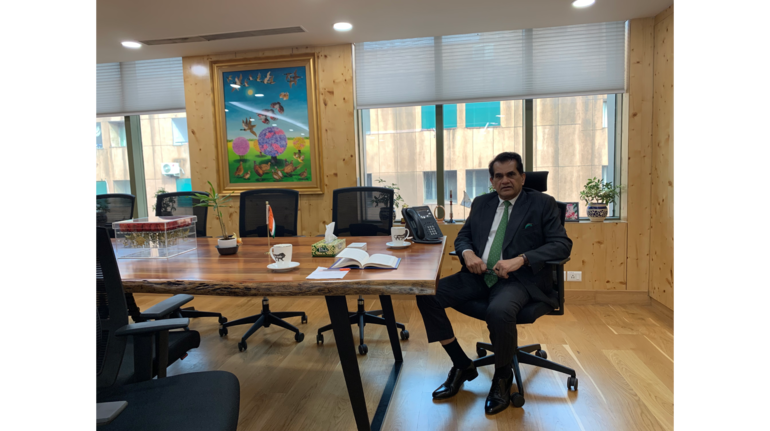
Former NITI Aayog CEO Amitabh Kant has now committed some of these BTS events and memories to paper, in his latest book 'How India Scaled Mt G20'. In an interview to Moneycontrol, Kant explained why he thinks G20 has surpassed the United Nations Security Council and the United Nations Framework Convention on Climate Change, the "300 hours of negotiation" on what the G20 declaration could say about the Russia-Ukraine war and how the Global South can become stronger still. Edited excerpts from an interview his office in Delhi's diplomatic enclave on January 13, 2025:
How do you remember so much of what happened at the 2023 G20 New Delhi Summit, over 15 months ago?
I jot down everything at the end of the day (in a diary format). I jot down points... And then when you are writing, you elucidate on that later... build(ing) a much larger macro story around it.
Some of the conversations you led back then were in rooms that we were closed to the media even. We've heard what was agreed in the declaration. Tell us some of what happened behind the scenes. Was it difficult to work out the language that all G20 members would find agreeable?
It was very, very tough because we had failed in all our ministerials. Right till the end, we had failed. Now the New Delhi Summit, if we had not achieved a consensus, would have been deemed to be a failure despite the fact that we done 225-odd meetings everywhere. And the crux of it all is in a multilateral discussion, in a multilateral forum, is your ability to arrive at a consensus on key issues. Multilateralism works on consensus. If a consensus is not arrived at, even if one country objects to it, that's not a consensus and therefore it's not an agreed declaration.
The challenge is to be able to bring emerging markets, G7, Russia, China all together on all key issues confronting the world and bring a consensus document and say that this is where consensus has been arrived at, and this is what is acceptable to all the 20 countries. That is what India managed to do on strong, sustainable, balanced and inclusive growth. That is what India managed to do on accelerating sustainable development goals (SDGs). That is what India managed to do on technological development and get the world to accept the concept of digital public infrastructure, its definition, its format. That's what India managed to do in terms of pushing for green development pact, and that's what India managed to do in terms of women-led development. All these issues, we brought them centerstage, got everybody to agree and arrive at a consensus and move forward.
What were some of the sticking points, especially since this is a group of 50-plus countries (including the European Union and African Union)?
The key challenges really were about climate action, climate finance. The key issues were really about getting a final acceptance on the geopolitical para, because Russia-Ukraine crisis was at peak. The sharp difference of opinion between Russia, China and between G7 countries. One of the main reasons why we could get acceptance on some of these issues was because India worked with the emerging markets. India had negotiated some of these issues along with Brazil and South Africa, and finally we got Indonesia also. But all emerging markets were with India.
Could you give an example?
When the Russia-Ukraine para was being negotiated word by word, we did the final round of Sherpa meeting - there were (also other) contentious issues left on climate, there were contentious issues left on geopolitics. We did not host the meeting in Delhi. We hosted it about 70 kilometres away from Delhi and we ensured that none of the Sherpas brought in their mobiles. We ensured that no media presence was there, so that we could have discussions. And since there was no consensus and all ministerials had failed, we started de Novo by putting out the basic principles of what a declaration should be on Russia-Ukraine para.
But the subsequent round of negotiations that we did with G7, Brazil and South African Sherpa sat with me for all negotiations that we did. It was a tripartite agreement; it was a tripartite discussion with all G7 countries. And that is why my conviction is that if Global South works together, if you are able to get a coalition of emerging markets, if you are able to get a coalition of Global South, then you are able to drive consensus on a range of issues. Because then you are working as a block of about 12 countries together within the G20.
And once you've got this consensus together from emerging markets and having pushed this through with G7, then it becomes easier to get Russia on board - because nobody wants to get isolated in multilateral declarations. Therefore, it's necessary that we do this exercise. And before we did this, I had very detailed discussions with Brazil, with Indonesia, with South Africa, all of them. So our ability to bring them together and build a coalition of partners from the Global South is very, very critical. And that is one of the key lessons that emerges from our ability to push consensus in G20: that India must act as a coalition partner, as a leader to bring everybody together, and that helped us to achieve consensus.
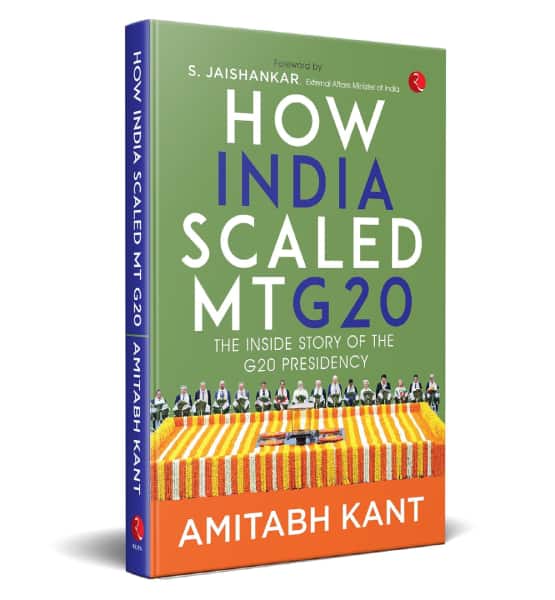 Rupa Publications, 240 pages, Rs 595.
You mentioned climate was a big part of the discussions. Now, soon after that 2023 New Delhi Summit, we had the CoP meeting Dubai. Some of the conversation around climate funding there did not go quite as well as we might have hoped after the G20 summit called for trillions of dollars for climate action.
Climate is a contentious issue simply because since the Kyoto Protocol developed world has been backing out. Then we had COP 21 in Paris where we became part of the solution rather than being constantly objecting. We have since then achieved 200 gigawatts of renewable. But in the last COP, India took a stand, which to my mind was the right stand, because I really think that USD 300 billion is not the appropriate amount because in G20. We had already moved (the conversation) from billions to trillions of dollars (at the G20 Summit). And the requirement is in terms of trillion dollars because the expert group has already said that the developing countries will require $3 trillion - $2 trillions for climate, $1 trillion for SDGs. Now, in real terms, $300 billion is less than $100 billion actually, if you look at the devaluation taking place. My only issue on that is that it should not have been the stand of India; it should have been a stand of all coalition partners - the Global South should have taken that stand together. If the Global South stands together, then you are bound to get a consensus.
Tell us about the induction of the African Union into the G20.
Prime Minister (Narendra Modi) was very clear right from the beginning that we have to make the G20 far more inclusive, far more decisive, far more action-oriented. And one of the key things about making it inclusive was to ensure that the African Union becomes a member of G20. Because when the summit was held in Indonesia, the African Union (representative) had walked up to the Indonesian President and he said that you have failed to make African Union a member of G20. And he then walked up to India, and the Prime Minister told him that we will consider this during India's presidency. Now this was a challenge for us, and I have explained this in the book, because there were other contentions, the ASEAN for instance, and many others. But it was important that we push this through. So the Prime Minister wrote to all the leaders of the G20, and there were very detailed negotiations on this. But by making African Union a member, we made G20 actually into G21 and we made it far more inclusive, far more vibrant, far more dynamic. Now G20 actually represents almost 85 percent of the global population, so it becomes a far more powerful body than the United Nations to my mind now, and it becomes a far more effective body as a multilateral forum than the United Nations. Because the Security Council of the United Nations is totally dysfunctional. To get a consensus in the Security Council, post the Russia-Ukraine war, has become impossible, whereas G20 has demonstrated its ability to take decisions and move forward.
For instance, our ability to bring in consensus in G20 on climate action and climate finance has been much greater than UNFCCC. Our ability to arrive at clear language on sovereignty and political integrity with reference to both the Russia-Ukraine crisis and in the Middle-East has been far greater in G20 than in the United Nations. To my mind, G20 is today a far more important body than the United Nation.
If one may play devil's advocate there, the G20 has more countries that will be at the receiving end of this climate finance. Is there an imbalance here?
That's not true. You have all the G7 countries (in the G20); you have the United States, you have Germany, you have France, you have UK. All the G7 countries are represented here.
How do you explain the massive difference in climate funding requirements suggested by the G20 vs UNFCCC's Conference of Parties (CoP), then?
UNFCCC (the United Nations Framework Convention on Climate Change) is too large a body, it loses focus, the process of discussion is very complex. It has become an annual Jamboree and many of the fossil fuel-producing countries have taken control of it, I think. For instance, the last UNFCC held in Azerbaijan, Azerbaijan President has gone on to say that oil is a creation of God, is a blessing of God. So you have a lot of vested interest now seeping into UNFCCC.
You also write about India's technological potential, especially digital public infrastructure and artificial intelligence, at the time of the Summit. How do you see developments in these space in 2025?
Two remarkable issues that happened: One was that throughout the year, every single event that India did, India promoted and highlighted the digital public infrastructure (DPI). Now the developed part of the world was used to Big Tech. That's how technological evolution is taking place (there). It's got used to Amazon, it's got used to Meta, it's got used to Google, it's got used to Apple, it's got used that because they have driven technological development. In China, it's Tencent and Alibaba. So defining an open-source, open-API, globally interoperable model where there is a public identity layer on top of which you have private sector innovating and competing is very complex. It's very complex, it's very tough. But since we demonstrated that in India, we are able to do fast payments, we are able to put money into the bank accounts of beneficiaries, we are able to do wealth-creation transactions, stock markets, we are able to do insurance. We made a difference to lives of citizens during the COVID period. We said that DPI is the only way that you would be able to achieve sustainable development goals even in health and education. And therefore open-source, open-API models where the data is owned by the citizens is very important, and that is what we pushed for throughout our presidency. It was one year of long, hard work. There was a separate committee chaired by me and Nandan Nilekani which came out with a report that was accepted. We drove this with vigour and energy, and both the definition and the principles of digital public infrastructure were accepted by all the G20 countries. And that, to my mind, was the notable achievement of India's G20 presidency. Later at the UN also, this principle and definition was accepted. That's number one.
Number two, AI was being discussed for the first time in G20, and it was very important that leaders of the world refer to AI, artificial intelligence, for the good of citizens and AI as responsible AI which would benefit the citizens in terms of education, health, nutrition etc. Because the basic assumptions on which it is based, the algorithms on which it is based, AI has the capacity to trigger conflict amongst nations. Therefore, much like the nuclear weapons, you need an international body to regulate it. It can't be done at a national level, it needs to be done at an international level. Though that was discussed for the first time at leaders' level.
And to my mind, India made headway in both DPI and artificial intelligence as a force for social good and for responsibility.
There was so much that came up for discussion during the year-long presidency. Tell us about the conversations around foundational literacy and numeracy. What has happened in these areas since in terms of implementing some of the ideas discussed?
One of the major impacts of the COVID (pandemic) was that sustainable development goals have been impacted, lives of citizens have been impacted, vast numbers of people had gone below the poverty line, huge number of people had lost their jobs. Only 12 of the SDGs were on track. And, therefore, it was a challenge for India to bring sustainable development goals centerstage. And what India did was to prepare an action plan for accelerated implementation of SDGs. And that to my mind was the key contribution of India in the development working group: that we had a specific plan which was accepted and will be taken forward for implementation by the UN.
It is still early days in 2025, but what are what are the discussions like at this point, what are some of the issues you are discussing in the run-up to the 2025 G20 Summit in South Africa?
The Brazil presidency is over. I would say that India's presidency was highlighted throughout the year, for being both ambitious and inclusive, and for the fact that India did its presidency all over India and it had an impact in every state of India, every Union territory of India. And we used as an opportunity to improve many of our cities also. Brazil did it in just three or four places. And now it is South Africa which has done its first meeting in Johannesburg, but we will do a couple of them in Cape Town, etc. These are early days of the South African presidency. But this is the first time that you have Indonesia, Brazil, South Africa and India all hosting, so four countries of the Global South working together one after another. And it is the first time in G 20 that the drafting of declarations - we are used to taking written declarations from the G7 - this is the first time that the Global South is drafting out global agenda, and that by itself, by being decisive and action oriented is a very big thing.
Drawing from your long career, what can you tell us about the language of diplomacy and drafting these agendas and declarations? Could you share an anecdote in terms of how this gets negotiated?
Every word matters. Every letter matters in a multilateral declaration. Every word makes a difference because that then becomes accepted language. And as you would see in the chapter on 'Elephant in the room' on geopolitics, it was very fascinating, but very complex, very tough negotiation. That is why one para (on the Russia-Ukraine crisis) took us 300 hours of negotiation. It took us 250 bilaterals, 16 drafts failed. The 17th one succeeded, late into the night, and yet had several challenges which was sorted out next day in the morning. But every word, every letter has its own complexity and to bring everyone together on that, is a huge, huge challenge and it requires diplomatic skills of a very high order. And I had a very good team which helped me to navigate that.
How do you see the future of multilateralism - you mentioned earlier in this interview that groups are too big like the UNFCCC can become unfocused?
Multilateralism is critical. It's important, it's very important that it becomes inclusive, it becomes more action-oriented, it becomes more decisive. But that would require Security Council to be restructured; It's antiquated. The multilateral forums which were designed in the post-World War 2 era have outlived their utility because at that particular point of time, sustainable development goals and climate was not a challenge. If you want action on climate change, if you want action on sustainable development goals, you need to restructure, redefine the basic forums on which multilateralism is driven. And in multilateralism, it's very important that the countries of the Global South work together; they collaborate, they coordinate, they have a common vision - it is absolutely necessary.
Why does it take so long for some of these agreements to go through, for example, the free trade agreement with the UK?
Because it's tough. It has to be a win-win for everyone. It's not easy. They are difficult, they are complex. And what you are seeing is that there are geopolitical challenges right now. There is a big power conflict back centerstage after 1945. The relative period of stability has come to an end. You have global supply chains being disrupted fully. You have seen United States imposing 100 percent duties on Chinese automobiles. You are seeing Europe imposing 45 percent duties. So the global scenario is complex right now.
Free traders lifted vast segments of population above the poverty line in the last few decades. But in several countries, free trade did not take care of people living below poverty line, did not take care of nutrition, health, education which is very critical. The safety valve got impacted and therefore there is a backlash against full free trade right now taking place in the world.
From the Incredible India campaign to now, how has India's image changed within India and in the world?
Well, India's image has radically changed. There is a lot of positivity. We're seen as a country which has driven technology. We're seen as a country which could provide vaccination to the world. We're seen as a country which is the fifth largest economy in the world, which will go on to become the third largest economy. We are also seen as a country which has worked for climate action. We're also seen as a country which has driven infrastructure in the last decade. We are seen as a country which has been laying a lot of focus on uplifting its women. And I think there is a lot of positivity about India right now.
Finally, why did you write this book?
I had jotted down points. And then I started writing; it was tough, in the midst of meetings, etc., but I kept doing it chapter by chapter by chapter. I had interesting anecdotes which I needed to bring out because behind the scene, there is a lot of inside story to this. And that inside story needed to be told on how different countries negotiated it. And those to my mind, should be put out in public domain: how different Sherpas were, what were their personalities, how they were negotiating, how it came out. So it's a perspective from a Sherpa's first-hand outlook.
Do you have a favourite?
I think the most favorite incident was that after everything had been arrived at, the leaders had come in, the Chinese said that they want to remove a line which had already been agreed to, and that was that the United States will hold the 2026 G20, and the Chinese didn't want it. They said that the Prime Minister would come... (they) wanted to remove it because (they said) the US doesn't issue visas for the Chinese. And at the last minute we had to sit and negotiate for two-and-a-half hours. They wanted a written legal guarantee from the United States. Finally, on our insistence, after 3 hours of negotiations, by 12.30, they agreed to a written letter which said that the United States will ensure that visas are issued. It was a bilateral issue which got negotiated at a multilateral level at the last moment, and that was the final last clinching issue that we sorted out. Even to get that right was very tough, very complex. But the success of our G20 rested on that and that is why I played a key role in that.

Discover the latest Business News, Sensex, and Nifty updates. Obtain Personal Finance insights, tax queries, and expert opinions on Moneycontrol or download the Moneycontrol App to stay updated!
Find the best of Al News in one place, specially curated for you every weekend.
Stay on top of the latest tech trends and biggest startup news.