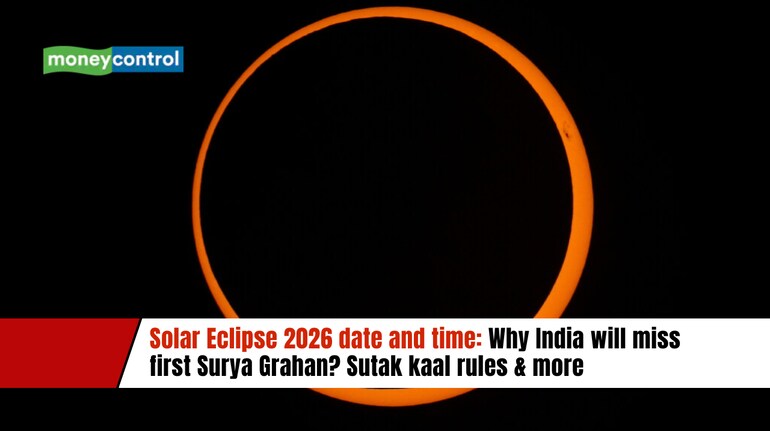

The celestial calendar for 2026 is opening with a spectacular event that has captured the attention of astronomers and skywatchers worldwide. The first Solar Eclipse of 2026 is set to occur this February, creating the rare and mesmerizing "Ring of Fire" phenomenon.
However, for devotees and enthusiasts across India, the excitement comes with a crucial question: Will this Annular Solar Eclipse be visible in our skies and do the traditional religious rules of Sutak Kaal apply?
Here is a comprehensive guide to the Surya Grahan 2026 date, timings, India visibility and its astrological significance:
Solar Eclipse 2026: Date and time
The first Solar Eclipse of the year will take place on Tuesday, February 17, 2026. According to the Hindu calendar, this astronomical event coincides with the Amavasya Tithi (New Moon) of the Krishna Paksha in the holy month of Phalguna.
For those tracking the celestial movement, the eclipse will span several hours. The global timings are as follows:
Will Surya Grahan be visible in India?
While the "Ring of Fire" promises to be a visual treat for many parts of the world, there is disappointing news for skywatchers in India. The Annular Solar Eclipse on February 17, 2026, will not be visible in India.
The path of the eclipse is concentrated largely in the Southern Hemisphere, meaning the shadow of the Moon will not pass over the Indian subcontinent.
Sutak Kaal rules: Do they apply?
In Vedic tradition, Sutak Kaal is an inauspicious period observed before and during an eclipse, during which temples are closed and specific rituals are paused.
However, religious texts state that Sutak rules are only valid when an eclipse is visible to the naked eye in a specific region. Since this Surya Grahan will not be seen in the Indian sky, Sutak Kaal will not be valid in India.
Surya Grahan: Astrological significance
Even though it is not visible in India, the eclipse holds value in Vedic astrology. The event will occur in the Aquarius zodiac sign (Kumbha Rashi) and under the Dhanishtha Nakshatra. These planetary positions are considered significant for astrological calculations, marking a powerful shift in cosmic energy.
Global visibility: Where can you see the "Ring of Fire"?
While India misses out, other parts of the world will witness the Moon covering the center of the Sun, leaving the outer edges visible as a brilliant ring. This Annular Solar Eclipse will be partially visible in:
For enthusiasts in India who wish to witness this celestial event, watching live streams from space agencies like NASA is the best option.
What is an Annular Solar Eclipse?
An Annular Solar Eclipse happens when the Moon is at its farthest point from Earth (apogee) in its orbit. Because of this distance, the Moon appears smaller than the Sun and does not cover it completely. Instead, it creates a "ring" of sunlight around the dark silhouette of the Moon, known as the annulus.
ALSO READ | One week left for the ‘ring of fire’ eclipse: Where annular solar eclipse will be visible around the world
FAQs: Solar Eclipse 2026
1. Will the Solar Eclipse on February 17, 2026, be visible in India?
No, the Annular Solar Eclipse on February 17, 2026, will not be visible in India. It will primarily be seen in Antarctica and parts of the southern hemisphere like South America and Africa.
2. Is Sutak Kaal valid for the February 2026 Surya Grahan?
No, Sutak Kaal is not valid in India for this eclipse. According to Hindu scriptures, Sutak rules apply only when an eclipse is visible to the naked eye in your region.
3. Do pregnant women need to follow any precautions during this eclipse?
Since the eclipse is not visible in India, religious texts suggest that no special precautions are necessary for pregnant women. However, those who wish to be extra cautious can stay indoors during the eclipse timings (3:26 PM to 7:57 PM IST).
4. When is the next Solar Eclipse visible in 2026?
The next solar eclipse will occur on August 12, 2026. It will be a Total Solar Eclipse, visible in parts of Europe and the Arctic, but like the February eclipse, it will not be visible in India.
5. How can I watch the "Ring of Fire" eclipse from India?
You can watch the Annular Solar Eclipse live online. Space agencies like NASA and various astronomy channels on YouTube often host live streams of the event.
ALSO READ | Annual solar eclipse on Feb 17, 2026: Will India witness the stunning ‘ring of fire’ eclipse?
Although India will miss the spectacular "Ring of Fire" this February, the year 2026 holds more celestial wonders. Astronomers and enthusiasts can look forward to the next major event, a Total Solar Eclipse on August 12, 2026. Until then, technology bridges the gap, allowing us to witness these cosmic marvels virtually.

Discover the latest Business News, Sensex, and Nifty updates. Obtain Personal Finance insights, tax queries, and expert opinions on Moneycontrol or download the Moneycontrol App to stay updated!
Find the best of Al News in one place, specially curated for you every weekend.
Stay on top of the latest tech trends and biggest startup news.