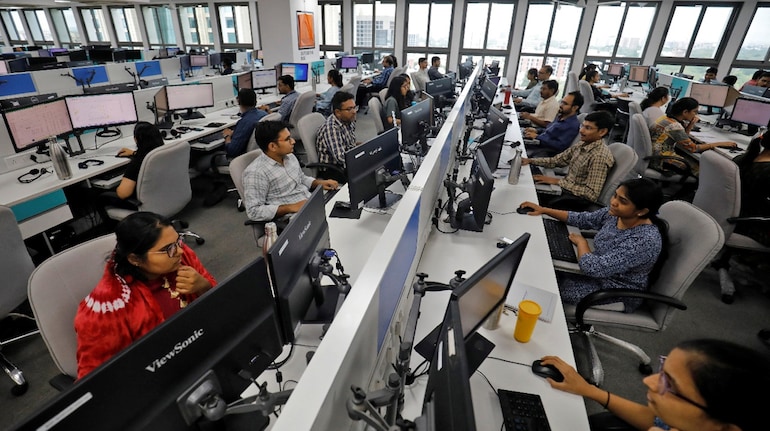

The Nifty IT index crashing for the third time in a week reflects a larger structural shift anticipated in India’s $283-billion technology services industry, as artificial intelligence (AI) is likely to change growth metrics and deal negotiation terms in the near term, analysts said.
Top Indian IT behemoths, such as Tata Consultancy Services, Infosys and HCLTech, were the biggest losers on January 13 morning, down 4.88 percent, 6.28 percent, and 4.66 percent, respectively. This was among the worst weeks for IT stocks since March 2020.
Despite these fears, industry analysts remain bullish on the sector’s long-term business opportunity, citing that short-term weakening will only expose the low-value services that will get replaced by automation, but IT services are here to stay.
According to Phil Fersht, CEO, HFS Research, AI is not eliminating enterprise transformation budgets overnight. The sector is only getting repriced from labour-led growth to productivity-led growth.
Growth metrics like revenue per employee and margin per employee will now increasingly depend on how effectively firms embed AI into delivery. In turn, Indian IT firms that still cling on to the traditional linear headcount growth will struggle.
“This is less about collapse and more about transition,” Fersht told Moneycontrol.
“The underlying anxiety is simple,” said Sanchit Vir Gogia, founder and CEO, Greyhound Research. Enterprises are not going to stop spending on technology. However, they will start demanding productivity gains to show up in pricing.
“And that has started happening before service providers have fully rebuilt their revenue base around AI-native offerings… At the moment, markets are pricing speed. Enterprise transformation rarely moves at that speed,” Gogia told Moneycontrol.
Changing deal terms, AI disrupts traditional IT
The biggest shift expected will perhaps be in the way upcoming client contracts are getting negotiated or deal renewals with existing clients. Analysts said conversations will now increasingly move away from staffing to showcasing measurable productivity thresholds and automation ratios.
“Clients will demand smaller teams, faster cycles, more automation embedded by default, and more outcome-based pricing. Low-complexity, repeatable work will feel the squeeze first,” said Fersht.
“The firms that succeed will be those that turn AI into repeatable, managed outcomes rather than simply layering tools onto existing staffing models,” he added.
Gogia believes this complete transition will happen over a 3-5 year horizon as the IT firms pivot towards managed AI operations, governance engineering, orchestration capability and building trust frameworks that can stabilise under a new economic structure.
The actual fear is of AI’s impact on software development, which is nowhere incremental. It has been exponential. Gaurav Parab, Principal Research Analyst, Nelsonhall, said: “Even the AI tools available today are likely the least capable versions we will see, and they will steadily expand into areas that many still assume are insulated from automation.
What’s causing the on-going sell off?
The IT stocks started declining last week, primarily driven by AI anxiety, following Palantir Technologies’ earnings commentary in the US highlighting how AI-led platforms are compressing timelines for complex enterprise work, and Anthropic unveiling new agentic capabilities through Claude Cowork.
But this week, the trigger was the US jobs data that showed stronger growth. The US job growth unexpectedly increased in January and the unemployment rate fell to 4.3 percent.
These signs of labour market stability could give the Federal Reserve room to keep interest rates unchanged for some time while policymakers monitor inflation.
What are IT companies saying?
Meanwhile, Indian IT companies are adapting to the new reality and have been ramping up their tech stack and building IPs accordingly. Companies are already forming partnerships with AI platform providers, and experimenting with outcome-based engagement models.
For instance, last month, speaking to Moneycontrol, Infosys CEO Salil Parekh said the Bengaluru-based company is seeing opportunities from AI, even as parts of traditional work come under pressure.
“We see some places where there’s compression and some places where there’s growth. And we see the growth a little bit more than what we see on the compression,” he said.
Parekh highlighted that AI is creating new service demand across software development, customer service, and modernisation of legacy applications, driven by increasing adoption of AI agents and broader use of different foundation models.
HCLTech CEO C Vijayakumar said that AI is in fact taking up a chunk of client’s discretionary spending even as they remain cautious due to geopolitical uncertainties.
“You need to be able to leverage new technologies. If you don't do it, your competitors are already getting ahead of you. There is a realisation that we just can't hold on. We just need to leverage new technology and continue to make progress,” he said.
For Tech Mahindra, AI is bringing IT services industry “back in the limelight” as clients have evolved from AI experimentation to now understanding the need for data readiness and clean data for AI.
“You need to make sure that your apps are simplified and modernised. Only then can you get AI and start that virtuous cycle. This means that a lot of the work that the industry is very good at, which is building out modern data stacks, simplifying applications, will come back in the limelight,” Tech Mahindra CEO and MD Mohit Joshi told Moneycontrol on the sidelines of the World Economic Forum in Davos in January.
Experts say the reality lies somewhere in between as Indian IT services companies are not going away.
"They remain deeply embedded in global enterprise systems, enjoy sticky client relationships, strong balance sheets, and industry-leading margins. The sector still commands one of the largest pools of engineering talent globally, and capital availability is not a constraint," according to Harshall Dasani, Business Head at Portfolio Management Service INVasset.



Discover the latest Business News, Sensex, and Nifty updates. Obtain Personal Finance insights, tax queries, and expert opinions on Moneycontrol or download the Moneycontrol App to stay updated!
Find the best of Al News in one place, specially curated for you every weekend.
Stay on top of the latest tech trends and biggest startup news.