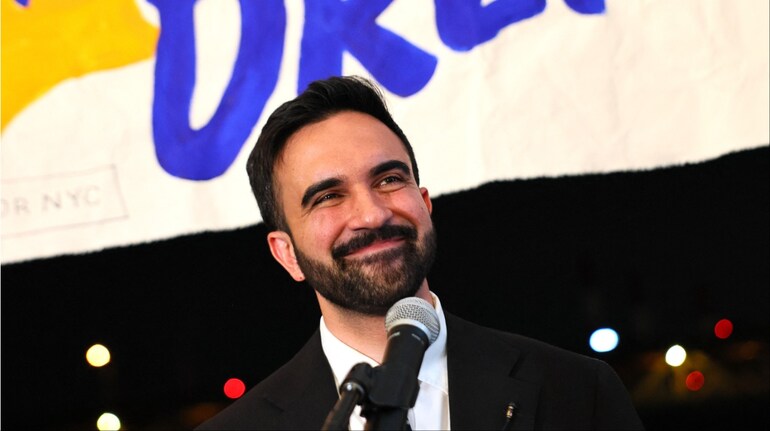
Zohran Mamdani won New York’s top job on two promises: free the subway, freeze the rent. Now comes the hard part.
At 34, the city’s first Muslim and South Asian mayor steps into office facing a housing shortage, a $118 billion budget under strain and an impatient electorate. His campaign slogans sounded simple; the execution won’t be.
Transit at a turning point
Ridership is rebounding: According to a study by Columbia SPS, the Metropolitan Transportation Authority (MTA) reached 1 billion subway riders in 2025, three weeks ahead of last year.
According to Bloomberg, the city’s congestion-pricing toll raised $159 million in Q1 2025, a new revenue stream key to transit funding.
But a free-fare or reduced-fare pledge needs the money to back it. According to the New York government data, the MTA currently covers about $6.9 billion in fare/toll revenue annually.
Mamdani’s palatable 'free transit' pledge can succeed only if the city secures durable revenue (from tolls, state subsidies, or federal grants) and keeps enforcement strong (to curb fare-evasion losses). The margin for error is narrow.
Do Not Miss | Zohran Mamdani's four-word warning for POTUS: 'Trump, I know you’re watching...'
Housing supply meets affordability crisis
Mamdani's campaign page suggests, NYC’s rental vacancy rate is ~1.4 percent, the lowest in decades, a textbook sign of limited supply and upward pressure on rents.
New housing permitting plummeted: some recent years saw permits drop ~ 75 percent vs prior decades, meaning the supply pipeline is weak.
Budget health and tax trade-offs
The City’s FY26 budget is about US $115.1 billion, per official projections on New York City's government website.
Downturn risk looms: City Comptroller reports show that a modest revenue dip could reduce tax intake by $2-3 billion.
Must Read | Why Donald Trump and DOGE feared Zohran Mamdani, and how his New York win shuts their leverage
Federal-city dynamics: funding & oversight
Washington holds the purse strings: grants for transit, housing and social services often come with conditions.
The White House’s Department of Government Efficiency (DOGE) is set up to audit and challenge local governments’ spending, a rising source of tension.
Mamdani’s win places the city under the spotlight. If DOGE inserts audit/conditionality strings into major grants, the Mayor’s office may find itself navigating political fallout and legal scrutiny. The 'free transit, freeze the rent' approach now hinges, in part, on federal cooperation.
The credibility test: expectations vs execution
According to CBS News, polls during the campaign found younger voters driven by affordability and anti-establishment sentiment; two-thirds of voters who preferred a candidate who’d oppose Trump backed Mamdani.
A New York Post report suggested nearly half of voters expressed concerns about crime under his leadership in a pre-election poll—47% feared spiking crime, 45 percent feared rising antisemitism.
Zohran Mamdani’s win is a change of direction for New York. It’s also a test of capacity.
For the city, it means new energy, representation and ambition. For the mayor, it means real time constraints—funding, supply, federal alignment, public trust.
(This story draws on reporting from The Guardian, NBC New York, Columbia SPS, CBS News and official NYC budget documents.)

Discover the latest Business News, Sensex, and Nifty updates. Obtain Personal Finance insights, tax queries, and expert opinions on Moneycontrol or download the Moneycontrol App to stay updated!
Find the best of Al News in one place, specially curated for you every weekend.
Stay on top of the latest tech trends and biggest startup news.