






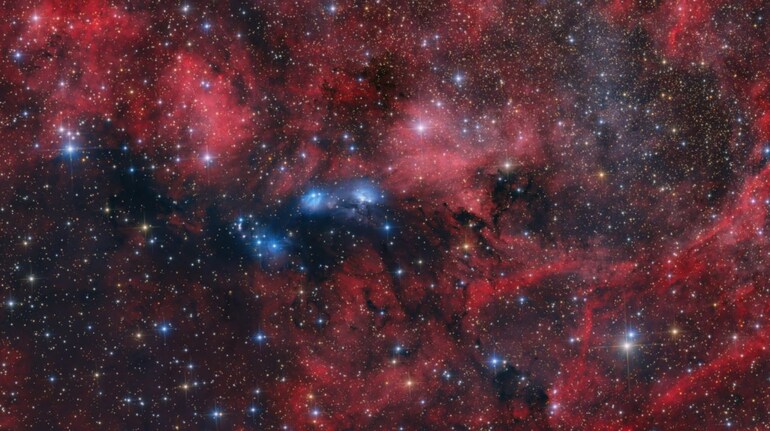
The night sky often appears calm, yet telescopes reveal dazzling scenes of colour and light. One such perception is around NGC 6914, a shining nebula in the constellation Cygnus.
What Makes NGC 6914 Special?
The nebula lies nearly 6,000 light years from Earth. It sits along the Milky Way’s crowded plane where gas, stars and dust collide. In this region, dark interstellar clouds cut sharp shapes across the sky, while hydrogen glows red and nearby reflection nebulae shimmer blue. The wide view stretches over one degree, equal to around 100 light years across.
How Do the Colours Form in Space?
The vivid hues are created by the hot, young stars of the Cygnus OB2 association. Their ultraviolet radiation ionises hydrogen atoms, which then emit a red glow as protons and electrons recombine. The area contains dust that scatters blue light from these stars, creating a dramatic colour contrast that fills the space canvas.
Why Do Astronomers Observe This Area?
Scientists say NGC 6914 offers a natural laboratory for understanding stellar birth. The young stars not only light the clouds but also shape them, altering how new stars form nearby. Observing the balance of radiation, gas and dust helps astronomers learn how galaxies like ours build their stars over billions of years.
Discover the latest Business News, Sensex, and Nifty updates. Obtain Personal Finance insights, tax queries, and expert opinions on Moneycontrol or download the Moneycontrol App to stay updated!
Find the best of Al News in one place, specially curated for you every weekend.
Stay on top of the latest tech trends and biggest startup news.








