






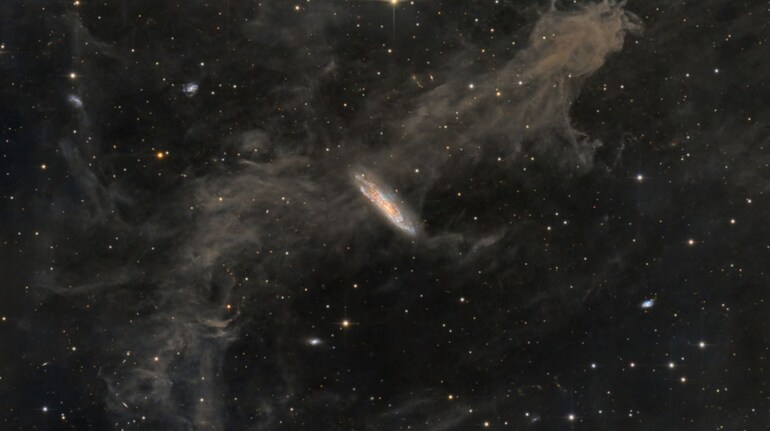
A new telescopic image offers a mesmerising sight of the universe. The field of view is larger than the full Moon. It focuses on the constellation Pegasus high in the night sky.
What does the image reveal in our galaxy?
The brighter stars in the image display diffraction spikes. This is a result of the support structures in reflecting telescopes. These stars are part of our own Milky Way. Wisps of interstellar dust also appear in the frame. They sit above the galactic plane and faintly scatter starlight. Astronomers call these clouds galactic cirrus or integrated flux nebulae. They are closely linked with the Milky Way’s molecular clouds.
How far are these dust clouds located?
The diffuse cloud catalogued as MBM 54 dominates the scene. It is situated less than a thousand light-years from Earth. The dusty cloud appears faint but spreads widely across the frame. It highlights the subtle yet striking presence of cosmic material.
Which galaxy is seen behind the dust?
Amid the dusty veil lies the spiral galaxy NGC 7497. It appears near the centre of the image, viewed almost edge-on. The galaxy is located some 60 million light-years away. Its spiral arms and dark lanes echo the Milky Way’s colours. Dust within the galaxy resembles the dust clouds around our own.
The image captures both the nearby and the distant together. It links faint dust in our galaxy with a spiral far away.
Discover the latest Business News, Sensex, and Nifty updates. Obtain Personal Finance insights, tax queries, and expert opinions on Moneycontrol or download the Moneycontrol App to stay updated!





Find the best of Al News in one place, specially curated for you every weekend.
Stay on top of the latest tech trends and biggest startup news.



