





The phrase, “Gold standard” was not born overnight and harks back to gold’s high yardstick over centuries. The idiom refers to “a thing of superior quality which serves as a point of reference against which other things of its type may be compared”. From Egyptians in ancient civilisation to today’s central bankers consider gold as a special source of investment and value.
What makes gold a special asset class is that it is viewed as both a source of investment and an adornment. It also has practical applications especially in the manufacture of electronics where gold, as an efficient conductor of electricity, can carry tiny currents to keep vital equipment and entire industries going. Similarly, gold finds place in science, space and ayurveda. Such a “recurring demand”, consistent in nature, makes gold an invaluable asset with utility.
Gold’s dual nature makes it an all-weather asset classIn addition to the precious metal being an important investment vehicle and an asset for central banks alongside institutional and retail investors, it has a third wing: consumer demand. According to some estimates, the use of gold in technology and jewellery accounts for 42% of annual gold .
Moreover, gold is used as an industrial metal in various applications. According to the World Gold Council, “the demand is driven by the electronics sector” which accounts for four-fifths of all gold used in technology. This makes gold a proxy for consumer spending. Its popularity is thus directly proportional to the phase in the economic cycle.
At the same time, however, when it comes to investments, people turn to gold during economic uncertainties too. It has historically been used as a hedge against inflation. Hence, in that sense, from the investment standpoint, it is “countercyclical”.
This dual nature of gold makes it a hot asset class during times of economic downturns, recovery and boom. Few investment instruments can match the consistency of gold across eras and economic cycles.
Investors have traditionally considered gold as a potential source for diversifying their investment portfolio irrespective of the economic climate. There is empirical evidence too. According to research conducted by the World Gold Council, adding a 2-10% allocation to gold within a well-diversified portfolio can significantly enhance long-term returns.
Inflation across the world is on the rise. On September 30th Reserve Bank of India's monetary policy committee raised interest rates yet again to reign in rising prices. Many central banks from across the world have estimated inflation to remain high for longer periods than was initially predicted.
According to the World Gold Council's report, "gold has performed well into CB hiking cycles and has been an effective inflation hedge. Coupled with healthy jewellery and CB demand, and the potential for market volatility in a vastly changing world, the strategic rationale for gold in a portfolio — particularly as a portfolio hedge — remains compelling."
Moreover, gold is negatively correlated with other asset classes like equity. In any well-diversified portfolio it is imperative that asset classes show low correlation to each other. In other words, a fall in the equity market would buoy the overall prices of gold. One can’t say the same about its distant cousin, silver, which has exhibited a positive correlation to stock markets over the last ten years, thereby casting yet another vote in gold’s favour.
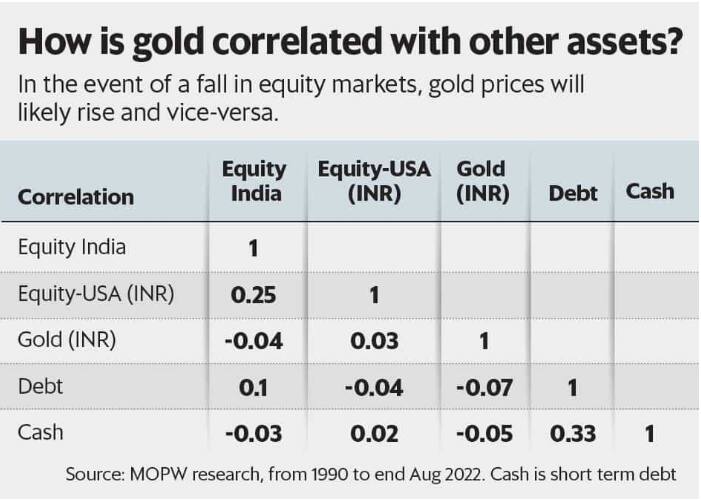
Source: Mint newspaper (link)
The percentage allocation comes down to the investor’s choice, savings goals and the time horizon. What separates gold from other asset classes is that generally, it is considered to be part of any well-balanced portfolio that would meet a rather wide array of investment objectives across all economic conditions. If you haven’t done so already, take a hard look at your portfolio and consider adding gold to it.
Moneycontrol journalists were not involved in the creation of the articleDiscover the latest Business News, Sensex, and Nifty updates. Obtain Personal Finance insights, tax queries, and expert opinions on Moneycontrol or download the Moneycontrol App to stay updated!



