

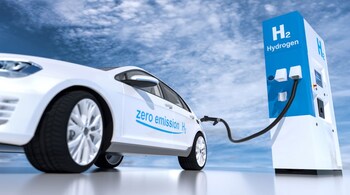
The efficacy of hydrogen as renewable energy has once again come under the spotlight with Reliance Industries (RIL) announcing an investment of Rs 75,000 crore to create a New Energy Ecosystem. The plan includes building four gigafactories, two of which are dedicated to renewable, green hydrogen.
Hydrogen fuel cell technology is far from a novelty in the global EV ecosystem. Essentially, a fuel cell uses on-board hydrogen in a vehicle to create electricity on the fly, which powers the vehicle. While hydrogen fuel cell technology is currently transforming Europe’s heavy-duty trucking industry, it hasn’t been touted as an obvious and immediate alternative to fossil fuel, even though its benefits, in the longer run, far outweigh those of battery electric vehicles.
In the Indian context, both lithium-ion battery power and hydrogen power are receiving a huge push from the government. The recently announced FAME Phase II EV subsidies combined with Gujarat’s renewed policy for EVs have been done primarily to increase customer interest in electric vehicles.
Battery electrics (BEVs) currently occupy both ends of the private transport sector from low-cost, low-speed two-wheelers (primarily powered by lead-acid batteries), lithium-ion battery-powered scooters and high-end luxury cars like the Mercedes-Benz EQC and the new Audi e-Tron. There are, however, no hydrogen fuel cell (FCEVs) vehicles on sale in the country at present.
The Indian government is eager to use green hydrogen in a bid to boost the country’s green energy credentials, as evidenced by the Prime Minister announcing plans to launch a National Hydrogen Energy Mission last November.
Why is India big on renewable hydrogen energy?
Green hydrogen has largely been considered as the future of energy, even by major automotive giants like Toyota and Volkswagen. Having had a slow start on the lithium-ion battery EV front, India wants to be one of the first movers in the green hydrogen space, given that most countries have laid out some sort of renewable hydrogen power layout.
Also Read: Explained | Reliance is betting big on green hydrogen. What is it and why is it important?
Reliance’s move has a multi-industry approach behind it, with far-reaching consequences since the benefits of hydrogen energy go beyond the realm of transportation.
Industrial usage and exporting hydrogen
To begin with, a surplus of green energy could make India one of the biggest exporters of green hydrogen by the end of the decade. Not only does hydrogen already have an existing market, its usage in the commercial transport sector, particularly in Europe, is also likely to cause a sharp rise in demand in the near future.
Large-scale investments from big corporations will provide the base for large scale manufacturing. With green hydrogen production ramped up, India could look at revolutionising its own diesel-emission-heavy trucking industry soon. Reliance Industries, along with Chart Industries is leading a coalition of energy and industrial firms named “India H2 Alliance”, with the intention of having fertiliser, iron steel and petrochemical industries shift to using green hydrogen – essentially, decarbonise the industrial process in order to meet the country’s carbon neutrality targets. India’s energy sector remains heavily dependent on imports, particularly crude oil and natural gas.
Not only would a green hydrogen surplus reduce our reliance on fossil fuel imports, making India a manufacturing hub for green steel and green chemicals, along with electrolysed production it would also create several new jobs in the country. In the most optimistic of scenarios, India could help, through the export of green hydrogen, neighbouring countries reach their net-zero targets.
Is the Indian automobile industry ready for hydrogen?
The Council of Scientific and Industrial Research field-tested a homegrown hydrogen fuel-cell car last year. Tata Motors even went as far as developing a hydrogen fuel cell bus developed in partnership with ISRO, back in 2018. Neither of these efforts bore any fruit primarily because fuel-cell technology isn’t cheap to produce, and neither is green hydrogen.
For the moment, it’s safe to say that the private transport sector in India, will not be seeking green hydrogen power. Hyundai announced back in April that it was no longer keen on bringing a hydrogen car to India. One of the main reasons that hydrogen energy is being harnessed for the heavy-duty trucking sector and not the passenger vehicle sector is because there, the benefits outweigh the drawbacks.
For passenger vehicles, it’s a different story. For starters, there isn’t anything close to hydrogen fuel-cell infrastructure in the country. Battery electric vehicles are more efficient as there’s less power loss in a lithium-ion battery.
Secondly, fuel cells are sophisticated and intricately built devices susceptible to damage under extreme temperatures. And thirdly, having an on-board hydrogen tank does present a hazard, in the same way having a CNG tank does. Furthermore, hydrogen is pressurised and stored in a cryogenic tank, which adds to the risk. Of course, with enough R&D, these issues can be ironed out, but for the moment, battery electric vehicles have a considerable advantage over hydrogen fuel cell cars.
Not only are they more readily available, and comparatively cheaper compared to hydrogen, they are much further along in terms of a supporting ecosystem than hydrogen cars. They are also more durable and energy-efficient with next to no idle power loss from charger to charger.
The Forecast
Despite its immediate shortcoming, two of the largest carmakers in the world – Toyota and Volkswagen – are convinced that hydrogen is indeed the fuel of the future. Hydrogen provides a longer range on a single tank, fast refuelling time and its emission-free manufacturing process give it greater longevity as an energy source than battery EVs.
Lithium-ion vehicles not only leave greater, non-recyclable waste (although several components of a lithium-ion battery can be recycled) they use electricity, which in India is largely derived through coal.
Even Hyundai is leading the charge on the hydrogen fuel cell front, with a subsidiary dedicated exclusively to fuel cell technology-based vehicles. What’s certain is the fact that all major automotive brands are working on improving battery EV tech while simultaneously developing hydrogen-powered FCEV technology.
And while a hydrogen fuel cell infrastructure is patchwork, pretty much worldwide, easy access to a surplus of green hydrogen, with the joint effort of industry and government could bring down the cost of FCEVs to the point that they could be considered a feasible alternative to BEVs. If India intends to meet its net-zero target and become a major hub of green hydrogen, the choice would be made by the customer.
Disclosure: Moneycontrol is a part of the Network18 group. Network18 is controlled by Independent Media Trust, of which Reliance Industries is the sole beneficiary.
Discover the latest Business News, Sensex, and Nifty updates. Obtain Personal Finance insights, tax queries, and expert opinions on Moneycontrol or download the Moneycontrol App to stay updated!





