
Just in: Bhavish Aggarwal's Krutrim to deploy DeepSeek AI models on its cloud servers
One quick thing: Insider trading in Infosys leads to ban on two, Rs 2.6 crore of illegal gains impounded
Ahead of tomorrow's highly anticipated Union Budget, Finance Minister Nirmala Sitharaman presented the annual Economic Survey in Parliament today.
Why it matters: The annual report provides a comprehensive analysis of the state of India’s economy through various indicators.
- It also charts a course for the future, pinpointing potential challenges that could impact the economy's trajectory
Here’s a quick rundown on all the key tech and startup highlights from Economic Survey 2025.
 Key Takeaways
Economic Survey 2025 flags risks of the AI era
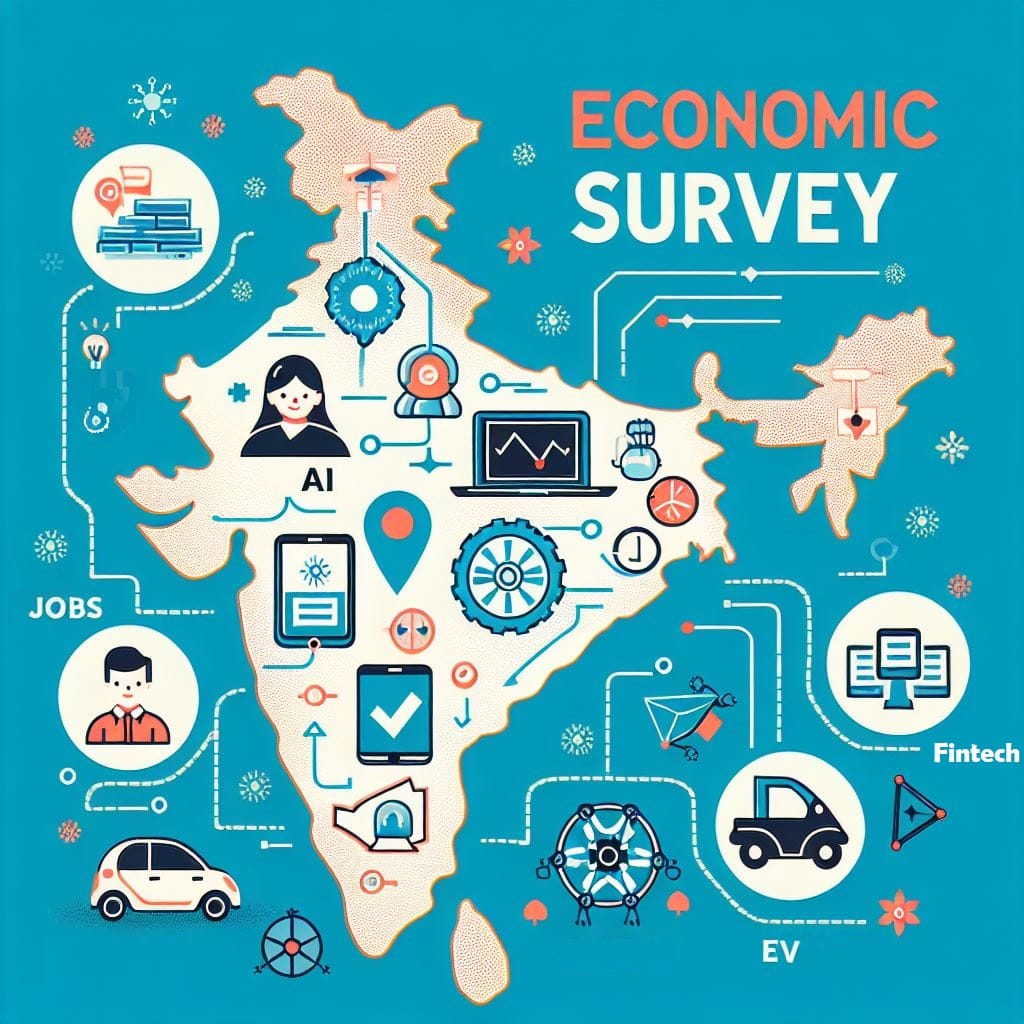
Is your job safe?
The government has recognised the potential for massive job displacement due to AI, raising concerns about the future of work for millions.
Driving the news
When Finance Minister Nirmala Sitharaman tabled the Economic Survey today, she focused heavily on AI and its potential to trigger widespread labour displacement.
- The survey shows that AI is expected to surpass human performance in critical decision-making across various fields such as healthcare and research
Moreover, the Indian IT workforce employed in low-value-added services is the most susceptible to automation.
Any safety net?
However, the survey highlights that India can prioritise education and skill development to equip its workforce in a world of rapid AI adoption.
- The government's skill council, in partnership with MeitY, has launched a platform to reskill and upskill IT professionals in 10 new and emerging technologies, including AI.
This programme will upskill/reskill over 13 lakh professionals by March 2027.
Banking and AI
The survey also highlights that Indian banks, while aggressively integrating AI, have their share of concerns regarding transparency, accountability, and cyber threats.
- The "black box" nature of AI systems can make it difficult to assess their reliability or contest their decisions, the survey noted
Taking a round-up view of all the challenges posed by AI, the government has advocated the corporate sector display a high degree of social responsibility for the nascent tech.
Other highlights from the Economic Survey

- The Economic Survey highlights how the Unified Payment Interface (UPI) has demonstrated that a well-designed platform can overcome the barrier of financial literacy to achieve success. "UPI can serve as a cost-effective solution for financial inclusion on a large scale. The widespread adoption of UPI proves that a lack of financial literacy did not hinder its success; rather, the necessity to utilise UPI encouraged the informal economy to open bank accounts," the Economic Survey noted.
- Private equity (PE) and venture capital (VC) firms collectively clocked $19.5 billion in exits from the stock market during the first nine months of 2024, an increase of 6.6% year-on-year, the economic survey released on January 31 revealed. During the same period last year, PE/VCs had made $18.3 billion in exits by selling shares to public market investors, as per analysis done by Avendus Spark, the survey added.
- The Economic Survey for 2024-25 raises concerns about India’s reliance on imports for electric vehicle (EV) production as the government pushes for greater adoption of green mobility. It warns that the high import dependency, particularly from countries with which India has substantial trade deficits, could pose risks. The Survey also stressed on the urgent need for indigenising EV technology and raw materials.
- India is seeing a significant growth and expansion of data centre infrastructure amid rising demand for digital services. The data centre market is poised to more than double from its current size, the Economic Survey said. The data centre market is expected to grow from $4.5 billion in 2023 to $11.6 billion by 2032 at a CAGR of 10.98%.
- Working hour restrictions were introduced to protect workers' health and prevent overwork, however, various limits on working hours — daily, weekly, quarterly, and yearly — often conflict, reducing workers' earning potential, the Economic Survey said. This follows a debate sparked by L&T Chairman SN Subrahmanyan's suggestion that employees should work on Sundays, and Infosys co-founder Narayana Murthy's proposal last year for millennials to work 70-hour weeks to boost productivity.
- India is emerging as a key global technology talent hub, with the rise of AI, machine learning, and cloud services taking global prominence, according to the Economic Survey 2024-25. The survey forecasts that the number of global roles from India, mainly through Global Capability Centres (GCCs) of multinational corporations, will grow from 6,500 to over 30,000 by 2030.
- The government-backed Open Network for Digital Commerce (ONDC) has registered more than 7000 Farmer Producer Organisations (FPOs) on the e-commerce platform, the Economic Survey said. "ONDC recorded more than 14 million transactions in the month of November 2024 across 1100+ cities. 7 lakh+ sellers and service providers are active on the ONDC network spread across 600+ cities and towns across India," it said.
- Sixty companies have registered as fintechs in Gujarat International Finance Tec-City in Gujarat, according to Economic Survey 24-25. The companies were selected by the International Financial Services Centres Authority (IFSCA) after conducting 13 hackathons and receiving 152 applications from 14 jurisdictions under its FinTech Entity framework. “This reflects the region’s dynamic fintech landscape while showcasing IFSCA’s commitment to innovation,” Economic Survey said.
- The Startup India Seed Fund Scheme (SISFS) has approved Rs 227.12 crore in funding for as many as 1,278 women-led startups since inception in April 2021, according to the survey. Women have been key beneficiaries of various government initiatives designed to foster entrepreneurship in India, it said.
- The Economic Survey 2025 says technology-specific skills run the risk of becoming obsolete very soon, especially in today’s world where the requirements shift rapidly. The survey said as developments in the field of AI create tools capable of automating basic knowledge creation and processing, skills such as critical thinking, higher degrees of creativity and the capacity for more specialised knowledge may well be the new normal.
Check out our live blog for more on the Economic Survey 2025.



 PREVIOUS


