-
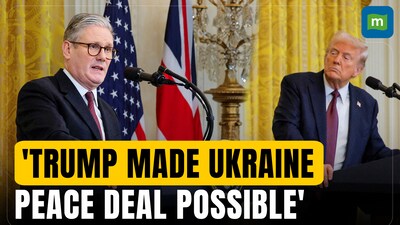
Trump, Starmer discuss 'tough and fair' Ukraine peace deal during meeting at White House | N18G
President Donald Trump met with British Prime Minister Keir Starmer at the White House, where Trump emphasized that a minerals deal with Ukraine would serve as the security guarantee Kyiv needs against Russia, downplaying Starmer's plea for increased U.S. military support. Starmer praised Trump's role in making peace in Ukraine possible, while Trump expressed optimism about the progress of his efforts to broker a cessation of violence between Russia and Ukraine. Starmer described the proposed peace deal as “tough and fair” and committed to sending British military forces to support it, including ground troops and aircraft. This meeting came after French President Emmanuel Macron's visit earlier in the week, which showcased contrasting views on the Ukraine conflict, particularly regarding the U.S. push for a quick ceasefire. Starmer is the latest European leader to engage with Trump on the matter of Ukraine's security and peace negotiations.
-

Europe's far-right leaders applaud Trump, downplay threat of possible US tariffs
Salvini and Vox president Santiago Abascal downplayed Trump's threat to hike tariffs on European imports, saying that the European Union's taxes and regulations are a bigger danger to Europe's prosperity
-
Ukraine pleads for more weapons as European leaders expected in Kyiv
Moscow has focused most of its firepower on the eastern city of Sievierodonetsk while also trying to consolidate control over southern territory encompassing the strategic city of Kherson, north of the Black Sea.
-
Divided European leaders struggle with post-Brexit vision
Meeting in the Slovak capital with the British conspicuously absent, the 27 other EU members unveiled a six-month "road map" of measures designed to restore public confidence in Europe's ailing common project.
-
Draghi tells EU leaders he can't fix the economy on his own
European leaders will discuss further integration of the economies and policy-making of the 19 countries sharing the euro at a summit in June.
-
David Cameron seals 'Brexit' deal after marathon EU summit
The European Union's two top figures, Donald Tusk and Jean-Claude Juncker, presented its 28 leaders with draft proposals at a long-delayed dinner after hours of painstaking face-to-face talks on an issue that threatened Britain's place in the union.
-
Greek PM easily wins confidence vote, EU showdown looms
In a rousing speech to parliament, Tsipras hailed the decisive role "little Greece" was playing in reshaping Europe and promised Athens would not cave in to demands it extend its international bailout "no matter how much" German Finance Minister Wolfang Schaeuble asked for it.
-
This is like the 'Cold War': Europe fumes over US spying
Claims by European leaders on US National Security Agency (NSA) bugging the European Union (EU) offices and hacking into their computer network could derail talks as the controversy over US spying got bigger.
-
Crisis-hit EU states get wiggle room on deficits
European leaders meeting in Brussels on Thursday hinted that some countries could be given more time to meet their deficit goals as they address high unemployment and seek to ease the pain of tough austerity measures.
-
Merkel wants ambitious overhaul of euro zone in 2-3 years
German Chancellor Angela Merkel called on fellow European leaders on Wednesday to agree an ambitious, concrete plan for closer fiscal and economic integration next month that can then be put in place over the next two to three years.
-
Oil price rebound may not signal trend reversal: Survey
Oil prices will likely reverse last Friday's fourth-largest daily gain on record wiith traders saying the surge is unlikely to signal a major shift in the negative trend, according to CNBC's weekly survey of oil market sentiment.
-
Financial 'armageddon' will happen despite EU deal: Rogers
Even as markets cheered the agreement by European leaders to allow the direct use of the bloc's bailout funds to recapitalize struggling banks, well-known investor Jim Rogers told CNBC the move does nothing to help solve the region`s biggest problem, which is its high debt levels.
-
Rupee stronger for 3rd straight session
The rupee opened stronger for the third straight session on Monday, buoyed by the surge in regional stocks after European leaders agreed to shore up the region's troubled banks.
-
Rise in crude on EU promise doesn't change picture: O'Neill
Bill O'Neill, founder, Logic Advisers offers his perspectives on CNBC-TV18 as oil surged on Friday in heavy trading to the fourth biggest daily gain on record, on a deal by European leaders to shore up euro zone banks triggered frantic short-covering by funds that had been riding crude's price-collapse over the last quarter.
-
Wall Street ends weak quarter with a bang; Nasdaq gains 3%
Stocks surged on Friday to close out a sour quarter on a high note as investors cheered an agreement by European leaders to stabilize the region's banks, a pact that helped remove some of the uncertainty that has plagued markets.
-
Gold rises on EU pledge; eyes worst quarter in 8 yrs
Gold rose more than 1% on Friday, tracking a surge in the euro after European leaders moved to bring down soaring borrowing costs in Italy and Spain, helping ease fears over the region's debt crisis.
-
Euro zone agrees on bank supervision, bond support
European leaders agreed on Friday to create a single supervisory body for euro zone banks and to allow them to be recapitalized directly by the currency area's rescue fund without adding to government debt.
-
World stocks, euro fall on growth, summit worries
World stocks fell and the euro hit a three-week low on Thursday, as divisions among European leaders further diminished hopes of urgent measures to tackle the region's debt crisis when they meet later in Brussels.
-
Brent slips below $93, EU doubts counter N.Sea supply cut
Brent crude fell below USD 93 per barrel on Wednesday as heightened concerns that European leaders would fail to solve the region's intractable debt crisis at a key meet this week offset tighter North Sea oil supply.
-
RBI may give dollars to OMCs if Re falls more: Barclays Cap
Olivier Desbarres, Director and Head of FX Strategy, Asia-Pacific ex Japan of Barclays Capital says the weakness seen in the rupee is largely due to global risk aversion. From current levels, he sees the dollar appreciating further.
-
Spain considers tax hikes to curb deficit, please EU
Spain is considering raising consumer, energy and property taxes, the government said on Tuesday, as it struggles to reduce a public deficit that may have already exceeded one of its budgeted ceilings for the full year.
-
Global stocks flat, euro dips on EU summit doubts
Global stocks were little changed on Tuesday, while the euro fell to a two-week low against the US dollar on investors' doubts that European leaders would make meaningful progress on the debt crisis at a summit this week.
-
US wants 'flesh on the bone' from Europe on crisis
The United States on Monday urged European leaders to put "more flesh on the bone" for their ideas to tackle the euro zo ne's de bt crisis as they prepare for a crucial EU summit this week.
-
Treasurys only option as Greece roils markets: Gross
Investors have little choice now but to cling to low-yielding US government debt as European leaders ponder a messy Greek exit from the euro zone, Pimco's Bill Gross told CNBC.
-
Spain downgrade proof austerity not working
Ratings agency Standard and Poor's downgrade of Spain's credit rating Thursday for the second time this year highlights the fact that austerity alone is not enough to tackle the eurozone debt problem.