-
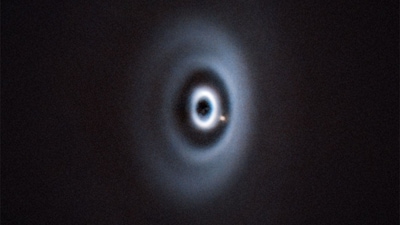
NASA's space photo of the day: A young planet captured carving birth disk during formation
A young planet has been spotted outside our Solar System, captured by the Very Large Telescope in Chile. The rare image shows a newborn world shaping its host star’s protoplanetary disk.
-

Moon Phase on July 10, 2025: How tonight’s Moon will look — Also known as the Buck Moon
A full cycle of the Moon, or a synodic month, lasts about 29.53 days. There are eight phases of the moon that consist of one full cycle, starting at the new moon and finishing at the waning crescent.
-
Scientists discover a mysterious, fastest-growing object, trillion times brighter than the sun; find out more here
Detected with the European Southern Observatory's Very Large Telescope (VLT), this discovery has amazed scientists with its intense light and rapid expansion.
-
'7 suns' appear in China’s sky? Watch the viral video of this bizarre phenomenon
Chinese stargazers were amazed by a viral video showing seven suns in the sky, captured from a Chengdu hospital window.
-
Astronomers uncover 10 new dead star 'Monsters' in Milky Way; why scientists call it an exciting discovery
Astronomers have uncovered ten mysterious neutron stars near the Milky Way's core, all spinning rapidly and classified as "pulsars."
-
Indian astronomers discover 34 giant alien radio sources
A team of Indian radio astronomers has identified 34 new giant radio sources (GRSs) using the Giant Metrewave Radio Telescope (GMRT) operated by the Tata Institute of Fundamental Research (TIFR).
-
IIT-Kanpur professor among astronomers to discover 'Super Jupiter' outside our solar system
Dr Prashant Pathak is among the team of astronomers have to discovered Epsilon Indi Ab, also called 'Super Jupiter' as its mass is more than six times that of Jupiter, the largest planet of our solar system
-
Can astronomers' simulations help in detecting dark matter? Know here about the dark matter mystery
Scientists use computer simulations which is built to help in the detection of dark matter and to broaden their understanding of it. Computer simulation has generated a 'Synthetic Universe' that will help in predicting the future universe which will be unveiled to the next generation of super-telescopes.
-
James Webb Telescope reveals planet WASP-107b's astonishing atmosphere: Sand clouds and sulphur
Webb's findings offer a rare glimpse into the intricate dynamics of exoplanet WASP-107b's atmosphere. The exoplanet completes a full orbit around its star in 5.7 days
-
Astronomers find a black hole in our cosmic backyard
Black holes are objects so dense that, according to Einstein’s theory of general relativity, not even light can escape them.
-
Partial solar eclipse seen in parts of India
The first contact, where in the moon begins to cover the solar disc, happened at 4:29 pm in Delhi, where the moon was expected to cover 43 per cent of the solar disc.
-
CSIRO scientists detect source of mysterious signals coming from galaxies just like ours
The location of four new fast radio bursts -- FRB 180924, FRB 181112, FRB 190102, and FRB 190608 -- have been traced back to galaxies that are still forming new stars at a moderate rate, just like our Milky Way galaxy.
Dr Bhandari’s research published in The Astrophysical Jour
-
Astronomers say Earth has a new mini-moon but it may not stay with us for long
The new Moon is extremely tiny, estimated to have a diameter panning a maximum of six meters, and is essentially an asteroid that might be breaking away from the Earth's orbit really soon
-
Mystery behind Einstein's theory may soon be over
Astronomers are testing an idea developed by Albert Einstein about a century ago to resolve a longstanding puzzle over what is driving the accelerated expansion of the universe.
-
Milkyway supernova to be visible from Earth within 50 yrs?
The study suggests that astronomers have a solid chance of doing something that's never been done before: detect a supernova fast enough to witness what happens at the very beginning of a star's demise.
-
Sun's 8.2-bn-year-old twin found
Located 250 light-years away, the star HIP 102152 is more like the Sun than any other solar twin - except that it is nearly four billion years older. This older twin may be host to rocky planets and gives us an unprecedented chance to see how the Sun will look when it ages, researchers said.
-
Mini planet found far beyond Earth's solar system
Astronomers have found a mini planet beyond our solar system that is the smallest of more than 800 extra-solar planets discovered, scientists said on Wednesday.
-
Astronomers discover largest known structure in universe
Astronomers have discovered the largest known structure in the universe - a group of quasars so large it would take four billion years to cross it while traveling at speed of light.
-
NASA eyes one of the flattest galaxies in universe
Astronomers have captured one of the flattest galaxies known in the universe, sitting like a silver needle in the haystack of space. The NASA/ESA Hubble Space Telescope produced a beautiful image of the spiral galaxy IC 2233, one of the flattest galaxies known, the US space agency said.
-
Hubble spies 7 galaxies from baby years of Universe
Astronomers using the Hubble Space Telescope have found seven galaxies that formed relatively shortly after the Universe's birth some 13.7 billion years ago, scientists said on Wednesday, describing them "as baby pictures of the universe."
-
Big asteroid flying by, no threat to Earth
A large asteroid that flies in nearly the same orbit as Earth will make a close pass by the planet, but there's no chance of an impact - at least for hundreds of years, astronomers said on Wednesday.
-
X-ray vision can reveal birth of supernovae?
Astronomers have uncovered new evidence that suggests that space-borne X-ray detectors could be the first to spot new supernovae signalling ...
-
First map produced of universe 11 billion years ago
An international team of astronomers has produced the first map of the universe as it was 11 billion years ago, filling a gap between the Big Bang and the rapid expansion that followed.
-
New planet discovered in habitable zone
An Anglo-German team of astronomers has discovered a new planet orbiting a nearby sun at just the right distance for an Earth-like climate that could support life
-
Oldest supernovae yet which exploded 12.5bn years ago found
Astronomers have discovered two 'super-luminous' massive stars which exploded 12.5 billion years ago, believed to be the oldest supernovae ever detected.