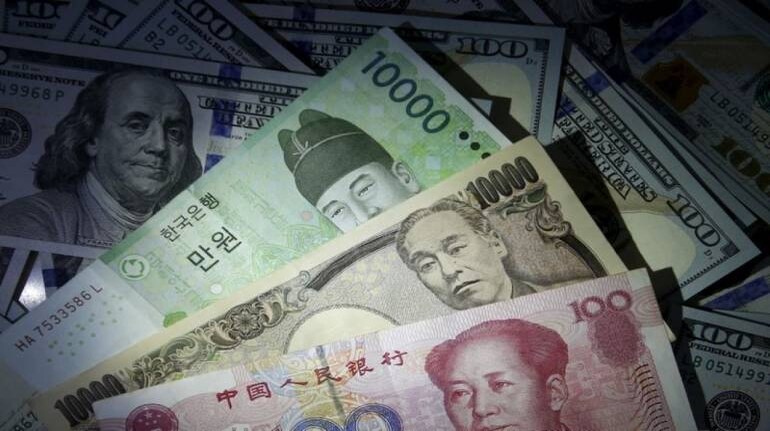
Where have Asia's rebels gone? It’s striking how conventional the region's response has been to the spike in inflation, and worrisome slides in currencies. Unlike a generation ago, today’s challenges haven’t forced a retreat from the orthodox. The radical centre is holding.
Whenever Asia is under financial duress, it’s tempting to reach for comparisons with the collapse of the late 1990s. Circumstances are far from great: Thailand Post Co. in July raised letter delivery prices for the first time in almost two decades, high energy costs spurred protests in Indonesia, and South Korea’s currency reserves shrank sharply last month. Trying times, but far from resembling the calamity that descended in July 1997.
The market tumult then brought a sudden end to stratospheric rates of growth, and induced deep recessions. It also marked the demise of an era characterised by hype about an ever-richer Asia where strongman leaders could rewrite the rules of capitalism.
When was the last time you heard anyone use the term ‘tiger’ to describe an economy? What began as a foreign-exchange crackup also delivered dramatic policy deviations, political upheaval and, in the case of Indonesia, sectarian violence, and revolution. We are not remotely close to that point. That tends to be skipped over when comparing the size and scope of currency moves, interest-rate increases, and hits to gross domestic product. The present moment is almost a story of what isn’t happening.
Currencies have declined this year, but the extent pales in contrast with the earlier episode. The Malaysian ringgit has lost 10 percent against the dollar, the Thai Baht is down 11 percent, the Korean Won retreated about 16 percent, and the Indonesian Rupiah slipped just 6 percent. Those are fractions of the collapses in 1997; the rupiah alone shed more than half its value. Many Asian nations had currencies that were quasi-fixed back then, and allowed to fluctuate only narrowly within government-ordered bands that cracked when there was a market run. Today, they are much freer to trade. That can amplify cyclical trends, but also make systems more resilient to shocks.
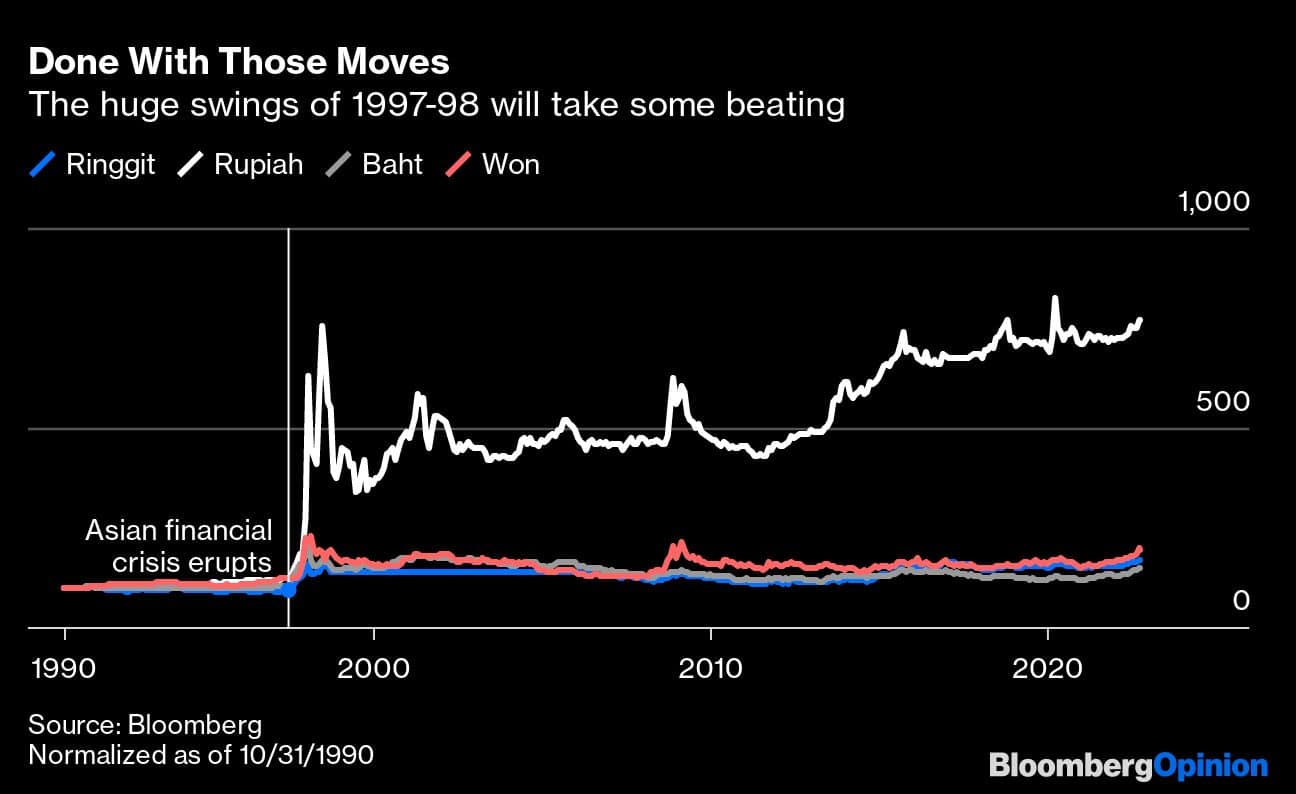
The response to inflation recently has been conventional. Borrowing costs have been pushed up, but at regularly-scheduled meetings by largely independent central banks with policy committees, and inflation targets. Decisions are explained in press conferences replete with technocratic language, forecasts, and projections. This wasn’t the way in 1997-1998. The response then was just as likely to be a sharp, but opaque market move with maybe a grudging comment, and no effort to explain in detail. Those same institutions function today in ways not significantly unlike the US Federal Reserve or the European Central Bank.
Take Malaysia, for example. The central bank released a carefully-written statement last month as the ringgit fell to a 24-year low. The authority was quick to rule out something Malaysia became famous for in 1998: capital controls, and fixing the currency. “Malaysia remains an open economy,” said Bank Negara Governor Nor Shamsiah Mohd Yunus. “Rather than resorting to capital controls or re-pegging of the ringgit, the policy priority now is to sustain economic growth in an environment of price stability, and to further strengthen domestic economic fundamentals through structural reforms.”
As denials of the past go, that’s pretty categorical. The purpose seemed to be to declare this isn't the Malaysia of the 1990s. In this, Shamsiah is correct: Mahathir Mohamad, then in his first 22-year stretch as Prime Minister, remains a lawmaker, but with greatly diminished influence. The government has changed hands several times in the past five years, something scarcely conceivable back then. Huge infrastructure projects that seemed to achieve little purpose other than to be enormous aren't on the agenda. Lectures about the evils of currency trading, among classic Mahathir bombast, have been absent from official discourse.
The worst-performing Asian currency, the yen, isn't beset by a banking crisis, as it was in 1997 and 1998. The currency’s travails are the result of a deliberate choice by the Bank of Japan, which is holding to its signature ultra-easy stance even as inflation exceeds the target, and rates climb elsewhere. Tokyo has intervened to purchase yen, but there is little sense the government is panicking. Yes, a generation of Japanese without experience of inflation are wrestling with increasing prices for electricity, chicken, and beer — as are their counterparts in other Group of Seven nations.
If things go further south, there’s a chance officials will opt for radical solutions. But the place feels different. The breakneck growth of the early-to-mid 1990s never really returned. Leaders who thought they could bully markets have left the building. If you think this all sounds rather unremarkable, you are correct. That may be the underlying revolution here: Asia is confronting an economic challenge from a fundamentally different — and better — place. For mould-breaking, look in the same museum you seek stuffed tigers.
Daniel Moss is a Bloomberg Opinion columnist covering Asian economies. Views are personal, and do not represent the stand of this publication.
Credit: Bloomberg
Discover the latest Business News, Sensex, and Nifty updates. Obtain Personal Finance insights, tax queries, and expert opinions on Moneycontrol or download the Moneycontrol App to stay updated!

Find the best of Al News in one place, specially curated for you every weekend.
Stay on top of the latest tech trends and biggest startup news.