






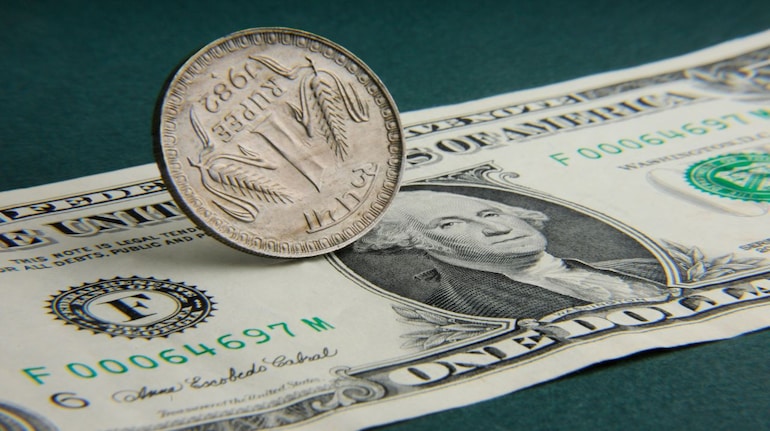
For the first time ever, the Indian rupee fell past the key psychological level of 90 to the dollar, falling 6 paise to 90.02 in early trade on Wednesday.
The slide comes as banks kept buying US dollars at higher levels and FII outflows continued amid a rush by companies to hedge against further weakness in the currency.
The rupee, one of Asia’s worst-performing currencies this year, has fallen nearly 5% against the greenback year-to-date, weighed down further by steep US tariffs on Indian goods and the prolonged wait for progress on a trade deal between New Delhi and Washington.
Sat Duhra, portfolio manager at Singapore-based Janus Henderson Investors, told Reuters that the recent tariff dispute with US has really accelerated the decline. "Until this issue is resolved, with India now paying the highest US tariffs globally, the pressure remains."
The 'parity' debate
The steady weakening of rupee has revived an old social media myth about its party with dollar, with some users recalling a time when “one rupee equalled one dollar”. However, in reality, this was never literally the case.
At Independence, the rupee was linked to the pound sterling, not directly to the dollar; the implied rate in 1947 works out to roughly Rs 3.3 to $1.
For years after Independence, the exchange rate was administratively fixed.
The rupee stood at about Rs 4.76 to the dollar in 1950, before being sharply devalued to Rs 7.50 in 1966 after droughts and a balance-of-payments crunch.
Then, liberalisation-era pressures saw the rate move from around Rs 17.5 in 1990 to Rs 22.7 in 1991 amid a severe external crisis.
Through the 2000s and 2010s, the currency weakened further, crossing 45 in 2000 and about Rs 56.6 during the 2013 “taper tantrum”. The taper tantrum was a market panic triggered by short-term fears that the Federal Reserve will reduce its bond purchases.
By 2018, the rupee had slipped past Rs 70, and in 2024 the average rate was close to Rs 84.8 per dollar.
For the last few days, the currency has been hovering around the Rs 88–89 per dollar mark before today’s plunge took it past the Rs 90 mark.
| Year | Rs per $1 (approx.) | Key context |
|---|---|---|
| 1947 | 3.3 | Post-Independence peg via pound sterling |
| 1950 | 4.76 | Fixed-rate regime continues |
| 1966 | 7.50 | Major devaluation after drought and BOP stress |
| 1991 | 22.74 | Balance-of-payments crisis, start of reforms |
| 2000 | 44.94 | Post-liberalisation, more market-driven rupee |
| 2013 | 56.57 | Fed taper tantrum hits emerging markets |
| 2018 | 70.09 | Oil, global risk-off push rupee past 70 |
| 2020 | 76.38 | Pandemic shock and risk aversion |
| 2022 | 81.35 | Global inflation, strong dollar cycle |
| 2024 | 84.83 | Persistent current-account and outflow pressures |
| 2025 | ~88–90 | Capital outflows, tariffs, trade deficit spike |
Discover the latest Business News, Sensex, and Nifty updates. Obtain Personal Finance insights, tax queries, and expert opinions on Moneycontrol or download the Moneycontrol App to stay updated!
Find the best of Al News in one place, specially curated for you every weekend.
Stay on top of the latest tech trends and biggest startup news.









