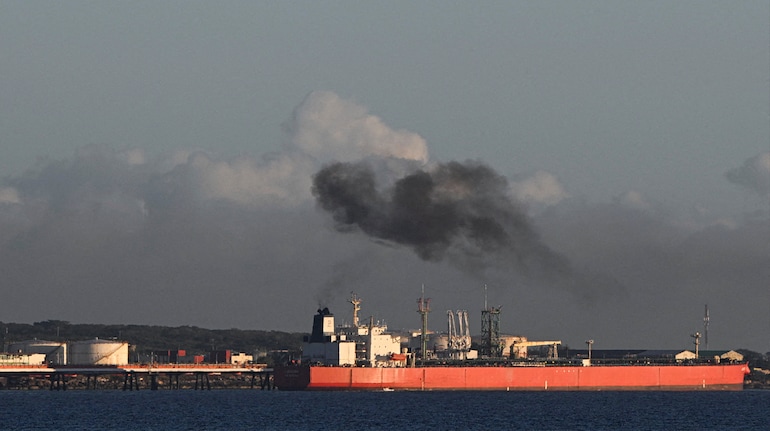

The first tanker carrying non-Iranian crude oil has exited the Strait of Hormuz, according to data from S&P Global Commodities at Sea.
As per S&P, the tanker ‘Shenlong’ which loaded oil from Saudi Arabia’s largest oil export terminal Ras Tanura on March 1, arrived at Mumbai in India on March 10.
“Its draught (how deep the ship is in the water) at Mumbai was 15.8 meters, up from 9.3 meters at Ras Tanura, indicating it had loaded,” S&P said.
The ship's destination is however unknown. The ship's Automatic Identification System was turned off before transiting the Strait and then turned on again afterward, CAS ship tracking software showed.
As per S&P, the vessel is owned by Shenlong Shipping Ltd. and managed by Greece’s Dynacom Tankers Management Ltd.
The White House said Tuesday that the US Navy has not escorted any commercial vessel through the Strait of Hormuz, clarifying confusion sparked by a social media post on X from the US energy secretary stating “US Navy successfully escorted an oil tanker through the Strait of Hormuz to ensure oil remains flowing to global markets”, which was later removed.
Platts, part of S&P Global Energy, assessed the rate to carry 130,000 metric tons of crude from the Persian Gulf to the Asian buyers in the far east at $158.63/mt on March 10, up from $51.42/mt on February 27 prior to the conflict.
The development assumes significance as the escalating conflict in West Asia has resulted in disruption of the Strait of Hormuz which serves as a key chokepoint for as much as 20% of global oil supplies and 50% of India’s energy imports.
Tanker traffic at the Strait of Hormuz has fallen to minimal levels, while alternative export routes via Fujairah and Yanbu are operating at record capacity, as per data from commodity analytics firm Kpler.
According to S&P Global Commodities at Sea, tanker traffic through the Strait of Hormuz hasn’t resumed significantly, with only 2-3 transits per day, compared to the usual 60.
Indian refiners, on the other hand, have started increasing their energy imports from alternative routes including Saudi Aramco’s and ADNOC’s oil pipelines specifically built to bypass the Strait. However, these routes remain insufficient to fully compensate for the loss of shipments through Hormuz, Kpler notes.
“It is in Asia where signs of market duress are most evident. Half of the crude oil processed in Asia in 2025 came from the Middle East Gulf region. But duress is spreading. The longer the Strait of Hormuz remains effectively shut, the worse the impact on physical supplies, inventories and prices—and not just in Asia,” Jim Burkhard, Vice President and Global Head of Crude Oil Research, S&P Global Energy said.
Discover the latest Business News, Sensex, and Nifty updates. Obtain Personal Finance insights, tax queries, and expert opinions on Moneycontrol or download the Moneycontrol App to stay updated!
Find the best of Al News in one place, specially curated for you every weekend.
Stay on top of the latest tech trends and biggest startup news.