
India's metals and mining industry went through a string of policy changes in the past decade to bolster domestic business as infrastructure development boomed, making the sector a prime opportunity for investors.
Along with efforts to open mining to private companies in 2018, the country overtook Japan to become the second-largest steel producer in the world.
The Centre’s allocation for the mining sector increased over 90 percent to Rs 1,911.60 crore in FY24 amid privatisation and the rise in the use of minerals. The allocation was Rs 991.08 in FY14. After the steel ministry received its highest allocation of Rs 2,41.3 crore in FY20, it dipped by about 70 percent in FY24.
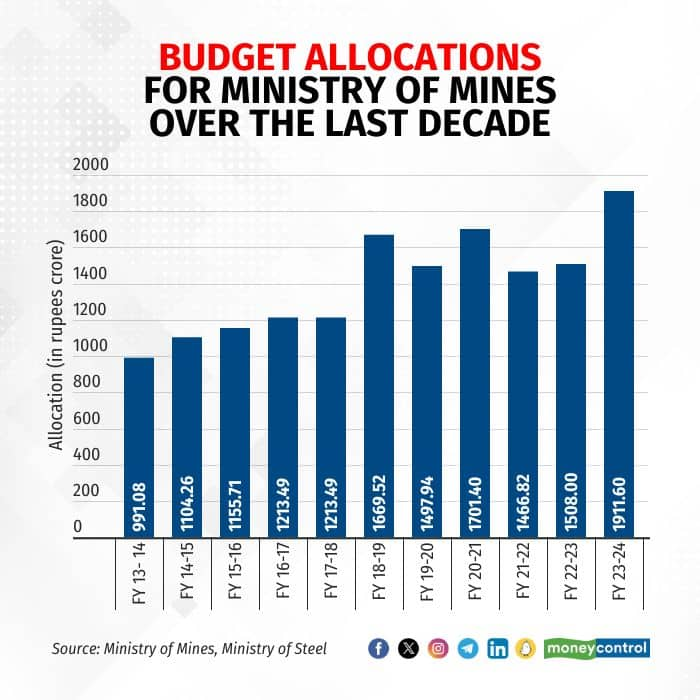 Budget allocation to the Ministry of Mines
 Budget allocation to Ministry of Steel
While mining sector reforms were introduced to break away from a monopoly market and attract foreign investments, the Fraser Institute, an independent, non-partisan research and educational organisation in Canada, ranked it poorly due to tepid foreign fund inflows.
In 2023, the government opened up mining of critical minerals to the private sector to help achieve sustainability goals and set a target for electric vehicles to account for at least a third of private vehicles on the road by 2030.
Here are the key wins and setbacks in the sector in the past 10 years:
Hits:
MMDR Act: In the 2014 budget, the Centre said it would tweak the Mines and Minerals (Development and Regulation) Act to encourage investment in mining and promote sustainable mining practices. Auctions for coal and mineral rights were streamlined and the Central government was empowered to intervene if the state government did not complete the process on time. The amendments resulted in a record 105 auctions of mineral blocks in FY23.
Coal block auctions: In the 2015 budget, the government highlighted the success of starting transparent coal block auctions to augment the resources of the states, after the Supreme Court cancelled the allocation of 204 mines. Prior to the e-auction process, mines were allocated to private companies by a screening committee.
Export duty on iron ore: The government removed the export duty on iron ore fines with Fe content (amount of iron) below 58 percent and on iron ore lumps with Fe content below 58 percent. The move was announced by then finance minister Arun Jaitley in Budget 2016-17. Domestic mining companies hailed the move as demand had cooled and prices were weak. In 2016, ore prices plummeted globally and there were only a few takers for Indian ore.
Coal gasification: While presenting the FY23 budget, the Centre announced the setting up of four pilot projects for coal gasification to convert coal to clean energy with private sector capital investment of Rs 30,130 crore.
Duty exemption on steel scrap imports: In the 2023 budget, the government proposed to continue basic customs duty exemption on ferrous scrap and stainless steel scrap, helping the industry to navigate a raw material shortage.
Misses:
Delay in enabling provisions for commercial coal mining: Although provisions to open up coal mines to private players were made in 2014, the first set of auctions was conducted only in 2020. A year later, about 70 percent of the mines set up for auction did not receive any bids, according to reports.
Lower allocation: The coal ministry received an allocation of Rs 393.24 crore in FY23, which was 38.9 percent lower than the revised estimate of Rs 644.09 crore in FY22. The allocation of Rs 192.32 crore in FY24 was over 60 percent lower than Rs 497.7 crore in FY14.
Iron ore exports slip: Export duty on iron ore was levied again in 2022 for a brief period, causing exports to fall more than 80 percent after buyers from places including Europe, West Asia, and Vietnam placed about 50 percent fewer orders. The duty was later withdrawn.
Mining accidents: According to media reports, 377 workers involved in mining coal, minerals and oil were killed in accidents between from 2015 to 2017. For conservation and safety in coal mines, the government allocated Rs 20 crore in FY24 and an additional Rs 20 crore was provisioned for FY25.
Expert comments:
B K Bhatia, additional secretary general of the Federation of Indian Mineral Industries
Currently, the contribution of the mining sector stands at 2 percent, which is lower than the contributions seen in countries like Australia and Canada, and the main reason behind the lag is subdued mining activities. We need to have a regulatory regime so that we can get investors from abroad.
Exploration is dominated by the private sector in the countries outside India, while here it’s mostly handled by government entities, hence to induce more private participation, the government should introduce incentives.
Also, we have higher taxation here for mining firms (45 percent to 50 percent in India compared to 30 percent in Australia and 25 percent in Canada), which should be brought down. The policy framework needs to be revisited. Otherwise we will continue to import these minerals. As of now, there is no focus on exploration activities.
Tushar Chaudhari - Research Analyst, Prabhudas Lilladher Pvt Ltd
On the policy front, the government has done a pretty good job in the last decade by bringing a transparent mechanism for auctions and upgrading the mines act. The only major concern right now is import of metals, which is at a higher rate currently. In the last six-seven months, exports from China have increased. The industry is expecting some kind of duty for Chinese imports to safeguard the domestic industry.
Discover the latest Business News, Sensex, and Nifty updates. Obtain Personal Finance insights, tax queries, and expert opinions on Moneycontrol or download the Moneycontrol App to stay updated!

Find the best of Al News in one place, specially curated for you every weekend.
Stay on top of the latest tech trends and biggest startup news.