

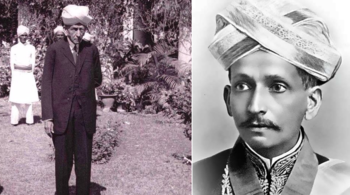
Often called the Father of Engineering in India, M. Visvesvaraya (1861-1962) wore a fair few hats. For instance, he wrote a draft Constitution of India at a time when the country was seeking dominion status. He was also among the more prominent 20th century voices to promote the idea of planned development for India. He’s famous today as the man who built the Krishnarajasagara Dam and as the one-time dewan or prime minister of the princely state of Mysore (now Mysuru), but, really, he had a wider impact on the making of modern India in the 20th century.
“We see the iconography — his figure, his face, his turbaned visage — it’s ubiquitous,” says Aparajith Ramnath, associate professor in the School of Art and Sciences at Ahmedabad University and author of ‘Engineering A Nation : The Life and Career of M. Visvesvaraya', which won the 2025 Kamaladevi Chattopadhyay NIF Book Prize. “But below that: who was he, what did he stand for, what were the influences that shaped him — we haven’t really gone into that so much. Partly it’s because we tend to tell our history primarily through the lens of political figures. But he was also a political figure. So that neat bifurcation between technical people and political people also needs to be addressed.”
Ramnath spent some seven years delving into these questions; collecting papers, letters, interviews, articles, records on Visvesvaraya — a man so invested in industrializing India and improving our irrigation and sewage management that he went down into the sewers on his personal travels to the US, UK, Japan, to bring back from these countries those solutions which made sense for India at the time. This kind of self-financed travel abroad for knowledge gathering was far from common in India at the time — his first foreign trip was to Japan in 1898, when that country was observing 30 years of the Meiji Restoration.
“He took extensive notes,” Ramnath says. Naturally, these notes became one important peg in piecing together the story of a man who's remembered now primarily on his birthday, September 15 - observed each year as Engineers' Day in India.
Over the seven-year period when he was researching the book, Ramnath also uncovered less-known facets of Visvesvaraya's personality and politics. For instance, his sharp wit and closeness to several freedom fighters like Madan Mohan Malaviya and M.R. Jayakar, though he didn't openly speak out against the British during his tenure as a government engineer in Mumbai. " Over a Zoom interview following the history prize announcement, Ramnath tells Moneycontrol about how he became interested to writing histories of technology, and why we have forgotten so many of Visvesvaraya's contributions outside of engineering even though we see his name on education institutions, museums and infrastructure projects today. Edited excerpts:
In ‘Engineering A Nation’, you explain how a lot of what M. Visvesvaraya was thinking about in terms of planning and development was actually adopted by Independent India, including the Planning Commission. And yet that is not the association that most of us make with him today. Why do you think some of these parts of his legacy have faded from the public discourse — why do we not remember this?
I make this point — and some other scholars in the past have also talked about — how his vision closely aligned with what became the Nehruvian template… the idea that the state should play a leading role in industrialization, the idea that industrialization should be central to the nation state or to development, the idea that technical education should be central to policy, a lot of these things were very similar. And of course, planning, as you mentioned. Visvesvaraya started something called the Mysore Economic Conference even before he was the dewan of Mysore, when he was chief engineer. Later, when planning came into vogue across the world, he became one of the chief popularizers of planning in the 1930s. In 1934, he wrote a book called ‘Planned Economy for India’, where he put forth a 10-year plan and then he built on that.
He was not the only person to talk about these things, but he was certainly one of the most consistent advocates for it. So the question, why does he get overshadowed? There are a couple of ways to think about it. One is that other people like P.C. Mahalanobis became more important as parts of the state machinery in the 1950s. Two, it is just a question of age: by that time, he was in his 90s and kind of towards the end of his productive life. So, (Jawaharlal) Nehru was turning to younger associates. But Visvesvaraya also had differences with Nehru’s government just after independence.
From the vantage point of 70 years later, we can say that their visions overlapped at the time, but they also had differences. The main point was that M. Visvesvaraya thought that Jawaharlal Nehru was leaning too far leftward. He wanted more of a role for the private sector. He was broadly capitalist in his thinking. Although he did think the state should play a leading role, he didn’t want it to take over all of basic industry. He did think that it should increasingly move out of the way and let private players take over. So that was one of the issues.
He also felt that they (Nehru’s administration) were being too slow. He wanted to see rapid progress. He wanted to see basic industries in every province. There were a number of points on which they differed.
Visvesvaraya was not sidelined per se. He got the Bharat Ratna along with Nehru in the 1950s. But suffice it to say that a slightly different ideological emphasis became prominent at least in the first two decades after independence. Visvesvaraya was more closely aligned to people like Rajaji (C. Rajagopalachari) who founded the Swatantra Party (in 1959) on a similar critical plank. So that could be part of the reason why he didn’t become such a big figure in our, sort of, folklore.
But I think there are a couple of other things at play. One is his almost total identification with Mysore, where he’s a really huge icon in Karnataka, and rightly so. But it kind of obscures the fact that he was this pan-Indian figure. People have slotted him as the former dewan of Mysore when he was much, much more. The other thing is that it’s a paradox that we think about him primarily as an engineer — his birthday is (marked as) Engineers’ Day (September 15). (The perception is that) he’s an engineer, so surely he must not be someone who was involved in major policy decisions or in the structure of the independent Indian nation and so on.
All of these things add up but he’s by no stretch overlooked. He’s a figure who’s everywhere, but I think he’s overlooked in the sense of depth. We all know him. We see the iconography: his figure, his face, his turban visage. It’s ubiquitous. But below that, what was he, what did he stand for? What were the influences that shaped him? We haven’t really gone into that so much. Partly it’s also that we tend to tell our history primarily through the lens of political figures. But he was also a political figure. So I think that neat bifurcation between technical people and political people also needs to be addressed.
Given how close he was to members of the Congress party, to people who clearly identified as freedom fighters, this seems like a bit of an oversight? Is it because of the fact while he was thinking about dominion status and modern India and a form of economic nationalism, he was not necessarily the face of any of the nationalist movements?
Exactly, yes. He’s not formally affiliated with any particular party. He’s also maintaining good relations with the colonial officials and so on. Just for example, he never goes to jail, right? Unlike many of the other freedom fighters. But that doesn’t mean he didn’t take a stand. He takes a stand, for instance, after Jallianwala Baag. He takes a stand on the repressive measures of the colonial government along with others and decries the detention of political opponents. He, in fact, ends up — and I think this is a very fascinating moment in his life — presiding over the biggest all-parties conference in 1921, the Malviya conference; this is almost a 10-year-long effort of this group of people to push the colonial government to arrange what ultimately becomes a roundtable conference. And all of them are gathering. You have (Madan Mohan) Malaviya and you have all of these other political leaders. And who would think that Visvesvaraya would end up chairman of that conference? Of course, it happens a little bit by chance, because he is in the wings. C. Sankaran Nair, who is supposed to be the chairman, has some differences with Gandhi and he (Nair) steps down. You’d think that this is the sort of thing that would make it into our textbooks, but for some reason, it doesn’t… it just doesn’t fit with our image of what Visvesvaraya is.
I emphasize in the book that he is very clearly shaped by what were known as the Poona liberals. And of course at this time, people could cut across party lines, so they could identify as liberals and they could still be members of the Congress and so on. Visvesvaraya was most at home with what we call either the liberals or sometimes the moderate Congress people. In his early life, Gopal Krishna Gokhale and Mahadev Govind Ranade, but in the ’20s, he worked very closely with Jayakar and Malaviya.
You’re right that he was behind the scenes. For example, he helps put together a draft constitution for dominion status for India at Jayakar’s behest. But he asks him not to put his name on it. And Jayakar then shops it around and tries to sell this idea to various people. So, yes, partly it’s by choice that he stays slightly in the background. But I don’t think that it was a question of his hiding his views; they were out in the open.
For instance, he presides over something called the Indian States People's Conference in the late 1920s, which is a movement of all the subjects of the princely states who are telling their princes: give us more political rights. This is fascinating from a guy who served a princely state for most of the crucial years of his life.
He is hard to pin down in some ways.
Would you say M Visvesvaraya was ahead of his time — you’ve written about his foreign travels and desire to bring back best practices to India, as well as the way he wanted to finance the KRS Dam? Was there some friction to his ideas in his time?
Absolutely, there was a lot of friction throughout his career. He had to fight a lot, push through a lot of his projects. And he also faced a lot of criticism after the fact. When we say ahead of his times — in the sense that, yes, he certainly travelled much more than many people of his time when there were all of these taboos about travelling overseas. He was a strong believer that travel was essential. He was an arch modernist. He wanted India to follow the path of the early industrializing nations. And this was his strength. But it was also his weakness, because he kind of failed to see sometimes the dark side of industrialization in the West. He saw only the outcome of it, which was to raise the standard of living. And that was his ultimate aim: to raise material prosperity in India. He was appalled by the poverty and suffering that he saw. And so this was his remedy.
He’s very, very consciously travelling abroad as early as in his 30s. He’s travelling to Japan in the 1890s, spending months there. He then makes several trips to the US, Canada, Europe, UK, Japan again. He’s very consciously taking notes on what he thinks can be implemented back in Mysore and then in India on the whole.
He does face opposition. For example, the KRS Dam near Mysore is a huge undertaking. And his own government — the finance officers and other ministers, equivalent of ministers — fought quite strongly against it because it obviously required a huge financial investment. And it was unheard of in those days for the government to take a loan or go into debt for a big project on the assumptions that it would pay for itself over time. So they had to balance the books.
Their idea was: 'We need to keep cash in the coffers in case there's a famine or something. We can't do this.' But this is obviously an idea that Visvesvaraya is bringing from his travels. He's seen the Aswan dam (over the Nile in Egypt), he's seen other places. And he's very conscious about this. He has this image of himself as being forward-looking... In one of his letters, he says something like: Forget what the practices may have been in the past. No civilized nation can function without doing this kind of thing. So, he has this very conscious idea of bringing the best from the world back to his environment.
But, of course, a lot of people, as I said, also criticized him in throughout the 1920s. There were signed and anonymous critiques of him in newspapers. There was one person who would write under several pseudonyms, criticize his big projects, his iron and steel project in Bhadravati, his big dam project, saying: These are white elephants; huge expenditures of public money; we don't know whether they're going to pay for themselves; they are the grandiose visions of one person who wants to make a name for himself and doesn't care about the immediate consequences for people.
Now there were some important points in those critiques and we can talk about that later, but of course, Visvesvaraya was very sensitive to them, and he was very careful to respond to them.
You mentioned that most people today, even though they've heard of him and seen his visage in public places, don't really know very much about M. Visvesvaraya. Tell us something interesting you discovered in your research that's little known or appreciated.
The extent of his political involvement, I think that was the most surprising thing. The broad ideas that he associated with these figures was known, but the extent to which he made it a part of his life... And it was not a case of retiring as an engineer and then becoming politically active. He was actually attending Congress sessions in-between negotiations as chief engineer of Mysore. This was quite a revelation to me.
Certain aspects of his personality — we have a stern image of him, and of course he was a very serious person, but he also had a sense of humour. He was also quite sensitive when it came to things like the criticisms I've mentioned. He was very tough to work with for a lot of people who worked under him. He tried, in his eyes, to be fair with them, but sometimes they couldn't figure out what he wanted from them and so on. All of these were certainly nuggets that came out that I wasn't necessarily thinking about.
And he also selected which of his papers and documents could survive. Did that make attempts towards getting to know him harder?
Yes, he had this very curated set of papers in that they all refer to his official life. It's not like he had a bunch of gossipy letters with other people that he had destroyed — I would very much doubt if that's the case because the pattern that one sees from his interactions with most people is that he had friends, but most of them were friends with whom he discussed basically work-related things and things related to his large projects.
One of the points I'd make is that it's a very voluminous archive. One may not have a complete archive to get a sense of the persona, (but) I think after a while, when you immerse yourself in the sources, you have a reasonably good idea of what they must have thought about a particular event, even if that particular thing is not in a particular document.
From your book, it seems like M Visvesvaraya had two seemingly opposing sides to his personality. On the one hand, he believed in the Victorian idea of progress, this idea of constant self-improvement. But on the other hand, he was deeply invested in bringing prosperity to Indians and involved with what you call ‘economic nationalism’ in the book. How do you reconcile these?
It’s key to remember that he lived a very long time — more than 100 years. The first quarter of his life is a very Victorian sort of education. He’s going to all of these colonial institutions: the Wesleyan Mission High School in Bangalore — Central College, and then engineering college in Pune, which was then called Poona College of Science. So he’s imbibing this very Victorian ideal of self-help, of progress and so on. He’s also becoming socialized into the public works department where he works for 25 years in the Bombay Presidency. So he’s imbibing all of these qualities that are seen as indicative of a good engineer by the ruling British.
He never completely abandons that worldview. It is fundamental to the way he sees the world. Even in the time after World War I, when he becomes very politically involved — more than people sometimes assume — what he was pushing for was dominion status, like many other political figures at that time. So, not to dissociate from the British Empire, but to have certain kinds of autonomy within it. He would always compare India with Australia and Canada, and say we need to have the same status as those parts of the British Empire. To that extent, he didn’t change that much.
But he did change in the sense that he became an increasingly strident critic of British policy, as he matured in his life and as his career developed. He was never afraid to mingle with the so-called nationalist thinkers — although of the moderate variety. So, (Gopal Krishna) Gokhale and (Mahadev Govind) Ranade were very close associates even when he was in the PWD and some engineers at that time in his position would have probably been hesitant to associate with people who are even mild critics of colonial rule.
He was definitely talking to them. But he was careful. He was careful not to openly criticize the powers that be. But he was always confident. When he spoke on technical matters, he didn’t hesitate to speak up.
After he became the dewan of Mysore and came on the national stage in the 1920s and ’30s, he became increasingly outspoken in criticizing the British, especially on their economic policy. He called it a dependency form of government — he used some pretty strong language. Basically extending the critique of colonial rule, which was not allowing Indian industries to come up, not allowing India to become materially prosperous.
By the time he was in his 70s and 80s, he was becoming a very, very vocal critic.
You spent some seven years researching this book. But how did you become interested in writing M Visvesvaraya’s biography? Your previous book was about the engineering profession in the late colonial period. Did that play into your decision?
It’s difficult to know where one’s interests stem from and how far back to go. Retrospectively, I can place my interest in history back to my childhood, but it was not something that I seriously thought about doing because the precedent was not there. Everyone around me was doing engineering. So it’s something that I had to rediscover in myself (later on). The history of science and tech then became a good segue to get back into this because, then, I had a background in tech and I was familiar with the world, broadly speaking, of engineers and science, at least of people who have that kind of leaning.
Then there’s also an element of the autobiographical: I wanted to understand how engineering became such a popular career option for people of my time and place. That defined the kinds of questions I’d ask for my research. When I was looking for a project for my doctoral work, that’s what suggested itself to me. It started with a sort of semi-autobiographical question, but then went further and further back to try and understand the origins.
So, in a way, this second book flows very naturally from that (first book). But it’s also a very different kind of project because in the first book I was trying to look at a broader social and political history of a profession, not at individuals. M Visvesvaraya’s name would of course keep coming up when I was researching my first book, but I knew that was a very different project.
You've mentioned somewhere that he was great at writing letters, and you've just mentioned his wry sense of humor. Could you give an example of what that was like.
He was a very methodical writer because he cut his teeth on drafting reports for the PWD and so on. And you could see that in the letters he wrote. Many people who worked with him have mentioned how he used to have his letters drafted and redrafted if his secretaries were doing them, and he would do the same. Having said that, he had some interesting turns of phrase. There’s one file noting, and I’ve spoken about this elsewhere, when Ashutosh Mukherjee, the famous Calcutta scientist, was invited to be one of the first or maybe the first convocation guests for the Mysore University, which was set up under Visvesvaraya’s tenure as Dewan (of Mysore). And so he was writing to Visveswaraya and the office — planning his trip, asking about the logistics, and saying, ‘Can I also go and see this place and that place when I’m there?’ And Visveswaraya writes to one of his associates that — and I'm quoting from memory — Sir Ashutosh seems to want to kill a whole flock of birds with one stone. So that’s the sort of wry remark that he’d make.
He also had an ability to laugh at himself. He didn’t have children, but we have stories of how he interacted with his grand nephews and grandnieces in his old age, how he recounted his early adventures and so on. One of those descendants has left an account of that, so we have all of these little nuggets. And of course we have what other people said. So even though he was reserved, we have accounts from other people who met him.
There’s this one British engineer who says he saw him near the Qutub Minar when they’re visiting Delhi. And he asks Visvesvaraya, ‘What do you think this thing must have cost to build?’ And Visvesvaraya takes out his notebook and does some calculation, and he says I can build another one for Rs 14 lakh or something like that.
There’s some debate around who should write history books today — do you think it’s important that the writer have training in history or be teaching in the history department of a university?
I am, in a way, a latecomer to history because my first degree was in electronics engineering and then I did study history formally, but only at the postgraduate level. I think anyone who does history is a historian, but there are good ways to do history, good practices: how you research things and how you analyse your material, how you make arguments.
I don’t think we need to be very rigid about saying that someone needs formal qualifications to do it. But I am keen to see the process by which a history is written. And it shines through in good histories, when you read them, when people have taken the trouble to understand their sources and also give you clearly the reasoning behind the claims that they have made.
Did you see anything in your research that led you to an answer for why engineering is such a popular career choice today?
Yes, a tentative answer. Because I think a full answer would need somebody to also follow through the profession to the late 20th century. But my understanding is that certainly one big part of the story is that when engineering becomes institutionalized as a profession in India in the late-19th century and early-20th century, it is very closely identified with the colonial state. An engineer was not just a technically qualified person — at this time they were all men — he was a sahib, he was a civil servant, he was in-charge of huge swaths of territories, he had sweeping powers, he had a very grand lifestyle with retinues of servants, and also it was associated with this idea of the civilizing mission; building the empire and so on. There was also this discourse about what made a good engineer — it was a very colonial kind of discourse, but it was about having what they call character and being able to take decisions, being an outdoorsy person. So, it encompassed something much wider than what we think of today. It’s not just the ability to solve technical problems.
So, it became aspirational for Indians. Also, because it was one of those professions which was relatively closed — Indians didn’t get to the top ranks. One of the big things in the nationalist movement was the demand for Indianization. We know the story about Indianizing the civil service, but it was the same in technical professions. Indians wanted to prove that they could do these jobs as well as the expat British.
It’s that association with the state, with power, with it being a fairly exclusive profession, even though it’s not anymore — right now, we have lakhs of graduates every year — but at that time, engineers would have numbered in the hundreds, perhaps across the country. So it was very exclusive, a very difficult thing to be. Some of that (perception) continues in the later periods. Then, of course, it blends into the Nehruvian idea of nation building. The idea of public sector industries, dams and other projects. Today, it’s very closely tied to the idea of the technocrat. Someone who has an engineering background — doesn’t necessarily work in that field — but brings that kind of background of rigour and analytical ability and so on.
Discover the latest Business News, Sensex, and Nifty updates. Obtain Personal Finance insights, tax queries, and expert opinions on Moneycontrol or download the Moneycontrol App to stay updated!





