

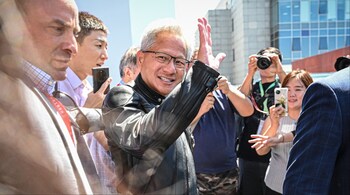


Jensen Huang took the stage at the CES trade show in Las Vegas this week to make the clearest pitch yet for Nvidia Corp.’s autonomous driving technology. In doing so, the chief executive officer’s vision for vehicles that can drive themselves edged into the terrain of major customers like Tesla Inc. and its boss, Elon Musk.
Huang’s remarks sparked a widely watched — if notably polite — indirect multiday exchange between two of the most influential figures in technology. It also sharpened a central question about autonomous driving: Who controls the technology that will first power consumer cars that drive themselves — and later, driverless cars known as robotaxis that are designed for ride-hailing? And whose autonomous vehicle system is the best?
On Monday, Huang used his speech to America’s largest technology showcase to extol the virtues of Nvidia’s Alpamayo, an open-source AI model designed to speed development of Level 4 self-driving cars. Such cars — consumer-owned at first, and robotaxi-fleet-operated later — can drive themselves without human supervision or intervention, within a defined geographic area.
Nvidia described Alpamayo as part of a broader toolkit it offers automakers on top of open models. That includes powerful chips in data centers to train self-driving software, chips inside vehicles that serve as the car’s “brain” while it’s on the road, and simulation software that can create vast amounts of driving data virtually — reducing the time and cost of collecting it in the real world. The pitch was aimed squarely at automakers.
Nvidia wants to supply the intelligence layer for autonomy without building the car itself, but it still wants to own the technology that makes self-driving a reality.
“The world’s first thinking, reasoning, autonomous vehicle AI,” Huang proudly announced, clad in a shiny leather jacket.
That afternoon, Musk weighed in with a post on X after a user shared a transcript of Huang’s remarks. “Well that’s just exactly what Tesla is doing ????,” Musk wrote.
The Tesla CEO added that while getting a system to work most of the time is relatively easy, solving rare and unpredictable edge cases is far harder.
The world’s richest man has claimed for a long time that Tesla’s system will have the ability to reason — that is, to make humanlike decisions in specific traffic scenarios — after a future software update. Earlier this week, his chief AI lieutenant, Ashok Elluswamy, responded to a question on X, saying a further update will come in the current quarter.
Huang learned of Musk’s response during an interview with Bloomberg Television at CES the next day.
“I wouldn’t be surprised,” Huang interjected, of Musk’s claim to already be doing reasoning. “I think the Tesla stack is the most advanced AV stack in the world.”
Tesla shares ended the week higher by 1.6%, closing Friday at $445.01. New Street Research analyst Pierre Ferragu, who has a buy rating and $600 price target on the stock, had posted on X earlier in the week after Huang’s keynote that Nvidia’s strategy “validated” Tesla’s approach.
What drew broader attention was the tone of the aftermath of Nvidia’s announcement. The exchange went viral — not because of confrontation, but because of restraint. The two rivals acknowledged each other’s technical credibility while advancing different paths.
Tesla and Nvidia already have an important, if uneven, relationship. Tesla relies heavily on Nvidia’s graphics processing units, or GPUs – the chips that go into data centers to train its autonomous driving software — even as it builds its own in-house chips to run that software inside vehicles.
Musk has said Tesla will have spent roughly $10 billion cumulatively on Nvidia hardware for training by the end of this year, and that figure would be higher had it not worked on their own AI chips. Musk’s AI startup, xAI, is also a major Nvidia customer, and Nvidia is an investor in xAI.
Tesla and Nvidia are fundamentally different companies. Tesla makes cars and builds the full system end to end. Nvidia builds chips and software that others use.
Their technologies are different too. Tesla has a vision-only approach, just relying on camera sensors. The company argues it’s the most economically viable approach at scale and avoids sensors confusing one another. The rest of the industry argues other sensors like lidar, radar and ultrasonics are better because they are safer and offer redundancy.
But the dynamic underscores how unsettled the autonomous vehicle arms race remains. Tesla depends on Nvidia to build its software, even as Nvidia builds tools that could one day help Tesla’s rivals catch up.
Their paths to consumers also increasingly overlap. Tesla sells a suite of features known as Full Self-Driving (Supervised), a driver-assistance system that requires the vehicle’s operator to remain at the wheel and watch the road. The system Tesla sells is capable of point-to-point driving with navigation, lane changes and can react to traffic, but drivers still need to keep their eyes on the road.
Nvidia now also sells advanced driver-assistance and autonomy platforms to automakers. And those automakers, in turn, pitch the systems to the consumer in the cars they sell.
Market analysts see robotaxis as the endgame, with Alphabet Inc.’s Waymo currently leading real-world commercial deployments and Tesla arguing it can win at scale.
Before that, the proving ground is consumer-owned cars that can do more of the driving themselves under owner supervision, serving as a bridge toward wider robotaxi adoption.
Tesla sees FSD as a stepping stone to a future robotaxi network it would control. Nvidia is pursuing a similar endgame, working with other technology companies, automakers and ride-hailing companies, including Uber Technologies Inc. Again, Nvidia would just provide the tech and sees it powering fleets of robotaxis as soon as 2027.
Tesla is betting on winning autonomy as a specialist, while Nvidia is positioning itself as the arms dealer, selling tools to the entire industry.
Huang said the upcoming Mercedes-Benz CLA will be the first car to use Nvidia’s stack, offering FSD-like capabilities. Deliveries are starting in the US in early 2026 and rolling out to Europe and Asia later in the year. Moving beyond that would require additional hardware, such as lidar, adding cost and underscoring how far today’s cars remain from full autonomy.
Musk returned to the subject of Nvidia’s push into autonomous vehicles on Tuesday, arguing it posed little immediate threat to Tesla’s efforts. The technology, he said, was far from being ready to be rolled out safely on a large scale.
“The actual time from when FSD sort of works to where it is much safer than a human is several years,” he wrote on X, adding that meaningful competition for Tesla could still be at least five or six years away.
For all the ambition on display, Huang and Musk have both effectively indicated that fully autonomous driving at scale is still a distant prospect.
And for both, the nearer proving ground comes first: cars that can drive themselves part of the way. Who wins that phase may help decide who dominates the next one.
Discover the latest Business News, Sensex, and Nifty updates. Obtain Personal Finance insights, tax queries, and expert opinions on Moneycontrol or download the Moneycontrol App to stay updated!





