

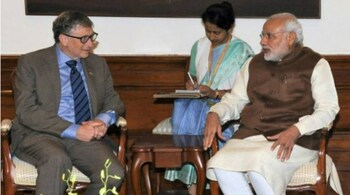
Microsoft co-founder Bill Gates congratulated Prime Minister Narendra Modi as the total number of Covid vaccinations administered in India crossed 200 crore. Gates also expressed gratitude to the Indian government for mitigating the impact of Covid through a vigorous vaccination programme, and to Indian vaccine manufacturers as well.
"Congratulations Narendra Modi for yet another milestone of administering #200crorevaccinations. We are grateful for our continued partnership with Indian vaccine manufacturers and the Indian government for mitigating the impact of COVID19," Microsoft co-founder tweeted on Wednesday.
"India's vaccination drive is big on speed and scale. It has been powered by collective efforts of many, including scientists, doctors and nurses. At the same time, the people of India have shown remarkable faith in science and taken their doses in a timely manner," PM Modi tweeted.
The Bill and Melinda Gates Foundation has committed $2 billion to support the global response to Covid-19. This includes funds for the development and procurement of new vaccines as well as guarantees and forgivable loans to stimulate private-sector innovation.
“In 2020, we facilitated a second-source agreement between AstraZeneca and Serum Institute of India to ensure timely COVID-19 immunization access in India as well as in other low- and middle-income countries through the Gavi-led COVAX initiative,” the foundation states on its website.
India achieved a major milestone in its vaccination programme against COVID-19 as the cumulative vaccine doses administered in the country surpassed the 200-crore mark on Sunday. According to the health ministry data, 98 per cent of the adult population has received at least one dose while 90 per cent have been fully vaccinated.
The cumulative Covid vaccine doses administered in the country crossed the 100-crore mark on October 21 last year and 150 crore on January 7 this year. The countrywide vaccination drive was rolled out on January 16 last year with healthcare workers getting inoculated in the first phase. Vaccination of frontline workers started from February 2 last year.
(With inputs from PTI)
Discover the latest Business News, Sensex, and Nifty updates. Obtain Personal Finance insights, tax queries, and expert opinions on Moneycontrol or download the Moneycontrol App to stay updated!





