

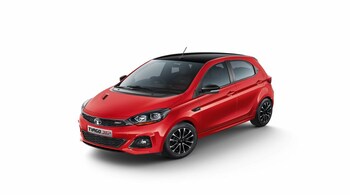
A Tata Motors-promoted joint venture company - created to produce performance-oriented, low volume versions of its existing models - may have ceased in less than three years of starting operations.
JT Special Vehicles, a 50-50 joint venture company between Tata Motors and Coimbatore-based Jayem Automotives - founded by former race car driver J Anand, was set up in March 2017.
Subsequently in October 2018, Tiago JTP and Tigor JTP - the performance variants of two Tata Motors models were launched. Both cars sported spruced-up interior and exterior styling, 34 percent more engine power, along with the ‘JTP’ branding on the front grille and rear.
These cars were targeted at performance seeking young buyer class and developed on the lines of the Volkswagen Polo GT TSI, Fiat Abarth Punto and Maruti Suzuki Baleno RS, which are performance version of the regular models. The JTP versions of the Tiago and Tigor have been pulled off from Tata Motors’ website.
In an email reply to Moneycontrol, however, Tata Motors did not specify the reasons behind the reduced focus on JTP business; nor did it state the number of units sold by the JV company or the investments made in developing these car models.
“Tata Motors will continue to support the JTP cars that the customers have bought. We have been in the process of reviewing the business model for delivering the JTP branded cars in light of multiple regulatory changes, in terms of emissions and safety. We will announce at the right time the set of actions emerging out of it”, Tata Motors said in the reply.
Considering the significant jump in costs to upgrade vehicles to Bharat Stage VI (BS6) from BS4 emission norms, several companies had to reduce their product offering because of uncertainty over retail demand for such models after April 1.
As per Tata Motors executives speaking at the time of launch, the idea behind launching such cars was not to generate huge volumes but to create a positive effect on the mother brand. Globally, such cars do not have more than 5-6 percent share of the main brand. But, the rub-off effect on that brand of car can be to the extent of 20 percent increase in volume.
In March, Tata Motors proposed to separate the passenger vehicle division from itself to explore a strategic alliance after years of effort to spruce up its market share remained fruitless.
The Tata Motors board has, in-principle, approved to hive off the PV business (including EV) by transferring relevant assets, intellectual properties and employees directly relatable to the PV business for it to be fully functional on a standalone basis through a slump sale.
Discover the latest Business News, Sensex, and Nifty updates. Obtain Personal Finance insights, tax queries, and expert opinions on Moneycontrol or download the Moneycontrol App to stay updated!





