-
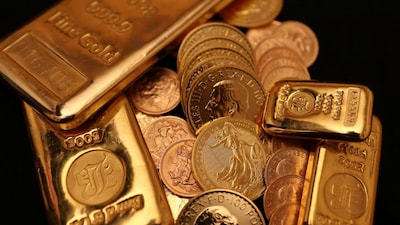
India likely to keep gold out of trade deal with Gulf bloc
Under the trade agreement with the UAE, tariff concessions on precious metals contributed to a sharp rise in Indian imports, raising concerns over domestic market disruption
-

Gold imports jump in January, Swiss, UAE inflows lead spike
Overall, gems and jewellery imports, at $15.3 billion in January, drove merchandise imports up 19% from a year earlier
-
FTA partners accounted for a third of India’s goods trade gap at $31 billion in Q2 FY26
India’s exports to its FTA partners amounted to $38 billion during the second quarter of the current fiscal, while imports rose 5 percent year-on-year to $69.8 billion, resulting in a sizeable trade gap.
-
India–EU trade talks near finish line, shaped by firm red lines on farms, industry and climate
As a long-pending free trade agreement heads for signature, years of negotiations show where New Delhi and Brussels held their ground — and what each side hopes to gain.
-
US lawmakers push Trump to seek tariff relief on Indian pulse imports
US senators from North Dakota and Montana want Trump to seek favourable pulse crop provisions in trade deal
-
India’s silver imports up 129% on price rise, supply concerns
The surge in silver imports comes at time when gold has slipped and petroleum growth slowed, likely driven by global price spikes and China export curbs
-
FY26 CAD could fall as low as 0.9% as trade deficit narrows to 5-month low in Nov
Economists say that the outcome of the negotiations for a trade deal between India and the US continues to be crucial, as the absence of an agreement could have negative implications for India’s current account deficit in the next fiscal year
-
10 and counting: India's 2026 FTA playbook to tackle tariffs, secure minerals
India is ramping up its trade efforts heading into 2026, with a free trade deal with the EU on the horizon and negotiations advancing with the US, Oman, Peru, Chile, New Zealand, Israel and more. These moves aim to diversify export markets, reduce reliance on any single economy, and secure critical minerals amid global supply constraints.
-
India–EU FTA talks to spill into 2026, next round set for early January
Italy’s Deputy Prime Minister and Foreign Minister Antonio Tajani said he hopes the FTA could be concluded in the first six months of 2026, though he clarified that he is not directly responsible for trade negotiations.
-
Budget FY27: Gold import duty unlikely to be changed amid stable CAD outlook
The government has tightened checks on 'mis-declared' gold and platinum imports. The basic customs duty on the yellow metal has been cut from 15% to 6% in July 2024
-
India-EU kick off fresh round of FTA talks as clock tick on year-end deadline
Carbon tax and market access for automobiles and steel, rules of origin, and barriers in services are the remaining sticking points, officials have said
-
CEA Nageswaran isn't 'losing sleep' over depreciating rupee, says it's 'not hurting' exports, inflation
Nageswaran said he is not 'losing sleep' over the weakening of the domestic currency as long as it is not hurting exports
-
India mulls wider Swadeshi manufacturing policy to cut import dependence amid FY27 Budget preparations
More labour-intensive sectors may be added as India looks to expand the scope of its manufacturing policy beyond the existing clusters.
-
India restricts imports of certain platinum jewellery
This follows similar steps taken in September, when the government restricted imports of certain silver jewellery until March 31, 2026
-
Tradition to tariffs: How India’s gold import tripled ahead of wedding season, defying record prices
When international gold prices see a sharp uptick, many buyers perceive it as an opportune moment to accumulate gold, anticipating that the prices may continue to rise further.
-
Merchandise trade deficit widens to $42 bn on 200% surge in gold imports
Merchandise exports for October 2025 stood at $34.38 billion, while the imports came in at $76.06 billion during the same period
-
FTA delayed, India to expand preferential trade agreement with Brazil-led Mercosur: Govt officials
Currently, the preferential trade agreement (PTA) with the Mercosur trade bloc covers about 450 tariff lines. Talks are on to expand the PTA further to cover more items across agriculture, industrial goods, pharmaceuticals, and textiles, government officials told Moneycontrol.
-
India’s goods trade deficit widens to 13-month high of $32.15 billion in September
'Import increase in September 2025 has been higher than exports. Gold, silver, fertiliser and electronics have led to the import surge,' Commerce Secretary Rajesh Agarwal said.
-
Tariffs being used as weapons, India will choose its own path: Shivraj Singh Chouhan
While India has achieved surplus production in rice and wheat, the Union agriculture minister said, the next frontier is achieving self-reliance in pulses and oilseeds. "PM Modi will be launching India's Dalhan Atmanirbharta Mission (Chana–Masoor) day after tomorrow to strengthen pulse production," he said.
-
India may announce $125 a tonne anti-dumping duty on met coke imports in October
In April this year, government initiated an anti-dumping investigation into imports of the raw material from Australia, China, Colombia, Indonesia, Japan, and Russia, post allegations that these countries were selling at unfairly low prices.
-
Uncertainty on tariffs hurt; paying them is worse, survey shows
That’s among the takeaways from a survey of 336 small to mid-size companies by Freightos, a Barcelona-based cargo booking platform
-
GST2.0 reforms support local manufacturers; less than 7% of imports expected to get cheaper
Cuts in photovoltaic cells, auto parts, and industrial inputs signal focus on domestic value-add, not cheaper foreign goods
-
India’s goods trade deficit widens to $27 billion in July
On a year-on-year basis too, the merchandise deficit recorded last month was larger compared to $23.5 billion in July 2024
-
India's solar modules shine at 100 GW
Prime Minister Narendra Modi said the development is yet another milestone towards self-reliance.
-
Goods trade deficit narrows to a four-month low of $18.78 billion in June
Merchandise exports fell marginally on-year to $35.14 billion in June, while imports dropped to $53.92 billion