

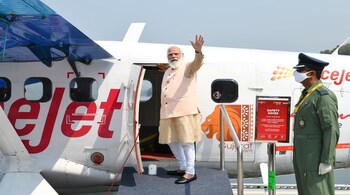
Encouraged by the good response to its Statue of Unity-Ahmedabad seaplane service, private carrier SpiceJet has said it plans a similar flight between Surat and the 182-meter tall statue located in Kevadiya in Gujarat’s Narmada district.
Prime Minister Narendra Modi on October 31 launched the seaplane service in Ahmedabad. He boarded the twin-engine plane from pond-3 close to Sardar Sarovar Dam.
In Pics | PM Modi launches India's first seaplane service in Gujarat
SpiceJet is also exploring other routes and destinations for the seaplane service, including Port Blair to Havelock, Delhi to Haridwar, Delhi to Rishikesh and Naini Lake, Udaipur, Dal lake, Leh and backwaters in Kerala.
"We only need water bodies like rivers and lakes to start such services. We are now planning to start seaplane service between Surat and Kevadiya. We are in touch with officials for the same and studying their suggestions," said Spicejet Chairman and Managing Director Ajay Singh.
The 18-seater plane covers the distance in about 40 minutes, while it takes around four hours to reach Kevadiya from Ahmedabad by road.
SpiceJet has already got around 3,000 booking requests in two days, Singh said. "Majority of the booking requests belong to the Ahmedabad region. We will start giving them tickets from tomorrow when the commercial flight would commence," he said. His company was planning to get two more aircraft to augment seaplane operations in the country,Singh said.
The service is operated by SpiceJet's fully-owned subsidiary, Spice Shuttle. As of now, daily two flights will be operated on the Ahmedabad-Kevadiya route from November 1, Singh told reporters in Ahmedabad.
Floating concrete jetties made by Marinetek India were installed at the riverfront and at pond-3 near the dam to enable passengers to board and alight from the plane.
The all-inclusive one-way fare will begin from Rs 1,500 and go up to Rs 5,000 under the UDAN scheme. The seaplane tickets are available for booking on www.spiceshuttle.com.
The Gujarat government in July had cleared a proposal to enter into a tri-party agreement with the Union Ministry of Civil Aviation and the Airports Authority of India (AAI) for the construction of four water aerodromes under the regional connectivity scheme for seaplane service.
A water aerodrome or seaplane base is an area of open water used by seaplanes for landing and taking off.
The water aerodrome was planned at the Sabarmati riverfront in Ahmedabad, Sardar Sarovar dam at Kevadiya in Narmada district, Shetrunji dam at Palitana in Bhavnagar district and Dhaori dam in Mehsana district.
Discover the latest Business News, Sensex, and Nifty updates. Obtain Personal Finance insights, tax queries, and expert opinions on Moneycontrol or download the Moneycontrol App to stay updated!





