

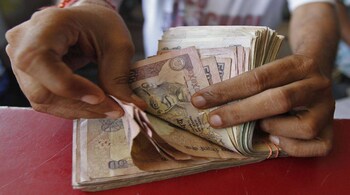
Dealing with a health crisis of such magnitude in India has been further complicated because it robs a vast majority of its population of basic livelihood.
In March, hundreds of thousands of migrant workers fled India's cities and crowded state borders to head home after the Prime Minister Narendra Modi announced a three-week lockdown to contain the spread of the coronavirus. They were left with no means to earn a living and provide for themselves or their families.
On April 14, when the initial 21-day lockdown was supposed to have ended, the prime minister announced an extension of the countrywide lockdown in India by another 19 days till May 3. Following the announcement, hundreds of migrant labourers gathered at Mumbai's Bandra station on April 14.
Defying the lockdown, these migrant workers gathered in large numbers to demand permission to go back to their native places.
In Charts | Economic impact of lockdown on Centre and states
Both the Indian government and the World Health Organization have officially maintained that India has still not entered community transmission phase, even as the total count of Coronavirus positive cases reached 12,380 and the death toll stands at 414.
However, the lockdown is a way to prevent the eventuality of community transmission. Community transmission in a country as populous, with a huge majority of its population being poor, would be catastrophic.
Track this blog for latest updates on the coronavirus outbreak
To prevent an explosion of transmission, the Singapore government pays $100 per day (about Rs. 5,300) as quarantine order allowance. Something similar has also been done by Odisha government by incentivising self-declaration, by those who came back from foreign tour after March 4, with Rs 15,000.
"Unless the government issues a notification, it (quarantine allowance) will be the discretion of employers to pay or not to pay," said KR Shyam Sundar, professor at Xavier School of Management in Jamshedpur.
Intensive testing regime will require cooperation from the people. If testing positive means being quarantined away from home and family, and losing livelihood for weeks, there is strong reason for the poor to evade quarantine and even testing in the first place, because of the sheer necessity of making a living.
On April 16, Andhra Pradesh Chief Minister YS Jagan Mohan Reddy announced financial assistance of Rs 2,000 each to the poor who complete quarantine for buying nutritious food. He made it clear that social distancing should be implemented strictly and special focus should be laid on Covid-19 prevalent areas.
"So there is certainly a case for giving quarantine allowance... there is enough legal basis in terms of Ministry of Home Affairs circular and ministry of Health and Family Welfare circulars. In fact they should be paid their normal pay and also quarantine allowance could be given to them in order to take care of expenses," Sundar said.
The International Labour Organization supports the fact that quarantine allowance is a form of social security, mainly because this is a contagious disease and hence can also come under ensuring occupational safety and health of fellow workers.
"So there are multiple legal and medical reasons under which the employees who are medically declared to be suspect or confirmed to be the infected people, the employer concerned must be asked to pay wages, either under the ESI (Employees' State Insurance) if the worker is covered under the ESI Act," Sundar said.
Follow our full coverage of the coronavirus outbreak here
Discover the latest Business News, Sensex, and Nifty updates. Obtain Personal Finance insights, tax queries, and expert opinions on Moneycontrol or download the Moneycontrol App to stay updated!





