

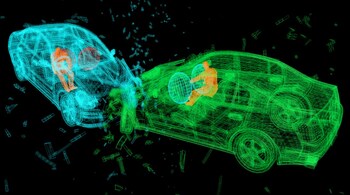
Union Transport Minister Nitin Gadkari has stated on February 10 that the central government is working on an independent star rating system for automotive safety in India. In addition to this, Gadkari has also announced that he plans on making six airbags a mandatory fitment for all cars, along with a three-point seat belt harness for all front-facing passengers. Gadkari criticised existing safety norms in India as being outdated, and intends to renew the parameters to reflect global norms.
While the idea of an indigenous safety ratings system, designed on the lines of international, not-for-profit outlets like Global New Car Assessment Program and EuroNCAP, has been floated in the past, no clarity has been offered on when such a system, dubbed Bharat NCAP, will be officially introduced. At present only Global NCAP, a UK-based not-for-profit, independent charity assigns a safety rating for Indian cars following a stringent set of parameters which are more or less similar to a global standard set by the UN, and followed by other NCAP’s such as EuroNCAP and USNCAP.
What are Bharat NCAP parameters going to look like?
Gadkari has said that India’s star rating system for vehicular safety will be superior to the ones followed internationally. He has also announced a 12-point initiative and mandatory provisions in the Motor Vehicle Rules including Electronic Stability Control, seat belt reminder and a lane-departure warning signal. Gadkari believes driver error to be primarily responsible for a bulk of India’s alarmingly-high road accident numbers and mitigating levels of driver distraction, drowsiness top the priority list.
While details on the parameters of the upcoming Bharat NCAP are sketchy, the standard parameters that all New Car Assessment Programs are based on include structural integrity of the vehicle, adult and child occupant safety levels, electronic safety measures such as ESC, seat-belt warning, ESC, and according to the government, hill-assist technology that prevents vehicles placed on an incline from rolling backwards.
What will likely differentiate and possibly allow India’s own safety rating system to be superior to international norms, is the inclusion of six airbags, ESC, ABS, hill-assist etc as standard fitments. Doing so would improve the overall safety ratings received by these cars, since often, the base-level models fare quite poorly given the absence of certain safety features. Gadkari dismissed concerns regarding a further increase in overall costs resulting from enforcing such rules stating that recently announced PLI’s have encouraged local manufacturing of airbags, lowering the costs.
The Bharat NCAP, when introduced is likely to be based on parameters that include a safety score, similar to one allotted by Global NCAP where a car can score a maximum of 17 points. The total score on the Bharat NCAP system is likely to differ, as it does for various international NCAP tests, in order for the scores to not be interchangeable. These points are allotted based on front-offset and side impact crash tests, pedestrian safety score, child and adult protection during both frontal and side impact tests and a safety assist score allotted, with an additional point given for any driver assistance and crash avoidance technology. Based on the total score, with a scoring system that can vary from having a total number of points limited to 16-17 or going up to 50. Regardless it’s the total score, collected from these 5-6 categories that will determine whether a car receives 0 stars or five, with the latter being the maximum number of stars a car can receive on vehicular safety.
The speed of the frontal impact test would also make a massive difference. While Global NCAP keeps the impact speed at 64kph, Indian government regulated tests, thus far, have stuck with the 54kph speed that is in accordance with Regulation 94 from the United Nations regulations for impact protection. A higher speed makes it harder for a car to achieve a higher safety rating, thereby being the more stringent and preferable option. For the impact tests to be indeed superior to global norms, a mandatory speed of 64-65kph is a must. With six airbags as standard fitments, the cars are automatically primed to receive better safety ratings than before. For Bharat NCAP to surpass Global and EuroNCAP it would have to place equal emphasis on active safety measures as it does on passive safety measures.
The EV angle
It’s uncertain what sort of special parameters will be specified for EVs, given how the battery component changes things. Given the inflow of EVs in the market, the norms would also have to include specific safety criteria for EVs. According to the Society of Automotive Engineers (SAE) International, “Electric and hybrid vehicles are submitted to the same passive and active safety standards as fossil fuel engine vehicles and so they have to pass crash tests defined by homologation regulations or other consumer standards such as Euro NCAP.”
However, given that EV batteries can potentially cause an electric shock after a severe crash, new internal protocols would have to be established, primarily for the workers and the infrastructure that can neutralise a battery effectively during a lab-conducted crash test.
How will this affect on-road safety levels and the Indian automotive market?
In the last few years, India has seen the introduction of several government-mandated safety features, which have increased the overall levels of safety of both the driver and occupants. Since 2019, several features including warning sounds at 80kph and 120kph, ABS and front and passenger airbags, rear parking sensors have become mandatory features. In terms of new active safety features, it’s Electronic Stability Control that’ll take things forward.
Undoubtedly, when introduced Bharat NCAP will be a breakthrough moment not only for the Indian automotive market, but also the overall safety levels, the cumulative effects of which we will see several years down the line, as many older models will continue to ply the roads for the foreseeable future. The market for safety equipment like airbags etc, is also likely to get much bigger by 2030. According to a report by TechSci Research, the airbag market in India is expected to grow at a CAGR of over 13.02% by FY2026. Global suppliers have already begun collaborating with manufacturers in India, to provide low-cost, but high quality ADAS equipment. Brands like Tata Motors and Mahindra are leading the charge when it comes to providing safety equipment in high-end variants of their cars.
It must be noted that all NCAP assessment programs operate independently, free of government or corporate interference. The cars procured for the test, are generally independently sourced. For India’s own NCAP to maintain that integrity, it has to be a shade more stringent than international measures, given how high the stakes are for passengers in poorly rated cars in India.
Cost however, continues to remain a concern, especially given that mandatory ADAS (Advanced Driver Aid Systems) will undoubtedly lead to a price rise, which, at entry-level, can deter the consumer from making the purchase. Given that several automotive components will be obsolete in over a decade, the new supply chain currently being established would have to include partners who can provide affordable and durable ADAS systems, without hiking-up the price considerably.
Discover the latest Business News, Sensex, and Nifty updates. Obtain Personal Finance insights, tax queries, and expert opinions on Moneycontrol or download the Moneycontrol App to stay updated!





