

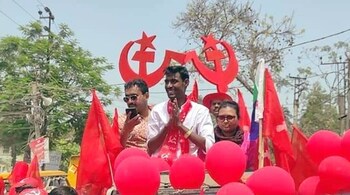
Following the decision of the Indian Secular Front (ISF) to contest independently in the upcoming 2024 Lok Sabha elections, the Communist Party of India (Marxist) (CPI-M), dealing with internal contradictions regarding the high-profile Diamond Harbour constituency, has nominated a promising young leader Pratikur Rahaman to challenge Abhishek Banerjee, the incumbent Member of Parliament (MP) and deputy leader of the Trinamool Congress (TMC), whose substantial influence is amplified by his familial connection as the nephew of Chief Minister Mamata Banerjee.
Emerging Left Youth: Idealistic Conviction
Political analysts argue that the rise of young members within the Left amid its existing challenges signifies a distinct ethos marked by idealism and steadfast conviction, diverging from the opportunistic tendencies of previous eras. Also, these young individuals understand that electoral engagement is only the beginning of a long and demanding journey ahead. Notably, many voters refrain from "wasting" their vote on parties or alliances deemed unlikely to secure power This tendency helps explain the phenomenon of "wave" elections, which have been common in other parts of India and have now become evident in Bengal as well.
Also Read | Lok Sabha Polls: Corruption allegations on TMC could shape election outcome
Diamond Harbour: TMC Dominance Continues
The Diamond Harbour Lok Sabha seat, historically a stronghold of the Left, has been under the control of the TMC since 2009. Abhishek is currently serving his second term as the MP representing this constituency and secured nearly 56 percent of the votes in the 2019 elections. The BJP emerged as the second runner-up with over 33 percent of the votes, while candidates from the CPI (M) and the Congress received around six percent and roughly 1.4 percent of the votes, respectively.
Also Read | West Bengal NIA attack row: Police file FIR against investigating team; TMC, BJP trade charges
Electoral Battlefield Heats Up
With roughly 53 percent of its constituents being Muslim voters, the Diamond Harbour Lok Sabha seat holds considerable demographic weight. Election strategists are of the opinion that the BJP views Diamond Harbour as a significant hurdle and is committed to engaging in a spirited contest. The prospect of a three-way battle in the constituency may potentially aid the saffron party in strengthening its electoral foothold, though it could also simplify the task of increasing its share of the vote.
Rahaman: CPM Candidate Profile
Rahaman, 33, chosen by the CPI (M), is a local candidate. He serves as a member of the CPI (M) state committee and holds the position of national vice-president within the Students’ Federation of India (SFI), the party's student wing. Rahaman completed his education at Fakir Chand College in Diamond Harbour and currently resides on the outskirts of Diamond Harbour with his parents, brothers, wife, and daughter. Reports say, the Left leader's family is involved in a business specialising in the supply of construction materials.
Also Read | Lok Sabha Elections 2024: BJP’s 'Rajmata' Amrita Roy may upset Mahua Moitra applecart in Krishnanagar
Rahman is no stranger to electoral contests, having earlier contested the assembly elections from Diamond Harbour in 2021. During that election, TMC candidate Pannalal Haldar clinched victory. Rahman secured the third position with 38,719 votes, while the BJP candidate, Deepak Kumar Halder, secured the second position.
Rahaman clarified to The Indian Express that his candidacy is not aimed at any specific individual. Instead, it represents a stand against the policies advocated by both the TMC and BJP.
Also Read | Lok Sabha Elections 2024: Five reasons why TMC-Congress alliance failed in Bengal
Siddique's Decision Alters Electoral Dynamics
The Bhangar MLA and chairman of the ISF, Nawsad Siddique, earlier opted against contesting from the Diamond Harbour Lok Sabha seat, despite his previous high-profile announcement to challenge Abhishek. This decision effectively closed the door on the possibility of an alliance with the Left and Congress. Both parties had hoped for Siddique's party to align with them in a united front, seeking to present a formidable challenge against both the TMC and the BJP. The ISF has selected Maznu Laskar as its candidate for the seat.
Also Read | Sandeshkhali: What makes Shahjahan an albatross around Mamata's neck ahead of Lok Sabha elections?
While opting to contest independently, Siddique attributed the failure to reach an understanding to both the Left, particularly the CPI (M), and the Congress, saying that neither party showed enthusiasm about forming an alliance with the ISF. The CPI (M), however, indicated that the alliance couldn't materialise due to the frequent changes in the ISF's stance.
The Left Front, Congress, and ISF, which had formed an alliance for the 2021 Assembly polls, encountered challenges in resolving their differences. The Left was hesitant to agree to the ISF's request for eight seats, while negotiations between the Congress and the Left Front faced obstacles regarding the Coochbehar and Purulia constituencies.
Discover the latest Business News, Sensex, and Nifty updates. Obtain Personal Finance insights, tax queries, and expert opinions on Moneycontrol or download the Moneycontrol App to stay updated!





