

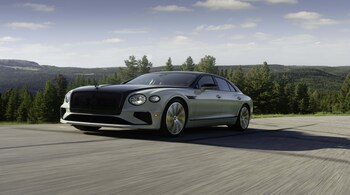
Are you planning to buy a high-end luxury car from a British brand, such as Rolls-Royce, Aston Martin, Bentley, McLaren, or Lotus? If so, you will save a lot of money, courtesy of the free trade agreement (FTA) signed between India and the United Kingdom (UK) on July 24.
Both sellers and buyers have always had this complaint that the high-end luxury cars being imported in India as completely built units (CBUs) are way more pricier than their country of origin or even other nations where they are sold in similar specifications.
So, why are the prices so high in our market? In India, CBUs with a cost, insurance and freight (CIF) value of up to USD 40,000 attract a Basic Customs Duty of 70%. Those above this threshold have to pay an additional 40% Agriculture Infrastructure and Development Cess.
Under the India-UK Comprehensive Economic and Trade Agreement (CETA), the import duty on high-end luxury cars, with an engine capacity of over 3,000 cc in petrol and more than 2,500 cc in diesel, will be cut to 30% in the first year and then gradually reduced to 10% by the fifth year. The duty was 110% on these vehicles before the deal.
To protect the domestic manufacturers, no concession will be given to internal combustion engine (ICE), hybrid, electric and hydrogen CBU models with a CIF value of up to GBP 40,000 as part of the deal between India and the UK.
Now, the British brands that stand to gain most out of this deal are Rolls-Royce, Aston Martin, Bentley, McLaren and Lotus as they make high-end luxury cars in the UK and export them to India as CBUs.
Tata Motors-owned Jaguar Land Rover (JLR) will not be impacted much as it is already making vehicles in India and importing its best-seller, the Defender, from Slovakia. Although Mini, which is part of the BMW Group, imports its current products as CBUs, either their CIF value is below GBP 40,000 or they are not manufactured in the UK, and hence, no benefit under the FTA.
The Rolls-Royce cars, including the Phantom, Ghost, Cullinan and Spectre EV, are exclusively manufactured at the company's facility in Goodwood, West Sussex, England, and exported across the world. Aston Martin operates a couple of manufacturing facilities in the UK -- Gaydon, Warwickshire (DB12 and Vantage models), and St Athan, South Wales (DBX and future electric models).
From the Continental to the Flying Spur and the Bentayga, all Bentley cars are manufactured at the company's factory in Crewe, Cheshire, England. McLaren makes its road cars, including the Artura and the Ultimate Series, at the McLaren Production Centre (MPC) in Woking, Surrey, England. Lotus has a manufacturing facility in Hethel, Norfolk, England (Emira and Evija EV) and Wuhan, China (Eletre EV and Emeya EV).
JLR locally assembles models such as the Discovery Sport, Discovery, Range Rover Evoque, Range Rover Velar, Range Rover Sport and Range Rover at Tata's Pune plant. The Defender is manufactured exclusively at the company's Nitra plant in Slovakia. At present, the company is only importing select Special Vehicle (SV) models as CBUs from the UK.
Mini is offering two CBU models in India at present, the Cooper S and the Countryman Electric, with the former being imported from the UK and the latter from Germany. While the Cooper S is manufactured at BMW's Oxford plant, the Countryman Electric is produced at its Leipzig facility.
The India-UK FTA does not extend any duty concession to electric, hybrid and hydrogen cars for the first five years. The levies on such models, having a CIF value of GBP 40,000 and above, will start lowering from the sixth year and drop to 10% from the 10th year onwards.
Discover the latest Business News, Sensex, and Nifty updates. Obtain Personal Finance insights, tax queries, and expert opinions on Moneycontrol or download the Moneycontrol App to stay updated!





