

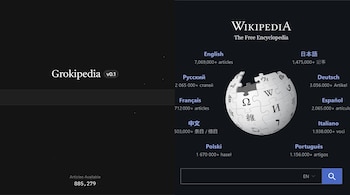
Elon Musk’s xAI team has started testing Grokipedia, an AI-managed knowledge platform that aims to function as a real-time alternative to Wikipedia. While both systems exist to document knowledge on the web, they differ radically in how they create, govern, update, and position information. For instance, the Grokipedia is AI-powered while the Wikipedia relies in crowd-sourced information and data. And, there are several other major difference like this one and to make things easier for you, we've put together a detailed guide on how both compare.
Wikipedia has operated for more than two decades with a volunteer-driven editorial model built on consensus and transparency. Grokipedia, by contrast, is architected around the Grok large language model, which continuously synthesises information and publishes articles without depending on human editors.
One of the central points of divergence is speed. Grokipedia intends to update entries in near-real time, especially during breaking events. Wikipedia, by design, prioritises verifiable sourcing, which introduces a delay when factual checks and human dispute resolution are necessary. This trade-off highlights the tension between velocity and verification.
Another structural difference lies in governance. Wikipedia is run by a non-profit entity, the Wikimedia Foundation, with a public editing trail and community moderation. Grokipedia is a for-profit xAI product with control centralised inside the model and its training data. Accountability, therefore, is algorithmic rather than communal — which raises questions about hallucinations and undisclosed training sources.
Musk and xAI have publicly framed Grokipedia as a response to what they claim is ideological skew on Wikipedia. Wikipedia, in contrast, defends its neutrality model (NPOV) with transparent sourcing rules and bans on original research. Grokipedia’s stated north star — “truth without censorship” — positions it more as a counter-narrative instrument than a consensus encyclopaedia.
The tone also splits the two projects. Grok is known for its informal, sometimes irreverent voice, which may bleed into Grokipedia entries. Wikipedia enforces an encyclopaedic style through policy and peer enforcement.
As of its early beta phase, Grokipedia is small in scale and experimental; Wikipedia remains the largest encyclopaedia ever compiled. Whether Grokipedia becomes a durable reference layer or an AI-assisted commentary platform will depend on adoption — and whether users prefer curated consensus or algorithmic synthesis.
Grokipedia vs Wikipedia — Key Differences
| Dimension | Grokipedia (xAI) | Wikipedia (Wikimedia) |
| Content creation | AI-generated and AI-edited | Human-written and collaboratively edited |
| Core mechanism | Model-driven synthesis | Consensus-based publishing |
| Update speed | Real-time / live updating | Delayed by manual review and verification |
| Editorial disputes | Resolved by model output | Resolved by community debate and policy |
| Stated goal | “Truth without censorship”; counter-bias ambition | Neutral point of view and verifiability |
| Accountability | Algorithm and training corpus | Transparent human edit history and citations |
| Governance | For-profit xAI product | Non-profit Wikimedia Foundation |
| Source policy | Hybrid synthesis incl. web and user signals | Published, reliable, citable sources only |
| Tone / style | Informal, occasionally witty | Formal encyclopaedic prose |
| Scale / maturity | Early beta with limited coverage | >7M English articles and global community |
Discover the latest Business News, Sensex, and Nifty updates. Obtain Personal Finance insights, tax queries, and expert opinions on Moneycontrol or download the Moneycontrol App to stay updated!





