

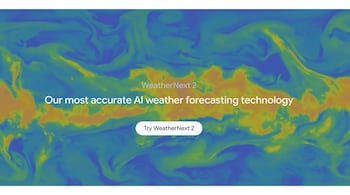
Google is taking a major leap in AI-powered forecasting with the launch of WeatherNext 2, its new and dramatically improved weather model. After years of experimenting behind the scenes, Google is finally rolling this technology into everyday products like Search, Gemini and Pixel phones. The company says the model is faster, more accurate and far more scalable than traditional physics-based systems, signalling the moment AI-driven forecasts move from research labs to millions of users.
Google’s AI weather work has been bubbling for years, but with WeatherNext 2, it’s finally ready for centre stage. According to Google DeepMind, the new model is eight times faster than the previous version and is able to predict 99.9 per cent of key variables such as temperature, rain and wind with far greater accuracy. Where conventional forecasting systems rely on recreating atmospheric physics on supercomputers, AI models like WeatherNext 2 take a different route altogether, analysing vast amounts of historical weather data to spot patterns and project them forward.
The performance gains are huge. A forecast that might take hours using physics-based models can now be generated in under a minute on one of Google’s TPU chips. That speed matters not just for everyday users but also for industries that depend on real-time, high-resolution predictions. WeatherNext 2 can produce hourly forecasts and look up to 15 days ahead, something Google says has already grabbed the attention of customers in energy, agriculture, transportation and logistics.
A large part of the breakthrough comes from Google’s Functional Generative Network (FGN) approach. Older AI models required multiple passes to generate a single forecast. With FGN, WeatherNext 2 introduces controlled randomness into each input, allowing the system to produce hundreds of potential outcomes in one step. The result is faster processing, richer scenarios and more reliable guidance.
Google is now integrating WeatherNext 2 across its major platforms, including Maps, Search, Gemini and Pixel Weather. For enterprise users, there’s an early access programme for custom modelling, and the forecast data is being made available in tools like Google Earth Engine and BigQuery for deeper analysis.
Discover the latest Business News, Sensex, and Nifty updates. Obtain Personal Finance insights, tax queries, and expert opinions on Moneycontrol or download the Moneycontrol App to stay updated!





