

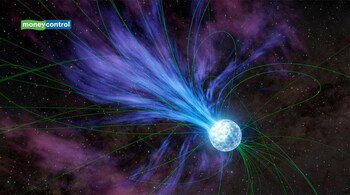
In a stunning breakthrough, astronomers have uncovered a surprising new source of the universe’s rarest elements — including gold and platinum — in a dramatic cosmic explosion that happened more than two decades ago. The source? A powerful flare from a magnetar, an ultra-magnetic type of neutron star.
The discovery, published this week in The Astrophysical Journal Letters, not only explains a lingering mystery from 2004 but also suggests that up to 10% of the heavy elements in our galaxy could come from these violent outbursts.
“This is really just the second time we've ever directly seen proof of where these elements form,” said study co-author Brian Metzger of Columbia University and the Flatiron Institute. “It’s a substantial leap in our understanding of heavy elements production.”
The story begins in December 2004, when a space telescope captured a brief but brilliant burst of radiation from a magnetar — a star with magnetic fields a trillion times stronger than Earth’s. The main flare lasted mere seconds but released more energy than our sun emits in a million years. A second, weaker flash detected 10 minutes later baffled scientists at the time and remained unexplained—until now.
Researchers led by Anirudh Patel, a Columbia University doctoral student, revisited the data using recent models of heavy element formation. Their findings suggest that this weaker signal was the radioactive glow of newly-forged r-process elements — rare heavy metals formed in extreme, neutron-rich conditions.
The 2004 event alone, they estimate, produced an amount of heavy elements equivalent to one-third the mass of Earth. That includes not only gold and platinum, but uranium, strontium, and other dense, neutron-rich materials that shape modern technology and industries.
For decades, scientists believed such elements were mainly born in neutron star collisions — cosmic smashups confirmed in 2017. But that process alone couldn't explain the abundance of heavy metals in young galaxies. Now, magnetar flares — which occur earlier and more frequently — may fill that gap.
“It’s pretty incredible to think that some of the gold in our jewelry or phones might have been forged in one of these wild flares,” said Patel.
These findings open a new chapter in astrophysics, one where tracking high-energy magnetar flares could help unlock more secrets of the cosmos. The next major leap is expected with NASA’s upcoming Compton Spectrometer and Imager mission, launching in 2027.
But catching one of these rare flares in action remains a challenge. “You’ve got maybe 10 or 15 minutes to point a telescope in the right direction,” said Metzger. “It’ll be a race against time — and space.”
Discover the latest Business News, Sensex, and Nifty updates. Obtain Personal Finance insights, tax queries, and expert opinions on Moneycontrol or download the Moneycontrol App to stay updated!





