

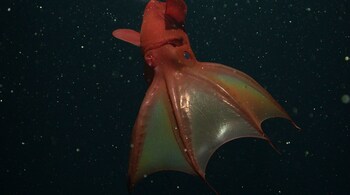
A mysterious deep-sea creature has now offered scientists a rare look into the distant past, as new research uncovers clues hidden in its enormous genome. The findings prompted a simple question for researchers: how did modern octopuses evolve from ancient squid-like ancestors?
Largest cephalopod genome and key evolutionary clues
Researchers from Vienna and Japan sequenced the largest cephalopod genome. They analysed the genome of the vampire squid from deep waters. They found evidence linking octopuses to ancient squid-like ancestors. They discovered parts of an old chromosomal structure still present. They confirmed the species retains a squid-like genetic blueprint today. They said this helps explain its unusual mix of features. They reported the findings through an international research collaboration.
Why is the vampire squid central to this scientific puzzle?
It has eight arms like common octopuses today. It also shows traits seen in squid and cuttlefish groups. It survives quietly in dark deep-sea habitats worldwide. Its appearance hides many clues about its ancient history. Japanese researchers call it the “bat-octopus” for its cloak-like webbing. Its genome reveals its position between two key lineages. It helps trace the early stages of cephalopod evolution.
How large is the genome unveiled in the study?
It spans more than 11 billion genetic base pairs. It is nearly four times larger than the human genome. It is the largest cephalopod genome examined so far. Scientists said its structure stays surprisingly well preserved. They described it as a “genomic living fossil” species. It retains an ancestral decapodiform-like chromosomal pattern today. Modern octopuses show fused and rearranged chromosomes instead.
What do these conserved chromosomes reveal to researchers?
They show early coleoids likely had squid-like karyotypes. They suggest octopus genomes later fused and compacted sharply. This process occurred through fusion-with-mixing events in evolution. These changes shaped key octopus features seen today. They altered arms, body structure and loss of hard shells. They also marked a shift from ancient forms to modern ones.
How did comparisons with other species support the findings?
Researchers analysed the pelagic octopus Argonauta hians genome sequence. This species develops a thin shell-like structure in females. Its genome also helped track ancient chromosomal changes. Together, both genomes showed the same evolutionary direction. They indicated a shared squid-like ancestor for both major groups.
What broader questions does this research answer now?
It confirms the octopus-squid ancestor was more squid-like originally. It highlights chromosomal reorganisation as the main driver of change. It shows fewer new genes were needed for cephalopod diversity. It offers the clearest genetic evidence linking both lineages. It opens new work for researchers studying deep-sea evolution.
The University of Vienna, which co-led the study, said such projects help explain ancient life with modern tools. The institution remains among Europe’s major research centres today, known for its global partnerships and wide scientific expertise.
Discover the latest Business News, Sensex, and Nifty updates. Obtain Personal Finance insights, tax queries, and expert opinions on Moneycontrol or download the Moneycontrol App to stay updated!






