

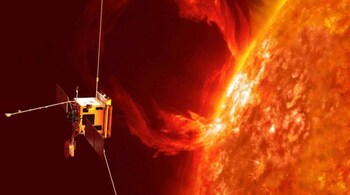


For the first time, scientists have watched a single solar active region continuously for 94 days. This is the longest uninterrupted observation ever of a Sun storm hotspot. It reveals new details about how solar magnetic fields evolve and erupt.
The active region, called NOAA 13664, later caused some of the strongest geomagnetic storms since 2003. Auroras lit up skies as far south as Switzerland. Power grids, satellites and communications were briefly affected.
Why This Observation Is Historic?
From Earth, scientists normally see an active region for only two weeks. The Sun rotates, hiding most regions from view. ESA’s Solar Orbiter can observe both the near and far side of the Sun. Combined with NASA’s Solar Dynamics Observatory, researchers could monitor NOAA 13664 continuously. This unprecedented coverage lasted from April to July 2024. It allowed scientists to see the full lifecycle of a solar storm region.
What Scientists Learned About these Magnetic Fields?
Continuous observation revealed how magnetic complexity grows over weeks. Scientists tracked the formation, twisting, and eventual release of energy. The data shows why some regions produce massive flares while others stay calm. Such insight is crucial to understanding space weather threats. It also helps refine models for predicting geomagnetic storms. These findings will improve early warning systems for Earth’s technology.
How This study helps NASA and ESA?
Observing from multiple spacecraft gives scientists a 3D view of the Sun. It confirms the value of coordinated missions like Solar Orbiter and Solar Dynamics Observatory. Future spacecraft, like ESA’s Vigil probe, will launch in 2031.
Vigil will monitor solar storms in real time, helping protect satellites and power grids. The 94-day study sets a benchmark for future space weather research. It shows that continuous solar monitoring is now possible.
Why Space Weather Forecasting Matters today?
People rely heavily on satellites, GPS and electricity grids. Even moderate solar storms can cause blackouts, satellite malfunctions and radio disruptions. Understanding how active regions evolve is key to mitigating these risks.
The long-term monitoring also teaches us how the Sun’s magnetic fields behave. Predicting eruptions is still difficult, but these studies provide a critical first step. By 2031, probes like Vigil may make space weather warnings far more accurate.
Discover the latest Business News, Sensex, and Nifty updates. Obtain Personal Finance insights, tax queries, and expert opinions on Moneycontrol or download the Moneycontrol App to stay updated!





