

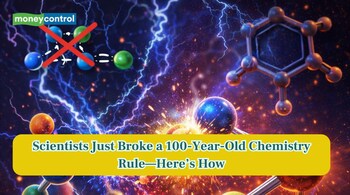


For nearly one hundred years, chemists followed a strict molecular rule. It defined how atoms could connect inside complex chemical structures. But recent experiments have rewritten that long-standing chemical belief. At UCLA, scientists dared to challenge traditional molecular boundaries.
They created structures once considered scientifically impossible. Their success stunned laboratories and universities worldwide instantly. This discovery shows science evolves by questioning old assumptions.
What Did Scientists Crack?
Researchers proved Bredt’s Rule is not always absolute. They showed double bonds can exist in restricted spaces. These bonds bend and twist into unusual three-dimensional shapes. Instead of breaking, they survive briefly under controlled conditions. This cracked a major limitation in molecular design.
What Is Bredt’s Rule?
Bredt’s Rule explains where double bonds cannot exist in molecules. It focuses on tight, crowded structures called bridgehead positions. According to this rule, double bonds there are unstable. Such bonds would twist unnaturally and quickly break apart. For decades, this principle guided organic chemistry research globally.
Who Led This Breakthrough Research?
The study was led by Professor Neil Garg at UCLA. His team included young researchers and computational chemists. Advanced simulations helped predict unstable molecular behaviour. Laboratory experiments then confirmed these predictions successfully. The work was published in a leading chemistry journal.
Meet the “Impossible” Molecules
The team created molecules named cubene and quadricyclene. These structures resemble tiny geometric cages at atomic scales. Their double bonds are severely distorted and strained. They do not lie flat like normal chemical bonds. Scientists once believed such molecules could never exist.
Why These Molecules Were Considered Unstable?
Normal double bonds prefer flat, balanced arrangements. In tight cages, atoms are forced into awkward positions. This creates extreme internal stress inside the molecule. Such stress usually destroys bonds instantly. This is the reason why chemists avoided these structures previously.
This Discovery Shocked Chemists Worldwide
Many experts believed Bredt’s Rule was permanently settled science. Breaking it challenged decades of teaching and research. It proved “impossible” ideas can still become reality. Researchers around the world praised the bold experimentation. The discovery sparked new debates in chemistry communities.
How This Changes Chemistry?
Chemists can now design more complex three-dimensional molecules. This benefits drug discovery and pharmaceutical research significantly. New materials with unique properties may be developed. Students will learn more flexible chemical principles. Science becomes more creative when boundaries are removed.
Discover the latest Business News, Sensex, and Nifty updates. Obtain Personal Finance insights, tax queries, and expert opinions on Moneycontrol or download the Moneycontrol App to stay updated!





