

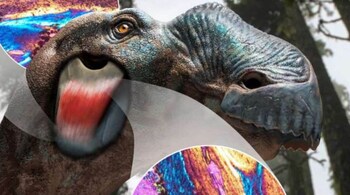
A new study in the Journal of Anatomy has uncovered a soft tissue characteristic in dinosaur skulls. Called the exoparia, it links the cheekbone to the lower jaw. It is thought to have served as either a muscle or ligament. No other non-avian reptile had previously been seen with this tissue.
Experts believe that this might alter everything we think we know about dinosaurs. Their discovery indicates that we might have underestimated dinosaur musculature's complexity. It also questions how dinosaurs moved, fed, and chewed.
Odd Clue Discovered in Hadrosaur Skull
Palaeontologist Henry Sharpe headed the team behind the find. While examining a hadrosaur fossil that was nicknamed Gary, he saw something unusual. A flanged bone in the cheek wasn't what is normally seen in reptilian anatomy. In mammals, that area tends to have a cheek muscle. But reptiles weren't supposed to have one.
The irregular pattern caused a further examination. Sharpe and his colleagues examined similar locations in other types of dinosaurs. They discovered the same pattern, indicating this was not coincidence. The trait existed across several species, indicating a common characteristic.
Uncovering More with Bone Histology
To prove their hypothesis, scientists applied bone histology methods. They cut the bone and examined it under polarised light. This produced compact collagen fibres where the tissue had previously attached. These textures weren't a result of fossilisation or disintegration. Rather, they indicated muscle or ligament attachment.
Sharpe described the microscopic bone texture as scratched or grooved. These marks are usually left by muscle contact in life. Across different species, the fibres followed similar directions. This proved the tissue was real and important, not random or rare.
Rewriting Dinosaur Anatomy Assumptions
The finding challenges how palaeontologists usually reconstruct dinosaur muscles. Experts often rely on a model called the Extant Phylogenetic Bracket. This compares dinosaur fossils to living relatives like birds and crocodiles. However, the exoparia doesn’t fit that model.
Sharpe asked if dinosaurs possessed special muscles we never anticipated. Birds could have lost them along the way of evolution. Crocodiles could have never had them to begin with. If true, this would imply previous reconstructions were incomplete.
The. find also raises new questions regarding how various species ate. Trends in the shape and size of the exoparia indicate functional diversity. It may be to chew or stabilise the jaw when eating.
While the specific function is unknown, its shape and position suggest its worth. It was consistently located in the same location, pointing to a shared function. The difference in size and orientation suggests that different species varied in diet.
A Broader Lesson for Palaeontology
Sharpe said the greatest thing learnt was about scientific assumptions. Extinct animals are far too frequently observed through the prism of animals living today. That puts boundaries on how much we can learn about ancient life.
The discovery of exoparia pushes scientists to study fossils more intently. Straight fossil evidence can present characteristics unseen in living organisms. Sharpe feels much more anatomical diversity exists in dinosaurs that is yet unknown.
Now scientists intend to apply powerful equipment for further research. Observatories such as the James Webb and Hubble telescopes may provide assistance. The researchers would like to examine more fossils in the collections of museums around the world.
As Sharpe explained, scientists are now able to look very far into the universe. But there is a great deal to be learned from bones here on our planet.
Discover the latest Business News, Sensex, and Nifty updates. Obtain Personal Finance insights, tax queries, and expert opinions on Moneycontrol or download the Moneycontrol App to stay updated!





