

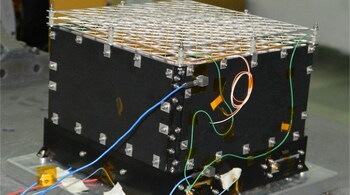


India’s space science landscape just got dusted with discovery. ISRO’s Cosmic Dust Experiment, known as DEX, has captured interplanetary particles. The tiny space debris holds secrets of comets, asteroids and the solar system.
DEX is a compact 3-kg instrument designed by the Physical Research Laboratory, Ahmedabad. It flew aboard ISRO’s PSLV Orbital Experimental Module, part of the XPoSat mission. Its mission is to detect dust particles hitting at high speeds in low Earth orbit.
What did DEX capture?
Tiny specks from space are raining down on Earth constantly. ISRO’s Cosmic Dust Experiment (DEX) has captured these interplanetary particles. They are remnants of comets, asteroids and other celestial bodies. Each particle carries secrets about the solar system’s past. DEX recorded these impacts in real time, revealing a cosmic bombardment pattern.
Who conducted the study and where?
The experiment was designed by the Physical Research Laboratory, Ahmedabad. It flew on ISRO’s PSLV Orbital Experimental Module, part of XPoSat. This compact 3-kg instrument operated in low Earth orbit, about 350 km above Earth.
Scientists monitored signals from dust particles striking the detector at high speeds. It is India’s first indigenous experiment to track cosmic dust in orbit.
What exactly does DEX measure?
DEX records the precise timing of each dust particle impact. It measures particle size, speed and impact energy. These details show how interplanetary dust behaves in near-Earth space. Scientists can use the data to predict dust flux in orbit.
How do shooting stars reveal hidden cosmic traffic?
These dust particles create shooting stars streaking across the night sky. Each meteor is a tiny visitor from space, invisible most of the time. DEX tracks these “invisible meteors” before they hit the atmosphere.
By studying their frequency and speed, scientists map cosmic traffic around Earth. It’s like monitoring a hidden highway of interplanetary debris.
Why this study matters so much?
DEX with tiny particles can damage satellites and spacecraft if unaccounted for. By tracking them, India can design safer space missions. The experiment strengthens India’s space science capabilities and technology. It gives Indian scientists access to real-time cosmic data for the first time.
DEX data complements research by NASA, ESA and other agencies. It ensures India’s place in the growing field of space particle studies. Future missions to the Moon, Mars, or Venus will benefit directly.
Discover the latest Business News, Sensex, and Nifty updates. Obtain Personal Finance insights, tax queries, and expert opinions on Moneycontrol or download the Moneycontrol App to stay updated!





