

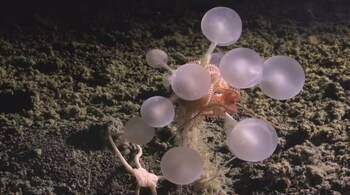
A team of researchers exploring one of the planet’s most remote waters has discovered 30 previously unknown species deep beneath the Southern Ocean. Among them is a carnivorous “death-ball” sponge that has fascinated scientists with its unusual and deadly design.
What makes the 'death-ball' sponge so unique?
Scientists from The Nippon Foundation-Nekton Ocean Census made the discovery during two 2025 expeditions with the Schmidt Ocean Institute. In a press release, they described the “death-ball” sponge as a spherical organism covered with tiny hooks used to trap prey. This predatory trait makes it stand out from most sponges, which typically filter-feed on microscopic particles drifting through the water.
Researchers say the sponge’s shape and hunting method reveal how extreme environments foster extraordinary adaptations. The team also observed ‘zombie worms’ (Osedax sp.), which feed on whale bones using bacteria instead of mouths or stomachs. Although not new to science, these worms were a reminder of the unusual survival strategies thriving in the dark ocean.
Dr Michelle Taylor, Head of Science at The Nippon Foundation-Nekton Ocean Census, said the Southern Ocean remains largely unexplored. She noted that less than 30 per cent of the expedition’s samples have been analysed, yet 30 new species have already been confirmed. “By coupling expeditions with species discovery workshops, we compress what often takes more than a decade into a faster pathway while maintaining scientific rigour,” she said.
Where was the deep-sea expedition conducted?
The Ocean Census Flagship expedition explored the remote South Sandwich Islands aboard the Schmidt Ocean Institute’s research vessel. The mission surveyed volcanic calderas, the South Sandwich Trench, and seafloor habitats near Montagu and Saunders islands.
The collected samples were later verified at the Southern Ocean Species Discovery Workshop hosted by Universidad de Magallanes in Punta Arenas, Chile. Scientists gathered nearly 2,000 specimens across 14 animal groups, along with thousands of high-definition images and hours of video footage.
What else did researchers find in the depths?
The expedition revealed several striking discoveries, including new hydrothermal vents at depths of around 700 metres. These vents hosted chemosynthetic communities that survive on chemical energy rather than sunlight. The team also recorded vibrant coral gardens, signs of undersea volcanic activity, and the first confirmed footage of a juvenile colossal squid.
Experts say these findings highlight how much of Earth’s biodiversity remains undocumented. As researchers continue to examine the vast trove of samples, the “death-ball” sponge and its neighbours in the abyss may hold answers to how life thrives in the most extreme corners of the planet.
Discover the latest Business News, Sensex, and Nifty updates. Obtain Personal Finance insights, tax queries, and expert opinions on Moneycontrol or download the Moneycontrol App to stay updated!





