

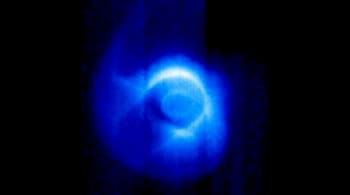
Most people picture space as empty, silent and still. Yet some discoveries make the familiar feel surprising again. A simple question recently resurfaced online. Could Earth have a tail like a comet? The idea sounds strange at first mention. But scientists say the answer is yes. That tail extends millions of kilometres behind us.
Why Do Mercury And Earth Develop Tails?
Mercury offers an easier example for researchers today. The planet has a thin atmosphere holding traces of sodium. Sunlight scatters across these atoms clearly. That scattered light forms a soft orange glow. Radiation pressure pushes sodium strongly outward. NASA says this pressure strips the atmosphere partly. It forms a long tail glowing behind Mercury. People on its nightside might see orange light. It would resemble skies lit by sodium lamps.
Earth’s tail is far less visible naturally. It forms on the night side beyond our view. Every object holds some magnetic strength inside it. Electron spins create tiny magnetic moments. In most materials these moments cancel naturally. But some align and create magnetic fields. Earth produces a strong field from its core. Molten iron moves and powers this structure.
NASA describes the magnetosphere clearly for readers. It controls charged particles around Earth significantly. It also shields our planet from solar wind. That same magnetosphere traps electrified gas effectively. Plasma held within becomes part of Earth’s long tail.
How Does The Magnetotail Form Behind Earth?
Scientists compare the process to falling raindrops. Solar wind constantly pushes against the magnetosphere. It compresses the sunlit side steadily. The night side stretches into a long shape. Plasma returns through this region continuously. NASA says this motion resembles raindrop flow. Tail material moves but stays connected overall. The stretched region becomes Earth’s magnetotail.
Solar activity can alter this structure quickly. A strong coronal mass ejection hit Earth in 04/2023. It disrupted the magnetotail for a short period. Researchers observed the tail being replaced briefly. The change formed structures called Alfvén wings. A related paper describes this behaviour in detail. It notes super-Alfvénic speeds in normal solar wind. It also describes shifts in sub-Alfvénic conditions. Simulations show magnetospheres transforming significantly.
How Far Does Earth’s Tail Reach?
The full extent remains difficult to measure accurately. Spacecraft have explored sections for decades. The European Space Agency comments on scale issues. The magnetotail extends at least two million kilometres. Single missions cannot map the entire space. Estimates suggest a reach near one thousand Earth radii. The true boundary likely shifts with solar conditions.
Earth’s tail remains one of space’s subtle features. It trails behind unnoticed yet constantly present. Its shape changes with every solar gust. Scientists continue exploring its structure with interest.
Discover the latest Business News, Sensex, and Nifty updates. Obtain Personal Finance insights, tax queries, and expert opinions on Moneycontrol or download the Moneycontrol App to stay updated!





