

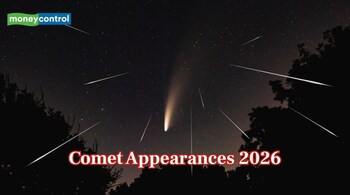

- Skywatchers in 2026 can expect multiple comet appearances, including 24P/Schaumasse, C/2024 E1 Wierzchoś, C/2025 R3 PanSTARRS, 10P/Tempel 2, and the interstellar 3I/Atlas. Most require binoculars or small telescopes, though PanSTARRS may briefly be visible to the naked eye. Visibility varies by hemisphere and date, with peak brightness and perihelion points guiding observation. Enthusiasts are advised to use dark locations, track trajectories with astronomy apps, and exercise patience to catch these fleeting celestial visitors in action.

Astronomers worldwide are gearing up for a year of spectacular comet sightings in 2026. Multiple comets will be observable through binoculars and small telescopes. Some, like C/2025 R3 PanSTARRS, may briefly become visible to the naked eye. Tracking their trajectories and brightness will require careful observation and reference to astronomy apps or charts. Sky enthusiasts are advised to monitor both hemispheres as visibility differs by location and date.
| Comet Name | Peak Dates / Observability |
|---|---|
| 24P/Schaumasse | January 4–8, 2026 |
| C/2024 E1 Wierzchoś | January 20 – February 17, 2026 |
| 88P/Howell | Mid-February – April 2026 |
| C/2025 R3 PanSTARRS | April 20 – early May 2026 |
| 10P/Tempel 2 | July – August 2026 |
| 3I/Atlas | Observable into spring 2026 |
24P/Schaumasse will reach peak brightness around January 8. Observers may see it as a fuzzy dot using binoculars. The comet will be visible from both hemispheres. Northern observers will see it rise earlier and climb higher. Southern observers can start around 2 a.m., tracking its path across the sky. The comet is fading by the end of February, requiring a telescope for observation. Discovered in 1911 by Alexandre Schaumasse, it has an orbital period of 8.18 years.
C/2024 E1 Wierzchoś: January to February
C/2024 E1 Wierzchoś will first peak around perihelion on January 20. Visibility will favour the Southern Hemisphere initially. The comet may reach magnitude 5 under dark skies. By February 17, it will be visible in the Northern Hemisphere near its closest approach. It is predicted to fade to magnitude 8 but remain observable with binoculars. Discovered by Polish astronomer Kacper Wierzchoś in 2024, it follows a hyperbolic orbit, likely leaving the Solar System.
88P/Howell: February to April
88P/Howell will appear primarily in the Southern Hemisphere. Its perihelion occurs on March 18, reaching around magnitude 10. The comet is visible through telescopes and remains near Capricornus for easy tracking. Discovered by Ellen Howell in 1981, this short-period comet orbits the Sun every 5.5 years, offering repeated opportunities for observation during favourable returns.
C/2025 R3 PanSTARRS: April to May
C/2025 R3 PanSTARRS may become the brightest comet of 2026. Its perihelion occurs on April 19, with a possible magnitude of 3 under ideal conditions. Observers in the Northern Hemisphere will see it in the morning sky, while Southern Hemisphere observers can view it in the evening. The comet’s visibility window is short but potentially spectacular. Discovered by the Pan-STARRS survey in 2025, it likely follows a hyperbolic orbit.
10P/Tempel 2: July to August
10P/Tempel 2 emerges in the evening sky after sunset from July onwards. Both hemispheres can observe it, with better elevation in the Southern Hemisphere. Around perihelion on August 2–3, the comet reaches magnitude 7.0. Discovered in 1873 by Wilhelm Tempel, it belongs to the Jupiter-family comets with a 5.37-year orbital period. Binoculars or small telescopes are recommended for safe viewing.
3I/Atlas: Interstellar Visitor
3I/Atlas, an interstellar comet, continues fading into spring 2026. It requires telescopes to observe as it dims from magnitude 10.8. In March, it passes near Jupiter. Its interstellar trajectory means it will not return, offering a rare chance for observation.
Observers are advised to find dark locations, track the comet’s path using apps, and exercise patience for the best views.
Discover the latest Business News, Sensex, and Nifty updates. Obtain Personal Finance insights, tax queries, and expert opinions on Moneycontrol or download the Moneycontrol App to stay updated!





