

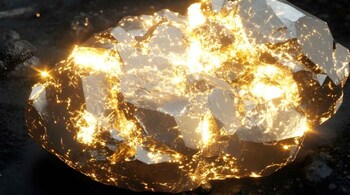


Gold has always symbolised permanence and chemical calm. For centuries, scientists called it stubbornly unreactive. Now, a laboratory experiment has shattered that belief. Researchers have forced gold to react with hydrogen. The result is a never-before-seen compound called gold hydride. This discovery changes how scientists understand noble metals.
Expectations vs Reality: The Birth of Gold Hydride
The experiment was led by Mungo Frost at SLAC. They aimed to study hydrogen under extreme pressures. Gold was chosen as a stable, inert reference material. It usually acts as a passive X-ray absorber. Scientists expected gold to remain chemically silent throughout.
No reaction was predicted or even considered possible. Then, unexpectedly, gold began interacting with hydrogen atoms. The “inert” metal refused to stay passive this time.
A new compound formed, and scientists called it the first solid "gold hydride". What started as routine observation became groundbreaking discovery. Gold revealed a hidden chemical personality in extreme conditions.
Where this Groundbreaking discovery happened?
The discovery took place at Stanford Linear Accelerator Center (SLAC), California. The experiments were led by Mungo Frost. His research focuses on matter under extreme pressures and temperatures.
SLAC’s advanced facilities allowed the team to recreate these extreme conditions. It was here that gold defied expectations and formed gold hydride.
Scientists discovered Gold is a "reactive metal"
Gold belongs to the noble metals group. These elements are famous for chemical stubbornness. They rarely bond with other elements. This stability made gold useful and predictable. It also made scientists stop questioning its behaviour.
But this experiment reopened that closed chapter. Under extreme pressure, gold’s electrons rearranged. New bonding pathways suddenly became possible, and scientists discover that gold is a 'reactive metal' by accidentally creating this new compound.
Why This Matters Beyond Curiosity?
The study is published in the National Library of Medicine. Understanding gold’s reactivity changes fundamental science. It affects models of planetary interiors. It informs high-pressure material research. The discovery could influence fusion energy studies.
Dense hydrogen behaviour remains poorly understood. Gold hydride offers a rare experimental window. It also reminds scientists to question assumptions. Even trusted facts can bend under pressure.
The Question Scientists Are Asking Now
If gold can react, what else can? Are other noble metals hiding secret chemistry Platinum and silver may hold similar surprises. Future experiments will push limits further. More unexpected reactions may soon appear. Gold’s secret reaction sends a powerful message. In science, certainty is always temporary.
Discover the latest Business News, Sensex, and Nifty updates. Obtain Personal Finance insights, tax queries, and expert opinions on Moneycontrol or download the Moneycontrol App to stay updated!





