

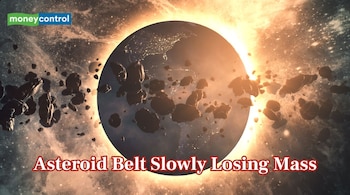
The asteroid belt between Mars and Jupiter has fascinated astronomers for centuries. Once thought to be debris from a failed planet, this region is now understood as a dynamic, evolving structure. New research shows it continues to lose material, shaping the Solar System over billions of years.
How the Asteroid Belt Lost Its Mass
When the Solar System formed 4.6 billion years ago, the material between Mars and Jupiter should have formed a planet. Jupiter’s strong gravity, however, stirred the region, causing collisions that were destructive rather than constructive. Today, the belt contains only about three percent of the Moon’s mass, spread across millions of kilometres. Fragments either drift toward Earth or outward toward Jupiter’s orbit, reports Universe Today.
Astronomers led by Julio Fernández from Uruguay calculated how quickly the belt is losing mass. They found it loses approximately 0.0088 percent of its actively colliding material. Though small, this rate represents a significant flow of material over the Solar System’s vast history.
What Happens to Lost Asteroid Material
The lost mass splits into two fates. About 20% escapes as asteroids and meteoroids, some crossing Earth’s orbit and appearing as meteors. The remaining 80 percent breaks down into meteoritic dust, feeding the faint glow of zodiacal light visible before sunrise or after sunset. Major asteroids like Ceres, Vesta, and Pallas were excluded, as they no longer participate in this ongoing depletion.
Understanding this mass loss helps scientists trace Earth’s bombardment history. Asteroids occasionally leave the inner Solar System, and records indicate the belt contained roughly 50% more mass 3.5 billion years ago. This agrees with geologic evidence on the Moon and Earth, indicating a decreasing rate of impacts over time.
Why It Matters for Earth and the Solar System
The asteroid belt can appear to be permanent but is anything but static. Its gradual decline spells out a more turbulent history when material hit Earth and the Moon more frequently. Layers of glass spherules in Earth's rock bear witness to this ferocious shelling. Now, the belt's steady trickle still brings minor impacts and offers vital information for the forecasting of near-Earth object hazards in the future.
This study provides a better understanding of the evolution of the asteroid belt and its long-term impact on the inner Solar System. It identifies the belt as a central component for the realisation of how the surface of Earth evolved billions of years ago.
Discover the latest Business News, Sensex, and Nifty updates. Obtain Personal Finance insights, tax queries, and expert opinions on Moneycontrol or download the Moneycontrol App to stay updated!





